









Umrah and Hajj Glossary
We have brought together the terms that come up often in Umrah and Hajj guides, with short, sourced definitions. On matters where the schools of law differ, we have conveyed only what the source states; under each definition you will find the source it rests on and, where there is one, our detailed guide.
A
Afaqi
A term for people who live outside the area bounded by the points called miqat. According to Diyanet Haber’s Hajj Glossary, the miqats mark the boundaries that afaqis coming directly to the Haram area or to Makkah may not cross without ihram; an afaqi therefore enters ihram for Hajj or Umrah at the miqat at the latest.
Sources: Diyanet Haber, Hac Sözlüğü (Hajj Glossary); TDV Encyclopedia of Islam, “Âfâkī” (Hamdi Döndüren). Read more: The miqat points
Arafah (Day of Arafah)
The ninth day of the month of Dhu al-Hijjah, that is, the day before Eid al-Adha. It takes its name from Arafat, where the wuquf, the essential pillar of Hajj, is performed; on that day pilgrims go out to Arafat and spend their time in talbiyah, takbir and dua. In Turkish, the same word (arefe) is also used for the day before Eid al-Fitr.
Sources: TDV Encyclopedia of Islam, “Arefe” (M. Özgü Aras); Diyanet Haber, Hac Sözlüğü (Hajj Glossary). Read more: The dua and worship of the Day of Arafah
Arafat
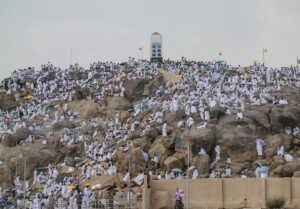
A flat area ringed by mountains, east of Makkah on the Taif road; the wuquf (standing), which is an essential pillar of Hajj, is performed here. The TDV Encyclopedia of Islam gives its distance from Makkah as about 21 km. Arafat lies outside the Haram boundary, in the Hill zone; the valley of Uranah separates it from the Haram.
Sources: TDV Encyclopedia of Islam, “Arafat”; Diyanet Haber, Hac Sözlüğü (Hajj Glossary). Read more: Mount Arafat and Jabal ar-Rahmah
Ayyam an-Nahr (Days of Sacrifice)
It means the days of sacrifice; these are the 10th, 11th and 12th days of Dhu al-Hijjah. The days of tashriq (ayyam al-tashriq), on the other hand, are the 11th, 12th and 13th days of Dhu al-Hijjah, that is, the second, third and fourth days of Eid. On these days pilgrims throw stones at the jamrahs in Mina; the sacrifice, the shaving and the tawaf al-ziyarah are also carried out on the days of Eid.
Sources: Diyanet Haber, Hac Sözlüğü (Hajj Glossary); High Board of Religious Affairs (Diyanet), “Tavaf nedir ve kaç çeşit tavaf vardır?”. Read more: When is Hajj performed?
B
Badal Hajj (Hajj by Proxy)
The Hajj performed when a person on whom Hajj is obligatory, but who cannot go in person because of old age or an illness with no hope of recovery, covers the cost and sends a proxy in their place; the proxy who is sent is called the badal. According to the High Board of Religious Affairs (Diyanet), the proxy performs the Hajj in person, makes the intention only on behalf of the sender, and no fee beyond the expenses may be stipulated.
Sources: High Board of Religious Affairs (Diyanet), “Vekâlet yoluyla hac yapılabilir mi? Şartları nelerdir?”; Diyanet Haber, Hac Sözlüğü (Hajj Glossary). Read more: What is badal Hajj, and what are its conditions?
Badanah
The name given to sacrificial animals of the camel and cattle kind slaughtered during Hajj and Umrah; those of the sheep and goat kind are called dam. A fatwa of the High Board of Religious Affairs (Diyanet) states that, according to the Hanafi school, a badanah is required for a tawaf al-ziyarah performed while menstruating, and that the penalty lapses if the tawaf is later repeated.
Sources: Diyanet Haber, Hac Sözlüğü (Hajj Glossary); TDV Encyclopedia of Islam, “Hedy”; High Board of Religious Affairs (Diyanet), “Âdeti bitmeden Mekke’den ayrılmak zorunda kalan kadın bu hâliyle ziyaret veya umre tavafını yapabilir mi?”.
Baytullah
One of the names used for the Kaaba. According to the TDV Encyclopedia of Islam, the Kaaba is referred to in the Qur’an by names such as al-Bayt, al-Bayt al-Atiq and al-Bayt al-Haram. The High Board of Religious Affairs (Diyanet) defines tawaf as starting level with the Hajar al-Aswad and going round the Baytullah seven times, keeping the Kaaba on one’s left.
Sources: TDV Encyclopedia of Islam, “Kâbe”; High Board of Religious Affairs (Diyanet), “Tavaf nedir ve kaç çeşit tavaf vardır?”. Read more: Where is the Kaaba, and what is inside it?
D
Dam
The name given to sacrificial animals of the sheep and goat kind slaughtered during Hajj and Umrah. In the fatwas of the High Board of Religious Affairs (Diyanet), the expression “a dam is required” is used to mean that a sheep or a goat must be slaughtered. According to the TDV Encyclopedia of Islam, for example, omitting the stoning of the devil, which is wajib, requires a dam.
Sources: Diyanet Haber, Hac Sözlüğü (Hajj Glossary); TDV Encyclopedia of Islam, “Hedy”; TDV Encyclopedia of Islam, “Cemre” (M. Özgü Aras). Read more: Ihram restrictions and penalties
Dhul-Hulayfah
The miqat for those coming from the direction of Madinah; it is also known as Abyar Ali. According to the TDV Encyclopedia of Islam, it is to the south-west of Madinah, about 11 km from Masjid an-Nabawi, and is the miqat farthest from Makkah. The Prophet (peace be upon him) stated that those coming from the direction of Madinah should enter ihram at Dhul-Hulayfah at the latest.
Sources: TDV Encyclopedia of Islam, “Zülhuleyfe” (Mustafa Sabri Küçükaşcı); TDV Encyclopedia of Islam, “Mîkāt” (Salim Öğüt). Read more: The miqat points: where do travellers from Turkey enter ihram?
H
Hady
The sacrifice slaughtered in the Haram area by those performing Hajj or Umrah. According to the TDV Encyclopedia of Islam, it is of two kinds, voluntary and wajib; the sacrifice of thanksgiving offered by those performing tamattu’ and qiran Hajj and the penalty sacrifice offered for violations in Hajj and Umrah fall under the wajib hady. The sacrifice offered at Eid al-Adha by those who are not on Hajj is called udhiyah.
Sources: TDV Encyclopedia of Islam, “Hedy”; Diyanet Haber, Hac Sözlüğü (Hajj Glossary). Read more: The sacrifice (qurbani) dua
Hajar al-Aswad (the Black Stone)
The stone at the eastern corner of the Kaaba, about 1.5 metres above the ground, which marks the starting point of tawaf. According to the TDV Encyclopedia of Islam, it is known by this name, which means the Black Stone, because of its dark red colour verging on black. Tawaf begins level with this stone; greeting the stone is called istilam.
Sources: TDV Encyclopedia of Islam, “Hacerülesved” (Salim Öğüt); TDV Encyclopedia of Islam, “Kâbe”; Diyanet Haber, Hac Sözlüğü (Hajj Glossary). Read more: What is the Hajar al-Aswad?
Hajj
One of the five pillars of Islam; it is fulfilled by entering ihram on specific days, performing the wuquf at Arafat and making tawaf of the Kaaba. According to the TDV Encyclopedia of Islam, it is obligatory once in a lifetime for a Muslim who meets its conditions. Depending on whether or not it is combined with Umrah, it is performed in three ways: ifrad, tamattu’ and qiran.
Sources: TDV Encyclopedia of Islam, “Hac” (fiqh section: Salim Öğüt); TDV Encyclopedia of Islam, “Vakfe” (Menderes Gürkan); High Board of Religious Affairs (Diyanet), “Tavaf nedir ve kaç çeşit tavaf vardır?”. Read more: What is Hajj, and for whom is it obligatory?
Halq
Shaving the hair of the head completely in order to leave ihram; shortening the hair is called taqsir. According to the TDV Encyclopedia of Islam, in Umrah one leaves ihram after the sa’y by having the hair shaved or shortened; shaving is an essential pillar in the Shafi’i school and wajib according to the majority. Women do not perform halq; they only cut a small amount from the ends of their hair.
Sources: Diyanet Haber, Hac Sözlüğü (Hajj Glossary); TDV Encyclopedia of Islam, “Umre” (Mehmet Boynukalın); TDV Encyclopedia of Islam, “Ihram” (Salim Öğüt). Read more: Shaving in Umrah: halq and taqsir
Haram
The area in and around Makkah whose boundaries have been set so that its plants are not picked and its animals are not hunted. Mina and Muzdalifah are inside the Haram boundary, while Arafat is outside it. According to Diyanet Haber’s Hajj Glossary, the Haram boundary closest to Makkah is Tan’im, in the direction of Madinah. The term Haram is also used for Madinah and its surroundings.
Sources: Diyanet Haber, Hac Sözlüğü (Hajj Glossary); TDV Encyclopedia of Islam, “Hil”; TDV Encyclopedia of Islam, “Mina” (Mehmet Şener). Read more: Where is Umrah performed?
Haramayn
An expression that refers to the cities of Makkah and Madinah together; in Ottoman documents it mostly appears in the form Haramayn al-Sharifayn. Khadim al-Haramayn, according to the TDV Encyclopedia of Islam, is the official title used by some Muslim rulers after the Abbasids and, from Sultan Selim I (Yavuz Sultan Selim) onwards, by the Ottoman sultans.
Source: TDV Encyclopedia of Islam, “Haremeyn” (Ş. Tufan Buzpınar, Mustafa Sabri Küçükaşcı). Read more: What does Khadim al-Haramayn mean?
Harwalah
Covering a specific stretch between Safa and Marwa with quick, brisk steps during the sa’y. Today this stretch is marked with green lights. According to Diyanet Haber’s Hajj Glossary, harwalah is performed in every lap (shawt) of the sa’y and is sunnah for men; women do not perform harwalah.
Sources: TDV Encyclopedia of Islam, “Hervele”; TDV Encyclopedia of Islam, “Sa’y”; Diyanet Haber, Hac Sözlüğü (Hajj Glossary). Read more: The hills of Safa and Marwa, and the sa’y
Hatim (Hijr)
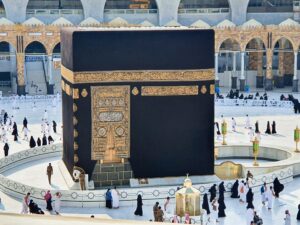
The Hatim is the semicircular wall, about 1.31 metres high, opposite the north-western wall of the Kaaba; the area between this wall and the Kaaba, which lies beneath the Mizab (the Golden Spout), is called the Hijr. According to the TDV Encyclopedia of Islam, in the Hanafi school performing tawaf by going round the outside of the Hatim is one of the wajib acts of tawaf.
Sources: TDV Encyclopedia of Islam, “Hicr”; TDV Encyclopedia of Islam, “Kâbe”; TDV Encyclopedia of Islam, “Tavaf”; Diyanet Haber, Hac Sözlüğü (Hajj Glossary). Read more: Parts of the Kaaba
Hill
The zone lying between the Haram area and the miqat boundaries. According to the TDV Encyclopedia of Islam, those who live here enter ihram in the Hill zone when going to the Haram for Hajj or Umrah; hunting and picking plants, which are forbidden in the Haram, are permitted in the Hill. Those in Makkah also enter ihram for Umrah by going out to a point in the Hill, such as Tan’im.
Sources: TDV Encyclopedia of Islam, “Hil”; Diyanet Haber, Hac Sözlüğü (Hajj Glossary); TDV Encyclopedia of Islam, “Ten’îm” (Salim Öğüt). Read more: The miqat points
I
Idtiba
When a man in ihram passes one end of his upper garment (rida) under his right armpit and throws it over his left shoulder, leaving his right shoulder and arm uncovered. According to the High Board of Religious Affairs (Diyanet), idtiba is sunnah only in tawafs that will be followed by sa’y, and it is maintained throughout all seven laps of the tawaf; omitting it does not require a penalty.
Sources: TDV Encyclopedia of Islam, “Iztıbâ” (Salim Öğüt); High Board of Religious Affairs (Diyanet), “Bütün tavaflarda remel ve ıztıbâ yapılmalı mıdır?”; Diyanet Haber, Hac Sözlüğü (Hajj Glossary). Read more: How to perform tawaf
Ifrad Hajj
The Hajj performed without performing Umrah in the Hajj season of the same year. According to the High Board of Religious Affairs (Diyanet), ihram is entered at the miqat with the intention of Hajj alone, the tawaf al-qudum is performed on arriving in Makkah, and one does not leave ihram until stoning Jamrat al-Aqabah and shaving on the day of Eid. A person performing ifrad Hajj is not required to offer a sacrifice.
Sources: High Board of Religious Affairs (Diyanet), “İfrad haccı ne demektir ve nasıl yapılır?”; Diyanet Haber, Hac Sözlüğü (Hajj Glossary). Read more: Types of Hajj: ifrad, tamattu’ and qiran
Ihram
When a person who intends Hajj or Umrah forbids themselves certain acts that are normally lawful until they complete these acts of worship. According to the High Board of Religious Affairs (Diyanet), for the Hanafis the intention and the talbiyah are the essential pillars of ihram; for the Malikis, Shafi’is and Hanbalis the intention is the pillar and the talbiyah is sunnah. Throughout this period men wrap themselves in the two pieces of ihram cloth called the izar and the rida.
Sources: TDV Encyclopedia of Islam, “Ihram” (Salim Öğüt); High Board of Religious Affairs (Diyanet), “Ihram ne demektir?”; Diyanet Haber, Hac Sözlüğü (Hajj Glossary). Read more: How to wear ihram
Ihram Restrictions
The acts that a person who has entered ihram must stay away from until leaving ihram. The TDV Encyclopedia of Islam lists them under these headings: cutting the hair, beard and nails; applying perfume; for men, wearing stitched clothing and covering the head; for women, covering the face; sexual intercourse; hunting land animals; and harming the plants of the Haram.
Sources: TDV Encyclopedia of Islam, “Ihram” (Salim Öğüt); High Board of Religious Affairs (Diyanet), “Ihram ne demektir?”. Read more: What are the ihram restrictions?
Ihsar
When, after entering ihram, an obstacle beyond one’s control prevents the tawaf in Umrah, or the wuquf at Arafat in Hajj, from being performed; a person in this situation is called muhsar. According to the High Board of Religious Affairs (Diyanet), the muhsar leaves ihram by slaughtering the ihsar sacrifice; according to the Hanafis the sacrifice must be slaughtered in the Haram area, while according to the Shafi’is it may also be slaughtered at the place where one was prevented.
Sources: High Board of Religious Affairs (Diyanet), “Muhsar olan kimse, ihsâr kurbanını ne zaman ve nerede keser?”; TDV Encyclopedia of Islam, “İhsâr” (Salim Öğüt); Diyanet Haber, Hac Sözlüğü (Hajj Glossary).
Istilam
Greeting the Hajar al-Aswad during tawaf; it is done by touching and kissing the stone if possible and, if not, by gesturing towards it with the hand from a distance and saying the takbir. According to the High Board of Religious Affairs (Diyanet), istilam is sunnah; trying to reach the stone in a crowd by causing harm to others is not permissible, and being unable to touch the stone is not counted as a deficiency in the tawaf.
Sources: High Board of Religious Affairs (Diyanet), “Hacer-i Esved’in selamlanması ve öpülmesinin hikmeti nedir?”; TDV Encyclopedia of Islam, “Hacerülesved” (Salim Öğüt); Diyanet Haber, Hac Sözlüğü (Hajj Glossary). Read more: The Hajar al-Aswad and the etiquette of visiting it
J
Jabal ar-Rahmah
The small hill, about 70 metres high, in the northern part of Arafat; it is also popularly known as Mount Arafat. According to the TDV Encyclopedia of Islam, the Prophet (peace be upon him) performed the wuquf at the foot of this hill during the Farewell Hajj. It is not necessary to climb the hill for the wuquf; the wuquf can be performed anywhere in Arafat except the valley of Uranah.
Sources: TDV Encyclopedia of Islam, “Cebelirahme” (Salim Öğüt); TDV Encyclopedia of Islam, “Arafat”; TDV Encyclopedia of Islam, “Vakfe” (Menderes Gürkan). Read more: Mount Arafat and Jabal ar-Rahmah
Jamrah
In Hajj, jamrah refers both to the small stones thrown at Mina and to the three places at which these stones are thrown. These are the small jamrah, the middle jamrah and Jamrat al-Aqabah. According to the TDV Encyclopedia of Islam, on the first day of Eid stones are thrown only at Jamrat al-Aqabah, and on the following days seven stones are thrown at each of the three jamrahs.
Sources: TDV Encyclopedia of Islam, “Cemre” (M. Özgü Aras); Diyanet Haber, Hac Sözlüğü (Hajj Glossary). Read more: How is the stoning of the devil performed?
Ji’ranah
A place between Makkah and Taif, in the Hill zone outside the Haram boundary. According to the TDV Encyclopedia of Islam, the spoils of the Battle of Hunayn were distributed here, and it is one of the places where those in the Haram area enter ihram for Umrah. As the most virtuous place for the Umrah ihram, Shafi’i and Maliki scholars point to Ji’ranah, and Hanafi and Hanbali scholars to Tan’im.
Sources: TDV Encyclopedia of Islam, “Ci’râne” (Ahmet Önkal); TDV Encyclopedia of Islam, “Hil”.
K
Kaaba
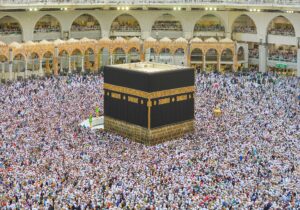
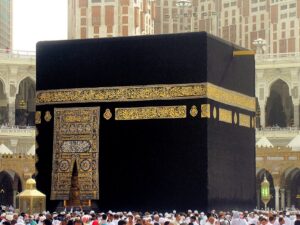
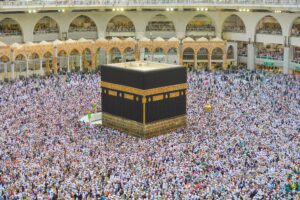
The structure in the middle of Masjid al-Haram in Makkah that is the qiblah of Muslims. According to the TDV Encyclopedia of Islam, it measures about 10.70 × 12 metres and is 15 metres high. Its corners are called rukn; the Hajar al-Aswad is at the eastern corner, and the southern corner is the Rukn al-Yamani. In Hajj and Umrah, tawaf is performed around the Kaaba.
Sources: TDV Encyclopedia of Islam, “Kâbe”; Diyanet Haber, Hac Sözlüğü (Hajj Glossary). Read more: Where is the Kaaba, and what is inside it?
Kiswah
The covering of the Kaaba. According to the TDV Encyclopedia of Islam, separate coverings are hung on the outside and the inside of the Kaaba; the outer covering is generally black, the inner covering is red, and there is a separate embroidered covering for the door. The kiswah is fastened to the rings on the shadharwan, the marble-clad part of the Kaaba’s foundation that remains exposed.
Source: TDV Encyclopedia of Islam, “Kâbe”. Read more: How is the Kaaba’s cover changed?
M
Mahram
In fiqh, a close relative with whom marriage is permanently forbidden. According to the High Board of Religious Affairs (Diyanet), in the Hanafi and Hanbali schools a woman must have a mahram with her for Hajj to be obligatory on her; in the Shafi’i school travelling with a group of trustworthy women, and in the Maliki school with a trustworthy company, is considered sufficient.
Sources: TDV Encyclopedia of Islam, “Mahrem” (Salim Öğüt); High Board of Religious Affairs (Diyanet), “Evli bir kadın, kocasının iznini almadan veya yanında mahremi olmadan hac veya umreye gidebilir mi?”. Read more: How do women go on Umrah?
Manasik
The general name for the acts of worship and rites carried out during Hajj and Umrah. According to Diyanet Haber’s Hajj Glossary, each of these rites and acts of worship is called a nusuk or a mansak. The same glossary defines the rites of Hajj and Umrah, such as tawaf, sa’y, wuquf and ramy al-jimar, one by one.
Source: Diyanet Haber, Hac Sözlüğü (Hajj Glossary). Read more: How to perform Hajj
Maqam Ibrahim
The stone near the Kaaba on which, according to narration, the Prophet Ibrahim (peace be upon him) stood while building the Kaaba, and the place where this stone stands. It is mentioned in the Qur’an in verse 125 of Surah al-Baqarah and verse 97 of Surah Al Imran. According to the TDV Encyclopedia of Islam, it is recommended that the tawaf prayer be performed behind this maqam.
Sources: TDV Encyclopedia of Islam, “Makām-ı İbrâhim”; Diyanet Haber, Hac Sözlüğü (Hajj Glossary). Read more: What is Maqam Ibrahim, and where is it?
Marwa
One of the two small hills where the sa’y is performed in Hajj and Umrah. According to the TDV Encyclopedia of Islam, it is opposite Safa, to the north-east of the Kaaba and about 300 metres from it. The sa’y begins at Safa and is completed at Marwa at the end of the seventh lap; in Umrah the hair is shaved or shortened after the sa’y.
Sources: TDV Encyclopedia of Islam, “Safâ ve Merve”; TDV Encyclopedia of Islam, “Sa’y”; TDV Encyclopedia of Islam, “Umre” (Mehmet Boynukalın). Read more: The hills of Safa and Marwa
Mas’a
The place between Safa and Marwa where the sa’y is performed. The TDV Encyclopedia of Islam gives the length of the mas’a as about 394.5 metres and its width as 20 metres. Four laps of the sa’y are walked from Safa to Marwa and three from Marwa to Safa; the stretch where men perform harwalah is indicated by green lights.
Sources: TDV Encyclopedia of Islam, “Sa’y”; Diyanet Haber, Hac Sözlüğü (Hajj Glossary). Read more: How far apart are Safa and Marwa?
Mash’ar al-Haram
The place in the area between Arafat and Mina where some of the rites of Hajj are carried out; it is mentioned in verse 198 of Surah al-Baqarah. According to the TDV Encyclopedia of Islam, most scholars of fiqh state that what is meant by it is the hill of Quzah in Muzdalifah, while the greater part of the scholars of tafsir and hadith state that the whole of Muzdalifah is meant.
Sources: TDV Encyclopedia of Islam, “Meş’ar-i Harâm” (Salim Öğüt); Diyanet Haber, Hac Sözlüğü (Hajj Glossary). Read more: Duas to recite at Arafat, Muzdalifah and Mina
Masjid al-Haram
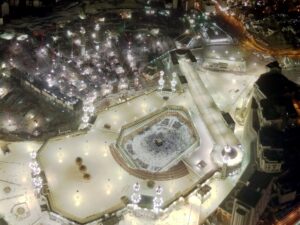
The mosque in Makkah with the Kaaba at its centre; it denotes the area that surrounds the Kaaba and is used for worship. According to the TDV Encyclopedia of Islam, it is mentioned in fifteen places in the Qur’an and is regarded as the oldest mosque on earth. The Prophet (peace be upon him) stated that prayer performed here is more virtuous than prayer in other mosques.
Sources: TDV Encyclopedia of Islam, “Mescid-i Harâm” (Nebi Bozkurt, Mustafa Sabri Küçükaşcı); Diyanet Haber, Hac Sözlüğü (Hajj Glossary). Read more: A guide to Masjid al-Haram
Masjid al-Khayf
The mosque built in Mina on the spot where the Prophet (peace be upon him) pitched his tent and led the congregational prayer during the Farewell Hajj. The TDV Encyclopedia of Islam mentions it among the historic mosques of Mina. Mina lies between Makkah and Muzdalifah and inside the Haram boundary; pilgrims stay here on the day of Tarwiyah and on the days of Eid.
Sources: TDV Encyclopedia of Islam, “Hayf Mescidi”; TDV Encyclopedia of Islam, “Mina” (Mehmet Şener).
Masjid an-Nabawi
The mosque in Madinah that the Prophet (peace be upon him) had built after the Hijrah and which also contains his grave. The Hujrah al-Sa’adah, the chamber in which the Messenger of Allah is buried, is the most important part of the mosque. According to the TDV Encyclopedia of Islam, most scholars accept that it ranks after Masjid al-Haram in virtue; the Prophet stated that prayer performed here is a thousand times more virtuous.
Source: TDV Encyclopedia of Islam, “Mescid-i Nebevî” (Nebi Bozkurt, Mustafa Sabri Küçükaşcı). Read more: Masjid an-Nabawi: its history and visiting it
Mataf
The area around the Kaaba where tawaf is performed. According to the TDV Encyclopedia of Islam, in the Hanafi school performing the tawaf inside Masjid al-Haram and around the Kaaba is one of the conditions for the validity of tawaf. The person making tawaf starts level with the Hajar al-Aswad and, keeping the Kaaba on their left, completes seven laps in the mataf.
Sources: TDV Encyclopedia of Islam, “Mescid-i Harâm” (Nebi Bozkurt, Mustafa Sabri Küçükaşcı); TDV Encyclopedia of Islam, “Tavaf”; Diyanet Haber, Hac Sözlüğü (Hajj Glossary). Read more: How to perform tawaf
Mina
An area between Makkah and Muzdalifah, inside the Haram boundary. The TDV Encyclopedia of Islam gives its distance from Makkah as about 7 km. Pilgrims stay here on the day of Tarwiyah and on the days of Eid; the stoning of the devil and the slaughter of the sacrifice take place in Mina. Its boundary is marked by Jamrat al-Aqabah in the west and the valley of Muhassir in the east.
Sources: TDV Encyclopedia of Islam, “Mina” (Mehmet Şener); TDV Encyclopedia of Islam, “Terviye” (Salim Öğüt); Diyanet Haber, Hac Sözlüğü (Hajj Glossary). Read more: Where is Hajj performed?
Miqat
The boundary points that those coming to Makkah for Hajj or Umrah may not cross without ihram; the term is also used for the time of entering ihram. The TDV Encyclopedia of Islam lists five miqat places: Dhul-Hulayfah, al-Juhfah, Dhat Irq, Qarn al-Manazil and Yalamlam. Ihram for Umrah may be entered throughout the year; ihram for Hajj is entered in Shawwal, Dhu al-Qa’dah and the first ten days of Dhu al-Hijjah.
Sources: TDV Encyclopedia of Islam, “Mîkāt” (Salim Öğüt); Diyanet Haber, Hac Sözlüğü (Hajj Glossary). Read more: What are the miqat points?
Mizab (the Golden Spout)
The spout that carries rainwater down from the roof of the Kaaba; in Turkish it is called Altınoluk (the Golden Spout), and it also appears in the sources under the name mizab. According to the TDV Encyclopedia of Islam, the first spout, installed by the Quraysh, was replaced in later periods with silver-plated and gold-ornamented spouts. The Hijr, the area between the Kaaba and the Hatim wall, lies beneath this spout.
Sources: TDV Encyclopedia of Islam, “Kâbe”; TDV Encyclopedia of Islam, “Hicr”. Read more: Parts of the Kaaba
Muhrim
The name given to a person who has entered ihram for Hajj or Umrah, for as long as they remain in ihram. The muhrim is obliged to observe the ihram restrictions until leaving ihram. According to the TDV Encyclopedia of Islam, certain acts that are normally lawful are forbidden to a person who intends Hajj or Umrah until they complete these acts of worship, and it is forbidden to pass the miqat places without ihram.
Sources: TDV Encyclopedia of Islam, “Ihram” (Salim Öğüt); Diyanet Haber, Hac Sözlüğü (Hajj Glossary). Read more: How to make the intention for ihram
Multazam
The section of wall, about two metres long, between the Hajar al-Aswad corner of the Kaaba and its door; its name means “the place that is clung to tightly”. According to the TDV Encyclopedia of Islam, dua is made here after tawaf, especially after the farewell tawaf; when it is not possible to approach the wall because of the crowd, dua is made standing opposite it.
Sources: TDV Encyclopedia of Islam, “Mültezem”; Diyanet Haber, Hac Sözlüğü (Hajj Glossary). Read more: Places where duas are accepted
Muzdalifah
An area between Arafat and Mina, inside the Haram boundary. Pilgrims come here from Arafat on the evening of the Day of Arafah, perform the maghrib and isha prayers combined, and perform the wuquf. According to the High Board of Religious Affairs (Diyanet), the wuquf at Muzdalifah is performed, for the Hanafis, between true dawn (fajr al-sadiq) and sunrise on the day of Eid; according to the TDV Encyclopedia of Islam, it is wajib in the four schools.
Sources: TDV Encyclopedia of Islam, “Müzdelife”; High Board of Religious Affairs (Diyanet), “Müzdelife vakfesi ne zaman yapılır ve asgari süresi ne kadardır?”; TDV Encyclopedia of Islam, “Vakfe” (Menderes Gürkan); Diyanet Haber, Hac Sözlüğü (Hajj Glossary). Read more: Where is Hajj performed?
N
Namirah Mosque
The large mosque to the west of Arafat. On the Day of Arafah, before the wuquf, pilgrims perform the dhuhr and asr prayers combined here. According to the TDV Encyclopedia of Islam, one half of the mosque lies inside the boundary of Arafat and the other half outside it. Arafat is outside the Haram boundary, and the wuquf is performed within the boundary of Arafat.
Sources: TDV Encyclopedia of Islam, “Arafat”; TDV Encyclopedia of Islam, “Nemire Mescidi”. Read more: How is the standing at Arafat performed?
Nusuk
The official digital platform and mobile app of the Ministry of Hajj and Umrah of Saudi Arabia. The Umrah permit and the appointment for visiting the Rawdah in Masjid an-Nabawi are obtained through this app. Because the rules and visiting hours may be updated by the ministry, the current information in the app should be checked before travelling.
Source: Ministry of Hajj and Umrah of Saudi Arabia. Read more: How to use the Nusuk app
Q
Qiran Hajj
The Hajj performed in a single ihram by making the intention for Umrah and Hajj together in the Hajj season of the same year. According to the High Board of Religious Affairs (Diyanet), the intention for both is made at the miqat or before the miqat; one does not leave ihram after the Umrah is completed, and the Hajj is performed in the same ihram. It is wajib for those performing qiran Hajj to offer a sacrifice of thanksgiving.
Sources: High Board of Religious Affairs (Diyanet), “Kıran haccı ne demektir, nasıl yapılır?”; Diyanet Haber, Hac Sözlüğü (Hajj Glossary). Read more: Types of Hajj: ifrad, tamattu’ and qiran
R
Ramal
When men walk quickly and with a confident bearing, taking short steps and moving their shoulders, in the first three laps of tawaf. According to the High Board of Religious Affairs (Diyanet), ramal is sunnah only in tawafs that will be followed by sa’y and is performed only in the first three laps; if it is omitted, no penalty is required.
Sources: Diyanet Haber, Hac Sözlüğü (Hajj Glossary); High Board of Religious Affairs (Diyanet), “Bütün tavaflarda remel ve ıztıbâ yapılmalı mıdır?”. Read more: How to perform tawaf
Rawdah
The section of Masjid an-Nabawi between the grave of the Prophet (peace be upon him) and his minbar; its full name, Rawdah al-Mutahharah, means “the pure garden”. The name rests on the hadith that describes this area as a garden from the gardens of Paradise. According to the TDV Encyclopedia of Islam, today it is an area of about 330 square metres. An appointment for the visit is made through the Nusuk app.
Sources: TDV Encyclopedia of Islam, “Ravza-i Mutahhara” (Nebi Bozkurt); Diyanet Haber, Hac Sözlüğü (Hajj Glossary); Ministry of Hajj and Umrah of Saudi Arabia. Read more: Visiting the Rawdah and its dua
Rukn al-Yamani (the Yemeni Corner)
The southern corner of the Kaaba. The corners of the Kaaba are called rukn; according to the TDV Encyclopedia of Islam, the eastern corner is the Hajar al-Aswad corner and the southern corner is the Rukn al-Yamani. The TDV Encyclopedia of Islam counts greeting the Rukn al-Yamani, together with the Hajar al-Aswad, among the sunnahs of tawaf; in Diyanet Haber’s Hajj Glossary, too, it appears as the southern corner of the Kaaba.
Sources: TDV Encyclopedia of Islam, “Kâbe”; TDV Encyclopedia of Islam, “Tavaf”; Diyanet Haber, Hac Sözlüğü (Hajj Glossary). Read more: Parts of the Kaaba
S
Safa
The hill where the sa’y begins in Hajj and Umrah. According to the TDV Encyclopedia of Islam, it is to the south-east of the Kaaba, at the foot of Mount Abu Qubays, and about 130 metres from the Kaaba. Verse 158 of Surah al-Baqarah states that Safa and Marwa are among the signs of Allah. Four of the seven laps of the sa’y are walked from Safa towards Marwa.
Sources: TDV Encyclopedia of Islam, “Safâ ve Merve”; TDV Encyclopedia of Islam, “Sa’y”. Read more: The hills of Safa and Marwa
Sa’y
The seven laps of going back and forth between Safa and Marwa in Hajj and Umrah, starting at Safa and ending at Marwa; four laps are from Safa to Marwa and three from Marwa to Safa. According to the TDV Encyclopedia of Islam, sa’y is a wajib of Hajj and Umrah in the Hanafi school and an essential pillar in the other three schools, and it is performed after tawaf.
Sources: TDV Encyclopedia of Islam, “Sa’y”; Diyanet Haber, Hac Sözlüğü (Hajj Glossary). Read more: How to perform Umrah
Shawt
In tawaf, one circuit around the Kaaba, starting from the Hajar al-Aswad and continuing until one comes back to the same place, is called a shawt; one tawaf is seven shawts. In sa’y, each walk from Safa to Marwa or from Marwa to Safa counts as one shawt, and the sa’y also consists of seven shawts.
Sources: Diyanet Haber, Hac Sözlüğü (Hajj Glossary); High Board of Religious Affairs (Diyanet), “Tavaf nedir ve kaç çeşit tavaf vardır?”; TDV Encyclopedia of Islam, “Sa’y”. Read more: How to perform tawaf
Stoning the Devil (Ramy al-Jimar)
In Hajj, throwing small stones at the places in Mina called jamrah; in fiqh it is called ramy al-jimar. According to the TDV Encyclopedia of Islam, it is wajib to throw seven stones at Jamrat al-Aqabah on the first day of Eid and seven at each of the three jamrahs on the following days. According to the High Board of Religious Affairs (Diyanet), those who have an excuse may have their stones thrown by a proxy. There is no stoning of the devil in Umrah.
Sources: TDV Encyclopedia of Islam, “Cemre” (M. Özgü Aras); High Board of Religious Affairs (Diyanet), “Şeytan Taşlama” fatwas; Diyanet Haber, Hac Sözlüğü (Hajj Glossary); High Board of Religious Affairs (Diyanet), “Umre ile İlgili Hükümler” fatwas. Read more: A guide to stoning the devil (the Jamarat)
T
Tahallul
It means leaving ihram, that is, the ending of the ihram restrictions. According to the TDV Encyclopedia of Islam, in Umrah it takes place when the hair is shaved or shortened after the sa’y. In Hajj it has two stages: with the shaving on the day of Eid most of the restrictions are lifted; according to the High Board of Religious Affairs (Diyanet), the prohibition of sexual intercourse continues until the tawaf al-ziyarah is performed.
Sources: TDV Encyclopedia of Islam, “Tahallül”; TDV Encyclopedia of Islam, “Ihram” (Salim Öğüt); High Board of Religious Affairs (Diyanet), “Tavaf nedir ve kaç çeşit tavaf vardır?”; Diyanet Haber, Hac Sözlüğü (Hajj Glossary). Read more: Shaving in Umrah and leaving ihram
Takbir al-Tashriq
The takbir said after the fard prayers at Eid al-Adha, from the fajr prayer on the Day of Arafah until the asr prayer on the fourth day of Eid; this makes twenty-three prayer times in total. According to the High Board of Religious Affairs (Diyanet), in the preferred view of the Hanafi school it is wajib for every Muslim, male or female, and in the Shafi’i school it is sunnah.
Sources: High Board of Religious Affairs (Diyanet), “Teşrik tekbirlerinin dinî hükmü nedir, bu tekbirleri kimler ne zaman getirir?”; TDV Encyclopedia of Islam, “Teşrîk” (Fahrettin Atar). Read more: The Day of Arafah: fasting, takbir and dua
Talbiyah
The dhikr that begins “Labbayk Allahumma labbayk” and is repeated when entering ihram and while in ihram. According to the TDV Encyclopedia of Islam, in the Hanafi school ihram is entered by saying the talbiyah together with the intention; in the Shafi’i and Hanbali schools the intention is sufficient and the talbiyah is sunnah. The talbiyah ends, in Umrah, when the tawaf is begun and, in Hajj, when the first stone is thrown at Jamrat al-Aqabah on the first day of Eid.
Sources: TDV Encyclopedia of Islam, “Telbiye”; Diyanet Haber, Hac Sözlüğü (Hajj Glossary). Read more: The talbiyah: its words and meaning
Tamattu’ Hajj
The Hajj performed by first performing Umrah in the Hajj season of the same year and leaving ihram, and then entering ihram again for Hajj; the Umrah and the Hajj are performed in separate ihrams. According to the High Board of Religious Affairs (Diyanet), the Hajj ihram is entered before the Day of Arafah, and it is wajib for those performing tamattu’ Hajj to offer a sacrifice of thanksgiving.
Sources: High Board of Religious Affairs (Diyanet), “Temettu haccı ne demektir ve nasıl yapılır?”; Diyanet Haber, Hac Sözlüğü (Hajj Glossary). Read more: Types of Hajj: ifrad, tamattu’ and qiran
Tan’im
The place to the north-west of Makkah, in the direction of Madinah, where the Haram boundary is closest to the Kaaba. When those in Makkah wish to perform Umrah, they enter ihram by going outside the Haram, mostly to this place. According to the TDV Encyclopedia of Islam, the Aisha Mosque (Masjid al-Tan’im) stands today at the place where Aisha (may Allah be pleased with her) entered ihram for Umrah.
Sources: TDV Encyclopedia of Islam, “Ten’îm” (Salim Öğüt); Diyanet Haber, Hac Sözlüğü (Hajj Glossary). Read more: The miqat points and Umrah from within Makkah
Taqsir
Shortening the hair in order to leave ihram; shaving the hair completely is called halq. According to the High Board of Religious Affairs (Diyanet), in the Hanafi school a woman leaves ihram by cutting about one finger joint’s length from the ends of at least a quarter of her hair; according to the Shafi’i school, cutting at least three hairs is sufficient.
Sources: Diyanet Haber, Hac Sözlüğü (Hajj Glossary); High Board of Religious Affairs (Diyanet), “Kadınlar ihramdan çıkmak için saçlarının ne kadarını kesmelidirler?”. Read more: Shaving in Umrah: halq and taqsir
Tarwiyah (Day of Tarwiyah)
The eighth day of the month of Dhu al-Hijjah, that is, the day before the Day of Arafah. According to the TDV Encyclopedia of Islam, on this day pilgrims go out from Makkah to Mina, spend the night there and set off for Arafat after sunrise on the Day of Arafah. Those performing tamattu’ Hajj enter ihram for Hajj on the day of Tarwiyah.
Sources: TDV Encyclopedia of Islam, “Terviye” (Salim Öğüt); Diyanet Haber, Hac Sözlüğü (Hajj Glossary). Read more: When is Hajj performed? The days of Dhu al-Hijjah
Tawaf
Going round the Kaaba seven times, starting level with the Hajar al-Aswad and keeping the Kaaba on one’s left; each circuit is called a shawt. The High Board of Religious Affairs (Diyanet) counts seven kinds of tawaf: the qudum (arrival), ziyarah, wada (farewell), Umrah, nadhr (vow), nafl (voluntary) and tahiyyat al-masjid tawaf. The ziyarah and Umrah tawafs are fard, the farewell and vow tawafs are wajib, and the tawaf al-qudum is sunnah.
Sources: High Board of Religious Affairs (Diyanet), “Tavaf nedir ve kaç çeşit tavaf vardır?”; TDV Encyclopedia of Islam, “Tavaf”; Diyanet Haber, Hac Sözlüğü (Hajj Glossary). Read more: How to perform tawaf
Tawaf al-Qudum (Arrival Tawaf)
The first tawaf performed on arrival in Makkah; Diyanet Haber’s Hajj Glossary defines it as “the tawaf of arrival in Makkah”. According to the High Board of Religious Affairs (Diyanet), it is the tawaf that those performing ifrad Hajj make when they reach Makkah, and it is sunnah. The TDV Encyclopedia of Islam records that this tawaf is sunnah in the Hanafi, Shafi’i and Hanbali schools and wajib in the Maliki school.
Sources: High Board of Religious Affairs (Diyanet), “Tavaf nedir ve kaç çeşit tavaf vardır?”; TDV Encyclopedia of Islam, “Tavaf”; Diyanet Haber, Hac Sözlüğü (Hajj Glossary).
Tawaf al-Umrah
The tawaf that a person who has entered ihram for Umrah performs on arriving in Makkah. According to the High Board of Religious Affairs (Diyanet), it is the fard of Umrah; it is performed after entering the Umrah ihram and has no final time limit. Because it is followed by sa’y, idtiba and ramal are sunnah in this tawaf.
Sources: High Board of Religious Affairs (Diyanet), “Tavaf nedir ve kaç çeşit tavaf vardır?”; High Board of Religious Affairs (Diyanet), “Bütün tavaflarda remel ve ıztıbâ yapılmalı mıdır?”; Diyanet Haber, Hac Sözlüğü (Hajj Glossary). Read more: How to perform Umrah
Tawaf al-Wada (Farewell Tawaf)
The last tawaf that pilgrims who have come from outside the miqat boundaries perform before leaving Makkah. According to the High Board of Religious Affairs (Diyanet), it is one of the wajib acts of Hajj; women who are menstruating or in postnatal bleeding do not perform this tawaf, and nothing is required of them. The TDV Encyclopedia of Islam records that in the Maliki school the farewell tawaf is considered recommended (mandub).
Sources: High Board of Religious Affairs (Diyanet), “Tavaf nedir ve kaç çeşit tavaf vardır?”; TDV Encyclopedia of Islam, “Tavaf”; Diyanet Haber, Hac Sözlüğü (Hajj Glossary). Read more: How to perform Hajj
Tawaf al-Ziyarah (Tawaf al-Ifadah)
The tawaf that is fard in Hajj; it is also called tawaf al-ifadah. According to the High Board of Religious Affairs (Diyanet), it is performed after the wuquf at Arafat, from the first day of Eid al-Adha onwards, and it is an essential pillar of Hajj. Until this tawaf is performed, the Hajj is not considered complete and one is not considered to have left ihram fully; according to the majority of scholars it has no final time limit.
Sources: High Board of Religious Affairs (Diyanet), “Tavaf nedir ve kaç çeşit tavaf vardır?”; TDV Encyclopedia of Islam, “Tavaf”; Diyanet Haber, Hac Sözlüğü (Hajj Glossary). Read more: How to perform Hajj
Tawaf Prayer
The two-rak’ah prayer performed after tawaf. According to the TDV Encyclopedia of Islam, in the Hanafi school performing a two-rak’ah prayer after the tawaf is one of the wajib acts of tawaf. The same source states that it is recommended to perform this prayer behind Maqam Ibrahim; Maqam Ibrahim is mentioned in verse 125 of Surah al-Baqarah.
Sources: TDV Encyclopedia of Islam, “Tavaf”; TDV Encyclopedia of Islam, “Makām-ı İbrâhim”. Read more: Maqam Ibrahim and the tawaf prayer
U
Umrah
The act of worship that consists of entering ihram, making tawaf of the Kaaba, performing sa’y between Safa and Marwa and leaving ihram by shaving; it is not tied to a specific time. According to the TDV Encyclopedia of Islam, performing Umrah once in a lifetime is an emphasised sunnah (sunnah mu’akkadah) according to the majority of the Hanafis and the Malikis, and fard according to the preferred view among the Shafi’is and Hanbalis.
Sources: TDV Encyclopedia of Islam, “Umre” (Mehmet Boynukalın); Diyanet Haber, Hac Sözlüğü (Hajj Glossary). Read more: What does Umrah mean, and what is its ruling?
W
Wuquf
In Hajj, being present at Arafat and at Muzdalifah for a certain period of time. According to the TDV Encyclopedia of Islam, the wuquf at Arafat is an essential pillar of Hajj and begins at midday (zawal) on the ninth day of Dhu al-Hijjah; according to the Hanafis it lasts until dawn on the morning of Eid. The wuquf at Muzdalifah, for its part, is wajib in the four schools. There is no wuquf in Umrah.
Sources: TDV Encyclopedia of Islam, “Vakfe” (Menderes Gürkan); Diyanet Haber, Hac Sözlüğü (Hajj Glossary); High Board of Religious Affairs (Diyanet), “Umre ile İlgili Hükümler” fatwas. Read more: What is the standing at Arafat, and how is it performed?
Z
Zamzam
The water, held in great esteem by Muslims, that comes from the well near the Kaaba in Masjid al-Haram. According to the TDV Encyclopedia of Islam, the well is about 19 metres from the Kaaba and about 30 metres deep. According to narration, the water appeared while Hajar was searching for water between Safa and Marwa for her son Ismail.
Sources: TDV Encyclopedia of Islam, “Zemzem” (Mustafa Sabri Küçükaşcı); Diyanet Haber, Hac Sözlüğü (Hajj Glossary). Read more: Where is the Zamzam well, and what is its story?
References
The definitions rest on the sources of the Presidency of Religious Affairs of Türkiye (Diyanet), namely the fatwas of the High Board of Religious Affairs and the Hajj glossary published by Diyanet Haber, and on the TDV Encyclopedia of Islam; we have not presented our own interpretation as a ruling. For situations specific to you (health, valid excuses, cases that require a penalty), we recommend consulting Diyanet’s current statements and your religious officer. We explain how we choose our sources on our Editorial Policy page.
The sources we drew on are listed below; they are in Turkish. The online sources were last accessed on 11.11.2026.
- High Board of Religious Affairs (Diyanet), “Bütün tavaflarda remel ve ıztıbâ yapılmalı mıdır?”. kurul.diyanet.gov.tr
- High Board of Religious Affairs (Diyanet), “Evli bir kadın, kocasının iznini almadan veya yanında mahremi olmadan hac veya umreye gidebilir mi?”. kurul.diyanet.gov.tr
- High Board of Religious Affairs (Diyanet), “Hacer-i Esved’in selamlanması ve öpülmesinin hikmeti nedir?”. kurul.diyanet.gov.tr
- High Board of Religious Affairs (Diyanet), “Kadınlar ihramdan çıkmak için saçlarının ne kadarını kesmelidirler?”. kurul.diyanet.gov.tr
- High Board of Religious Affairs (Diyanet), “Kıran haccı ne demektir, nasıl yapılır?”. kurul.diyanet.gov.tr
- High Board of Religious Affairs (Diyanet), “Muhsar olan kimse, ihsâr kurbanını ne zaman ve nerede keser?”. kurul.diyanet.gov.tr
- High Board of Religious Affairs (Diyanet), “Müzdelife vakfesi ne zaman yapılır ve asgari süresi ne kadardır?”. kurul.diyanet.gov.tr
- High Board of Religious Affairs (Diyanet), “Tavaf nedir ve kaç çeşit tavaf vardır?”. kurul.diyanet.gov.tr
- High Board of Religious Affairs (Diyanet), “Temettu haccı ne demektir ve nasıl yapılır?”. kurul.diyanet.gov.tr
- High Board of Religious Affairs (Diyanet), “Teşrik tekbirlerinin dinî hükmü nedir, bu tekbirleri kimler ne zaman getirir?”. kurul.diyanet.gov.tr
- High Board of Religious Affairs (Diyanet), “Umre ile İlgili Hükümler” fatwas. kurul.diyanet.gov.tr
- High Board of Religious Affairs (Diyanet), “Vekâlet yoluyla hac yapılabilir mi? Şartları nelerdir?”. kurul.diyanet.gov.tr
- High Board of Religious Affairs (Diyanet), “Âdeti bitmeden Mekke’den ayrılmak zorunda kalan kadın bu hâliyle ziyaret veya umre tavafını yapabilir mi?”. kurul.diyanet.gov.tr
- High Board of Religious Affairs (Diyanet), “İfrad haccı ne demektir ve nasıl yapılır?”. kurul.diyanet.gov.tr
- High Board of Religious Affairs (Diyanet), “Ihram ne demektir?”. kurul.diyanet.gov.tr
- High Board of Religious Affairs (Diyanet), “Şeytan Taşlama” fatwas. kurul.diyanet.gov.tr
- Diyanet Haber, Hac Sözlüğü (Hajj Glossary). diyanethaber.com.tr
- TDV Encyclopedia of Islam, “Arafat”. islamansiklopedisi.org.tr
- TDV Encyclopedia of Islam, “Arefe” (M. Özgü Aras). islamansiklopedisi.org.tr
- TDV Encyclopedia of Islam, “Cebelirahme” (Salim Öğüt). islamansiklopedisi.org.tr
- TDV Encyclopedia of Islam, “Cemre” (M. Özgü Aras). islamansiklopedisi.org.tr
- TDV Encyclopedia of Islam, “Ci’râne” (Ahmet Önkal). islamansiklopedisi.org.tr
- TDV Encyclopedia of Islam, “Hac” (fiqh section: Salim Öğüt). islamansiklopedisi.org.tr
- TDV Encyclopedia of Islam, “Hacerülesved” (Salim Öğüt). islamansiklopedisi.org.tr
- TDV Encyclopedia of Islam, “Haremeyn” (Ş. Tufan Buzpınar, Mustafa Sabri Küçükaşcı). islamansiklopedisi.org.tr
- TDV Encyclopedia of Islam, “Hayf Mescidi”. islamansiklopedisi.org.tr
- TDV Encyclopedia of Islam, “Hedy”. islamansiklopedisi.org.tr
- TDV Encyclopedia of Islam, “Hervele”. islamansiklopedisi.org.tr
- TDV Encyclopedia of Islam, “Hicr”. islamansiklopedisi.org.tr
- TDV Encyclopedia of Islam, “Hil”. islamansiklopedisi.org.tr
- TDV Encyclopedia of Islam, “Iztıbâ” (Salim Öğüt). islamansiklopedisi.org.tr
- TDV Encyclopedia of Islam, “Kâbe”. islamansiklopedisi.org.tr
- TDV Encyclopedia of Islam, “Mahrem” (Salim Öğüt). islamansiklopedisi.org.tr
- TDV Encyclopedia of Islam, “Makām-ı İbrâhim”. islamansiklopedisi.org.tr
- TDV Encyclopedia of Islam, “Mescid-i Harâm” (Nebi Bozkurt, Mustafa Sabri Küçükaşcı). islamansiklopedisi.org.tr
- TDV Encyclopedia of Islam, “Mescid-i Nebevî” (Nebi Bozkurt, Mustafa Sabri Küçükaşcı). islamansiklopedisi.org.tr
- TDV Encyclopedia of Islam, “Meş’ar-i Harâm” (Salim Öğüt). islamansiklopedisi.org.tr
- TDV Encyclopedia of Islam, “Mina” (Mehmet Şener). islamansiklopedisi.org.tr
- TDV Encyclopedia of Islam, “Mîkāt” (Salim Öğüt). islamansiklopedisi.org.tr
- TDV Encyclopedia of Islam, “Mültezem”. islamansiklopedisi.org.tr
- TDV Encyclopedia of Islam, “Müzdelife”. islamansiklopedisi.org.tr
- TDV Encyclopedia of Islam, “Nemire Mescidi”. islamansiklopedisi.org.tr
- TDV Encyclopedia of Islam, “Ravza-i Mutahhara” (Nebi Bozkurt). islamansiklopedisi.org.tr
- TDV Encyclopedia of Islam, “Sa’y”. islamansiklopedisi.org.tr
- TDV Encyclopedia of Islam, “Safâ ve Merve”. islamansiklopedisi.org.tr
- TDV Encyclopedia of Islam, “Tahallül”. islamansiklopedisi.org.tr
- TDV Encyclopedia of Islam, “Tavaf”. islamansiklopedisi.org.tr
- TDV Encyclopedia of Islam, “Telbiye”. islamansiklopedisi.org.tr
- TDV Encyclopedia of Islam, “Ten’îm” (Salim Öğüt). islamansiklopedisi.org.tr
- TDV Encyclopedia of Islam, “Terviye” (Salim Öğüt). islamansiklopedisi.org.tr
- TDV Encyclopedia of Islam, “Teşrîk” (Fahrettin Atar). islamansiklopedisi.org.tr
- TDV Encyclopedia of Islam, “Umre” (Mehmet Boynukalın). islamansiklopedisi.org.tr
- TDV Encyclopedia of Islam, “Vakfe” (Menderes Gürkan). islamansiklopedisi.org.tr
- TDV Encyclopedia of Islam, “Zemzem” (Mustafa Sabri Küçükaşcı). islamansiklopedisi.org.tr
- TDV Encyclopedia of Islam, “Zülhuleyfe” (Mustafa Sabri Küçükaşcı). islamansiklopedisi.org.tr
- TDV Encyclopedia of Islam, “Âfâkī” (Hamdi Döndüren). islamansiklopedisi.org.tr
- TDV Encyclopedia of Islam, “Ihram” (Salim Öğüt). islamansiklopedisi.org.tr
- TDV Encyclopedia of Islam, “İhsâr” (Salim Öğüt). islamansiklopedisi.org.tr
- Ministry of Hajj and Umrah of Saudi Arabia. haj.gov.sa
If you notice an error or an omission in a definition, you can write to us through our Contact page; we will review it together with its source and correct it.