






Contents 22 sections
- Where Is Mount Arafat?
- What is Mount Arafat, and is it really a mountain?
- Where does the name Arafat come from?
- What Does Jabal ar-Rahmah Mean?
- What is the pillar on Jabal ar-Rahmah?
- What Is the Significance of Mount Arafat?
- Is Arafat mentioned in the Quran?
- The Farewell Sermon and the perfection of the religion
- What does the Day of Arafah mean for those not performing Hajj?
- Namirah Mosque and the Boundaries of Arafat
- Arafat, Muzdalifah and Mina Compared
- What Is at Arafat Today?
- Visiting Arafat Outside the Hajj Season
- Do you go to Arafat during Umrah?
- Is it necessary to climb Jabal ar-Rahmah?
- Can you visit Arafat with children?
- When is a good time to go to Arafat outside the Hajj season?
- Common Questions About Arafat
- What does the “Arafat Dağı” hymn describe?
- Which supplications are recited at Arafat?
- A Step onto the Plain of Mercy
- Frequently Asked Questions
The place popularly known as Mount Arafat is the shared name for the broad plain to the east of Makkah, where the standing (wuquf) regarded as the heart of the Hajj takes place, and for Jabal ar-Rahmah, the small hill that rises within this plain. In this article we have brought together in a single guide where Arafat is, the difference between the “mountain” and the “plain”, the meaning and history of Jabal ar-Rahmah, its connection with the Farewell Sermon, Namirah Mosque and what those who will visit the area outside the Hajj season need to know.
Where Is Mount Arafat?
Arafat is a broad plain located to the east of Makkah, beyond Mina and Muzdalifah. The road from Masjid al-Haram to Arafat passes first through the valley of Mina and then through Muzdalifah. During the days of Hajj, pilgrims cover this route by coach, by train or on foot.
One of the most striking features of Arafat is that it lies outside the boundaries of the Haram. While Mina and Muzdalifah, the other sites of the Hajj rites (al-Masha’ir), are inside the Haram area, Arafat is in the area called the “hill” (the land outside the Haram). The boundaries of the plain are marked with special signs so that pilgrims do not leave the area of the standing.
What is Mount Arafat, and is it really a mountain?
Arafat is essentially the name of a broad plain surrounded by mountains. In Turkish, the name “Arafat Dağı” (Mount Arafat) usually refers to Jabal ar-Rahmah, which lies within the plain. The standing is not performed on top of this hill; it is performed by being present anywhere within the boundaries of the plain of Arafat.
Where does the name Arafat come from?
The word “Arafat” is associated with the Arabic root meaning “to know, to recognise”. There are different explanations of the origin of the name; some link it to the meeting of the Prophet Adam and Hawwa (Eve), while others link it to the Hajj rites (manasik) being taught to the Prophet Ibrahim. These explanations do not amount to certain knowledge; the importance of Arafat comes less from the origin of its name than from the fact that the standing, the fundamental pillar of the Hajj, is performed here.
What Does Jabal ar-Rahmah Mean?
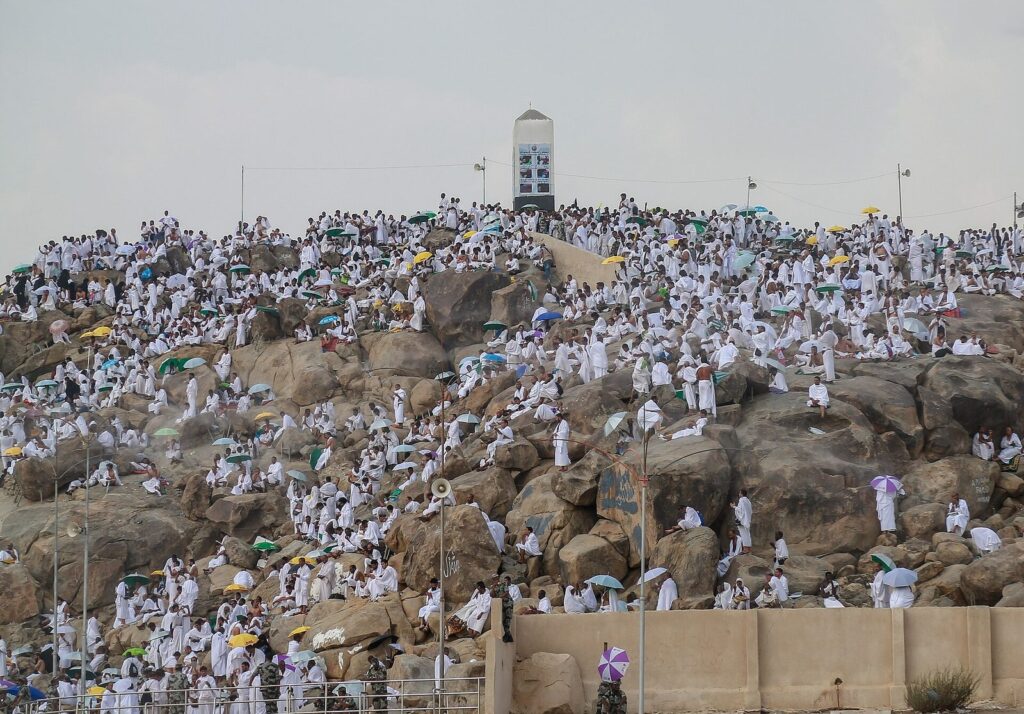
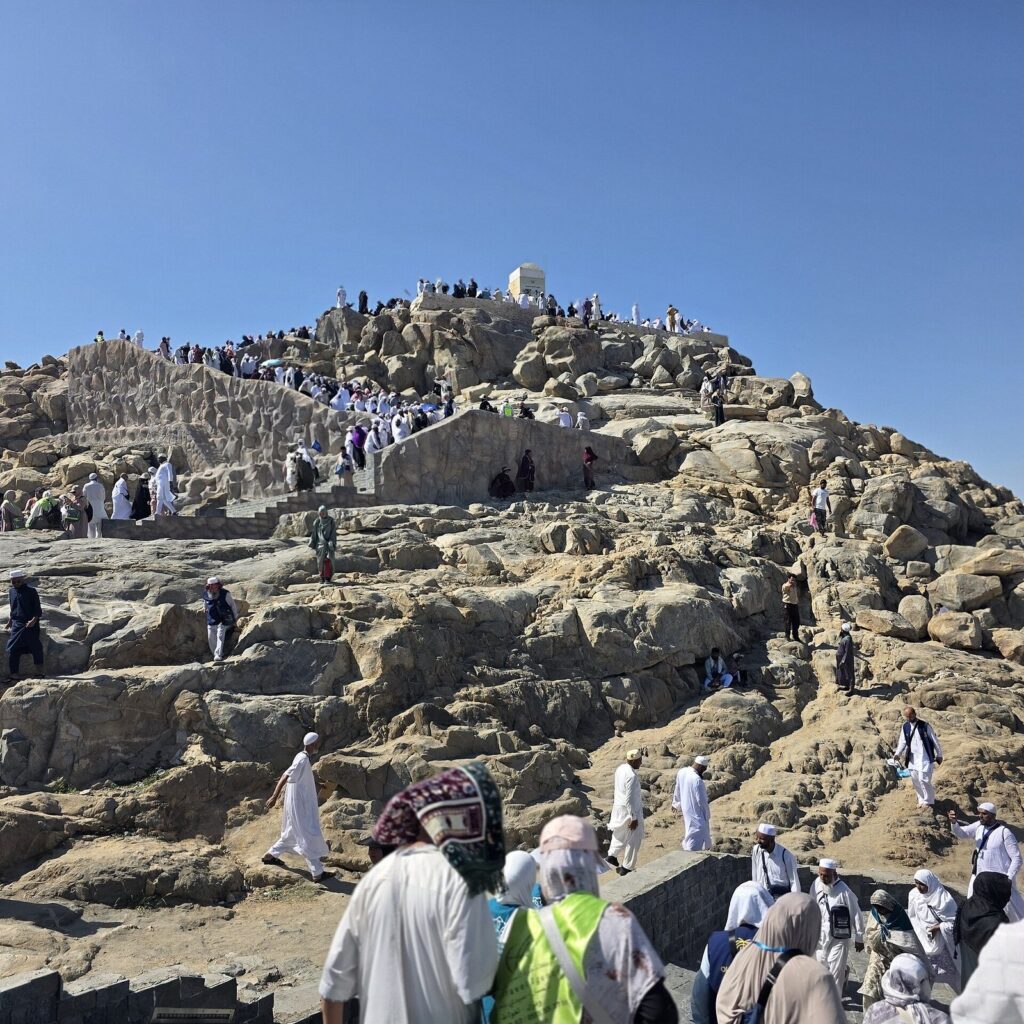
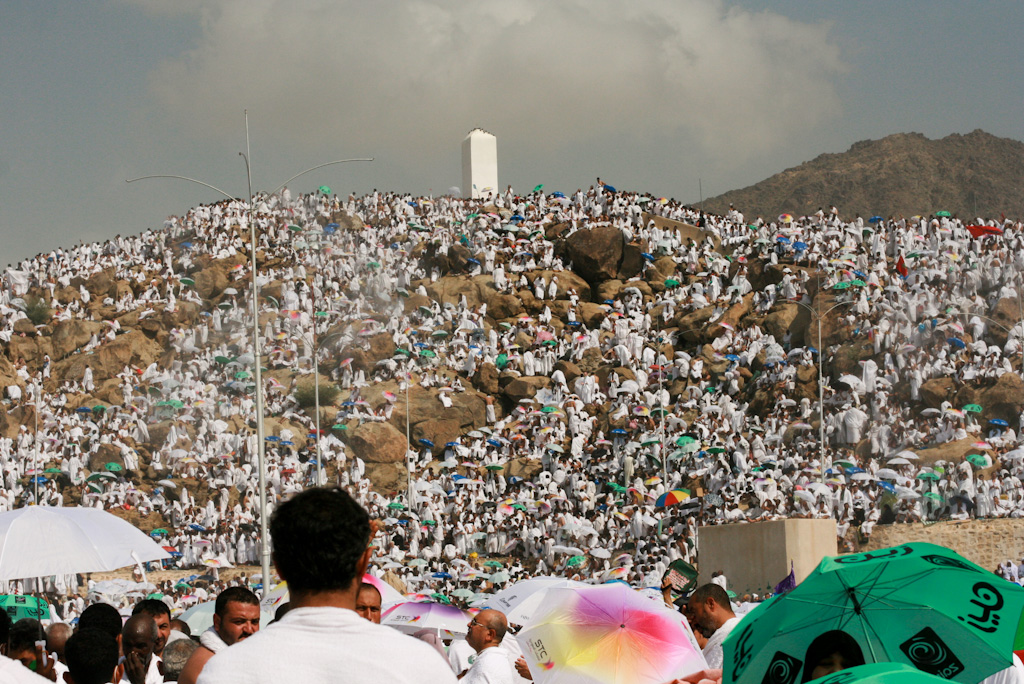
“Jabal ar-Rahmah” means “the mountain of mercy”; in Turkish it is also known as “Rahmet Tepesi” (the Hill of Mercy). It is a small, rocky hill rising within the plain of Arafat. The steps leading up the hill and the white pillar on its summit make it recognisable even from a distance.
It is known that during the Farewell Hajj the Prophet (peace be upon him) performed the standing at the foot of Jabal ar-Rahmah, near the rocks. For this reason, the area around the hill becomes one of the most crowded spots during the Hajj season. It is also reported that the Prophet said: “I have stood here, and the whole of Arafat is a place of standing.” (Muslim). This hadith clearly shows that it is not necessary to climb the hill or to reach its side in order to perform the standing.
What is the pillar on Jabal ar-Rahmah?
The white pillar on the summit of the hill is not a structure left from the time of the Prophet (peace be upon him); it is a marker erected later that makes it easier to find one’s bearings from a distance. Touching this pillar, writing on it or tying anything to it has no place in the religion. Diyanet (Türkiye’s Presidency of Religious Affairs) also warns visitors to refrain from such behaviour.
What Is the Significance of Mount Arafat?
The significance of Arafat in Islam stems from the fact that the standing, the most fundamental pillar of the Hajj, is performed here. The Prophet (peace be upon him) said: “Hajj is Arafah.” (at-Tirmidhi, Abu Dawud). According to the Hanafi school, the time of the standing begins on the Day of Arafah when the sun passes its zenith and lasts until the break of dawn (fajr) on the morning of Eid; the Hajj of a person who is not present at Arafat for even a moment within this period is not accomplished.
The virtue of the Day of Arafah is also emphasised in the hadiths. The Prophet (peace be upon him) stated that the day on which Allah frees the greatest number of His servants from the Fire is the Day of Arafah (Muslim). For this reason, the hours spent at Arafat are regarded as the most precious moments, which pilgrims spend in supplication, repentance and reflection.
Is Arafat mentioned in the Quran?
Yes, the name “Arafat” appears in the Holy Quran in Surah al-Baqarah: “When you surge down from Arafat, remember Allah at al-Mash’ar al-Haram.” (al-Baqarah 2:198). The verse that immediately follows says: “Then surge down from where the people surge down” (al-Baqarah 2:199). According to Aisha’s account, in the Age of Ignorance (Jahiliyyah) the Quraysh and those who followed them, regarding themselves as privileged, did not go out to Arafat but stayed at Muzdalifah; with this verse, everyone was commanded to perform the standing at Arafat (al-Bukhari, Muslim). In this way Arafat became a field of equality where all people stand in the same place without any distinction.
The Farewell Sermon and the perfection of the religion
During the Farewell Hajj, the only Hajj of his life, the Prophet (peace be upon him) addressed his Companions at Arafat. In this address, known as the Farewell Sermon, he emphasised the inviolability of life, property and honour, the rights of women, the fulfilment of trusts and brotherhood. According to Umar’s account, the verse “This day I have perfected your religion for you, completed My favour upon you and approved Islam as your religion” (al-Ma’idah 5:3) was revealed at Arafat on a Friday (al-Bukhari, Muslim).
The key messages of the Farewell Sermon are still remembered today as universal values:
- People’s lives, property and honour are inviolable to one another.
- Usury (riba) and the blood feuds of the Age of Ignorance have been abolished.
- The rights of women must be respected, and they must be treated well.
- A trust must be returned to its owner in full.
- The believers are brothers; superiority is not by lineage or colour, but by piety (taqwa).
What does the Day of Arafah mean for those not performing Hajj?
The Day of Arafah is a precious day for Muslims who are not at Arafat as well. The Prophet (peace be upon him) stated that he hoped from Allah that fasting on the Day of Arafah would be an expiation for the sins of the previous year and the following year (Muslim). For pilgrims, however, it is considered more appropriate not to fast on the Day of Arafah so that they have the strength for worship during the standing. In addition, according to the Hanafi school, the takbirs of tashriq begin to be recited from the Fajr prayer on the Day of Arafah.
Namirah Mosque and the Boundaries of Arafat
On the western edge of Arafat stands Namirah Mosque, where, during the Hajj season, the sermon is delivered on the Day of Arafah and the Dhuhr and Asr prayers are performed combined. The mosque takes its name from the place where the Prophet (peace be upon him) stayed during the Farewell Hajj.
The front part of Namirah Mosque falls within the valley of Uranah, which lies outside the boundaries of Arafat. The books of jurisprudence (fiqh) state that the valley of Uranah does not count as a place of standing. For this reason, during the days of Hajj, those in the front section of the mosque need to move inside the boundaries of Arafat before the time of the standing begins. The boundary signs in the mosque and the warnings of the staff should be followed carefully in this respect.
Important: For the standing to be valid, it is enough to be within the boundaries of Arafat; it is not necessary to climb Jabal ar-Rahmah, to touch the hill or to face the hill while making supplication. During the days of Hajj, the crush and the heat around the hill pose serious health risks. Staying in your group’s tent and making supplication facing the qiblah is both safer and more in keeping with the Sunnah. For the rulings on the standing, refer to Diyanet’s current publications.
Arafat, Muzdalifah and Mina Compared
Arafat, Muzdalifah and Mina are together called “al-Masha’ir”; the word refers to the places where the rites of the Hajj are carried out. These three places, where the Hajj rites are performed, can easily be confused, especially by those going for the first time. From the eighth day of Dhul-Hijjah onwards, pilgrims move between these places in a set order: from Mina to Arafat, from Arafat to Muzdalifah and from there back to Mina. Knowing this order makes it easier to understand the place of Arafat in the Hajj journey. The table below briefly compares these places.
| Place | Haram boundary | What is done during Hajj? | When |
|---|---|---|---|
| Arafat | Outside (hill) | The standing, supplication and reflection | The Day of Arafah |
| Muzdalifah | Inside | Staying overnight, the standing at Muzdalifah, collecting pebbles | The night and morning of Eid |
| Mina | Inside | Staying overnight and stoning the Jamarat | The Day of Tarwiyah and the days of Eid |
We have explained in detail how the standing at Arafat is performed, its necessary acts and its etiquette in our article on the standing at Arafat, and all of the Hajj rites in our guide on how to perform Hajj. For the supplications that can be recited on the Day of Arafah, you can also take a look at our article on Hajj supplications.
What Is at Arafat Today?
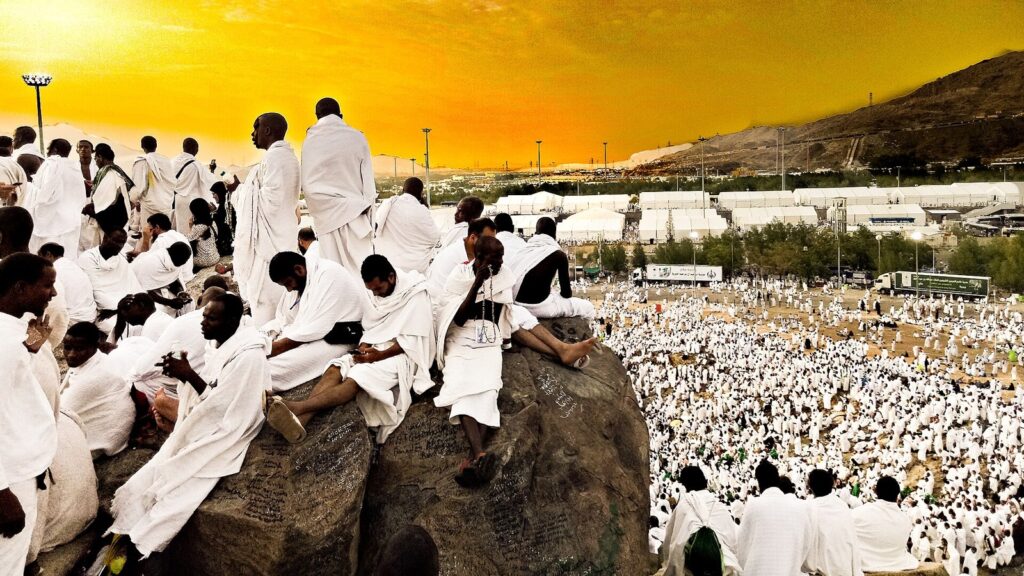
The plain of Arafat has been equipped with extensive infrastructure so that it can host millions of pilgrims during the days of Hajj. These areas, which look empty outside the Hajj season, consist of services prepared for a few days of intensive use.
On the plain there are tent areas where groups of pilgrims stay, trees planted to provide shade, water and cooling systems, and health points. The Mashaer train, which runs during the days of Hajj to make it easier for pilgrims to travel between Mina, Muzdalifah and Arafat, is also an important part of the area. In addition, the remains of the water channel that Zubaidah, the wife of the Abbasid caliph Harun al-Rashid, had built to carry water to Makkah are counted among the historic traces in the area.
During the Hajj period, entry to these areas is limited to people who hold a Hajj permit. Outside Hajj, some areas may be closed on visits to the region; you need to find out from your guide which points are open to visitors.
Visiting Arafat Outside the Hajj Season
Outside the Hajj season, the plain of Arafat is quite calm. Umrah visitors usually stop at Arafat during guided city tours in Makkah and have the chance to see Jabal ar-Rahmah up close.
Seeing Arafat on a quiet day makes it possible to observe details that are hard to notice in the crowds of the Hajj days. Having seen the breadth of the plain, the boundary signs and the location of Namirah Mosque in advance is an important preparation for those who will go for Hajj in the future. This visit is also a wonderful opportunity to make supplication while imagining the spiritual atmosphere of the Day of Arafah.
Do you go to Arafat during Umrah?
Going to Arafat is not part of the act of Umrah; there is no standing in Umrah. However, on city tours in Makkah, Arafat, Muzdalifah and Mina are usually toured by vehicle, and Jabal ar-Rahmah is seen during a short stop. This visit also offers those who intend to go for Hajj in the future the opportunity to get to know the area in advance.
Is it necessary to climb Jabal ar-Rahmah?
No, it is not necessary to climb Jabal ar-Rahmah during either Hajj or Umrah, and no special virtue has been reported for doing so. Outside Hajj, those who wish to climb the hill can use the steps; however, as the ground is rocky and exposed to the sun, care is needed.
On your visit outside the Hajj season, you can bear the following suggestions in mind:
- Plan the visit for the cool hours of the morning; do not stay in the open for long in the midday heat.
- If you are going to climb the hill, wear non-slip shoes and take water with you.
- Avoid writing on the pillar and the rocks, tying pieces of cloth and taking stones away.
- Rather than dealing with the vendors around you, devote this short stop to reflection.
- Ask your guide to show you the boundaries of the area of the standing and the location of Namirah Mosque.
Can you visit Arafat with children?
Yes, since on guided city tours the visit to Arafat is mostly made from inside the vehicle and with short stops, it is also suitable for families with children. Because the sun is strong in the open, it is necessary to protect children’s heads, to carry water with you and not to leave them alone on the steps of Jabal ar-Rahmah. At crowded moments, putting a small card with your contact details in your child’s pocket is also a useful precaution.
When is a good time to go to Arafat outside the Hajj season?
The best time to visit Arafat outside the Hajj season is in the morning hours, when the temperature is relatively low. During busy Umrah periods such as Ramadan and the mid-year school holiday in Türkiye, participation in city tours also increases; at these times short-lived crowds can form around Jabal ar-Rahmah. In the weeks close to the Hajj season, on the other hand, entry to some areas may be restricted because preparation work is carried out in the region.
Common Questions About Arafat
What does the “Arafat Dağı” hymn describe?
The hymns (ilahi) about Arafat are a literary expression of the Turkish people’s longing for Hajj and for standing at Arafat. These works speak of Arafat as a lofty mountain; however, in terms of worship, what matters is not the hill itself but being present in the state of standing on the plain of Arafat.
Which supplications are recited at Arafat?
There is no specific supplication that must be recited at Arafat; a person can make supplication in their own language and as it comes from the heart. The Prophet (peace be upon him) stated that the best of supplications is the supplication made on the Day of Arafah, and that the most virtuous of words spoken is the declaration of Allah’s oneness (tawhid) (at-Tirmidhi). Reciting the Quran, repenting and seeking forgiveness (istighfar), reciting the talbiyah and praying for loved ones are the finest ways to spend this time.
A Step onto the Plain of Mercy
Arafat is a meeting place where millions of people turn to their Lord on the same day, in the same clothing and with the same supplication. Seeing Jabal ar-Rahmah or standing for a few minutes on the plain is a powerful means of reflecting on the meaning of this gathering. For the other blessed places in and around Makkah, you can also read our article on the Cave of Hira.
At RotaNur, we visit Arafat accompanied by a guide in our Umrah tours programmes, and those intending to perform Hajj can take a look at our Hajj tours page. To decide together which programme suits you, you can get in touch with us through our contact page. May my Lord grant us all the opportunity to perform the standing at Arafat.
Frequently Asked Questions
If the Day of Arafah falls on a Friday, is it al-Hajj al-Akbar?
Among people, a Hajj in which the Day of Arafah falls on a Friday is called “al-Hajj al-Akbar” (the greatest Hajj). As for the expression “the day of al-Hajj al-Akbar” that appears in the Holy Quran (at-Tawbah 9:3), the Quran commentators have explained it as the day of Eid, the Day of Arafah, or the Hajj itself as the greater pilgrimage in comparison with Umrah. The soundness of the narrations stating that such a Hajj carries additional virtue is debated; it is known, however, that during the Farewell Hajj the Day of Arafah fell on a Friday.
When do pilgrims move from Arafat to Muzdalifah?
According to the Hanafi school, pilgrims leave Arafat after sunset on the Day of Arafah and move on to Muzdalifah; one should not leave the boundaries of Arafat before sunset. The Maghrib prayer is not performed at Arafat; on arrival at Muzdalifah, Maghrib and Isha are performed together at the time of Isha. Since this journey can take a long time because of the crowds, it is helpful to follow your group’s movement plan and to carry water and light food with you.
What should you do to avoid getting lost at Arafat?
The plain of Arafat is very large and during the days of Hajj it fills with tents that look alike; for this reason, noting down the number of your tent and the section it is in is the first step. Carry your group ID card and your guide’s phone number with you, and check that your phone is charged. Take care not to stray far from your tent, and especially not to go alone into the crowds around Jabal ar-Rahmah. If you get lost, show your group card to the officials and ask for help.
Is the covering of the Kaaba changed on the Day of Arafah?
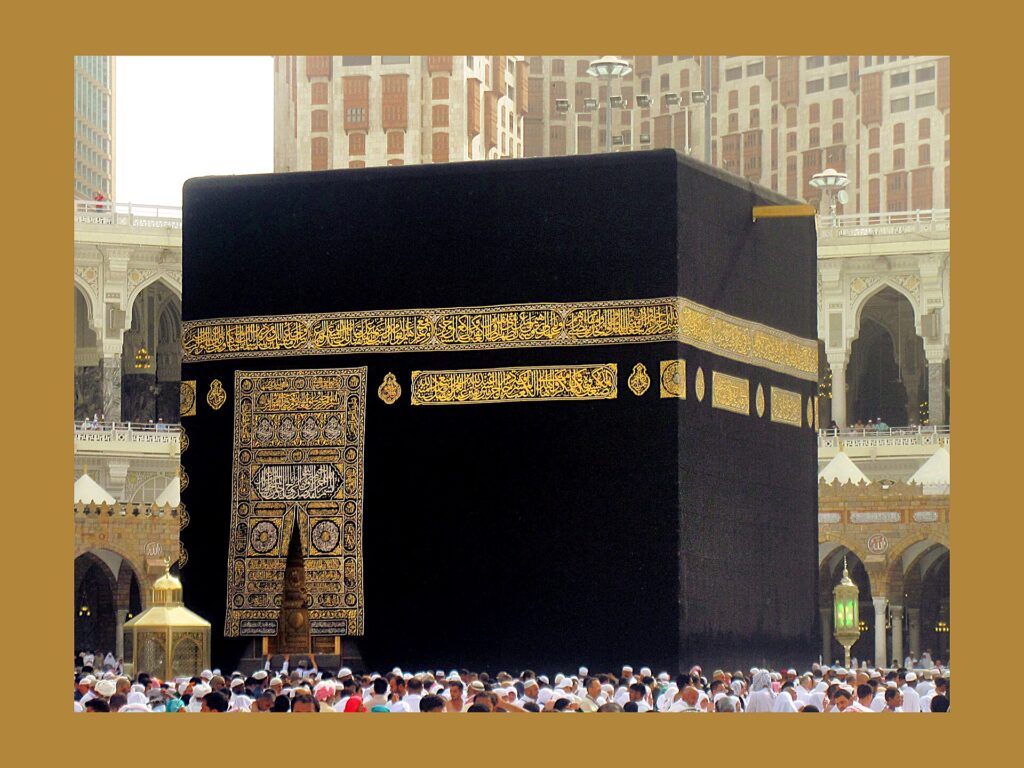
For a long time, the kiswah, the covering of the Kaaba, was changed on the Day of Arafah, while the pilgrims were at Arafat. Since 2022, however, the new covering has been placed on the Kaaba each year at the start of the Hijri year, on 1 Muharram. For this reason, no such change takes place in Makkah on the Day of Arafah today. You can find detailed information about the covering of the Kaaba, its door and its other parts in our article on the parts of the Kaaba.
Must the standing at Arafat be performed on your feet?
No, standing on your feet is not a condition for the standing to be valid; according to the Hanafi school, it is enough to be within the boundaries of Arafat during the time of the standing. The standing can be performed while standing, while sitting or while resting. It is commendable for those who are able to spend some time standing and making supplication facing the qiblah; the elderly and the tired, on the other hand, can make supplication while sitting in their tents. We have explained the rulings on the standing in detail in our article on the standing at Arafat.

Cihat Murat Yüksel is the editor of the RotaNur blog and the founder of Markention. Drawing on the sources of Türkiye's Presidency of Religious Affairs (Diyanet), he turns the questions travellers ask most about preparing for Umrah, Hajj and halal travel into clear, practical guides.
Questions answered in this article
Where Is Mount Arafat?
Arafat is a broad plain located to the east of Makkah, beyond Mina and Muzdalifah. The road from Masjid al-Haram to Arafat passes first through the valley of Mina and then through Muzdalifah. During the days of Hajj, pilgrims cover this route by coach, by train or on foot.
What is Mount Arafat, and is it really a mountain?
Arafat is essentially the name of a broad plain surrounded by mountains. In Turkish, the name “Arafat Dağı” (Mount Arafat) usually refers to Jabal ar-Rahmah, which lies within the plain. The standing is not performed on top of this hill; it is performed by being present anywhere within the boundaries of the plain of Arafat.
Where does the name Arafat come from?
The word “Arafat” is associated with the Arabic root meaning “to know, to recognise”. There are different explanations of the origin of the name; some link it to the meeting of the Prophet Adam and Hawwa (Eve), while others link it to the Hajj rites (manasik) being taught to the Prophet Ibrahim. These explanations do not amount to certain knowledge; the importance of Arafat comes less from the origin of its name than from the fact that the standing, the fundamental pillar of the Hajj, is performed here.
What Does Jabal ar-Rahmah Mean?
“Jabal ar-Rahmah” means “the mountain of mercy”; in Turkish it is also known as “Rahmet Tepesi” (the Hill of Mercy). It is a small, rocky hill rising within the plain of Arafat. The steps leading up the hill and the white pillar on its summit make it recognisable even from a distance.
What is the pillar on Jabal ar-Rahmah?
The white pillar on the summit of the hill is not a structure left from the time of the Prophet (peace be upon him); it is a marker erected later that makes it easier to find one’s bearings from a distance. Touching this pillar, writing on it or tying anything to it has no place in the religion. Diyanet (Türkiye’s Presidency of Religious Affairs) also warns visitors to refrain from such behaviour.
What Is the Significance of Mount Arafat?
The significance of Arafat in Islam stems from the fact that the standing, the most fundamental pillar of the Hajj, is performed here. The Prophet (peace be upon him) said: “Hajj is Arafah.” (at-Tirmidhi, Abu Dawud). According to the Hanafi school, the time of the standing begins on the Day of Arafah when the sun passes its zenith and lasts until the break of dawn (fajr) on the morning of Eid; the Hajj of a person who is not present at Arafat for even a moment within this period is not accomplished.