








Contents 22 sections
- What Is the Standing at Arafat?
- What does “the standing at Arafat” mean?
- The Ruling on the Standing at Arafat and Its Importance
- Why is the standing at Arafat so important?
- The Time and Duration of the Standing at Arafat
- When is the time for the standing at Arafat?
- How long does the standing at Arafat last?
- The Boundaries of Arafat and Jabal al-Rahmah
- Is it necessary to climb Jabal al-Rahmah?
- How Is the Standing at Arafat Performed?
- Are the midday and afternoon prayers combined at Arafat?
- What are the necessary acts of the standing at Arafat?
- What are the Sunnahs of the standing at Arafat?
- Suggestions for Making the Most of Your Time at Arafat
- How to Prepare for the Day of Arafah
- Special Situations and Common Questions
- Can the standing at Arafat be performed in a state of major ritual impurity (junub)?
- Is the standing valid for someone who passes through Arafat while asleep or unaware?
- What should someone who misses the standing at Arafat do?
- How do sick pilgrims perform the standing?
- After Arafat: Muzdalifah and the Day of Eid
- Frequently Asked Questions
The standing at Arafat (wuquf) is the act of worship that pilgrims fulfil by being within the boundaries of Arafat during a specific period on the Day of Arafah, the ninth day of the month of Dhu al-Hijjah, and it is regarded as the most important pillar of Hajj. The word “wuquf” means “to stand, to wait”; on this day, the pilgrim stands at Arafat and turns to their Lord with supplication (dua), remembrance of Allah (dhikr) and repentance. In this article, based on the Hanafi school and the explanations of Diyanet (Türkiye’s Presidency of Religious Affairs), you will find what the standing at Arafat is, its ruling, its time, how long it lasts, its necessary acts and Sunnahs, the situation of someone who misses it, and how you can make the most of this precious day.
What Is the Standing at Arafat?
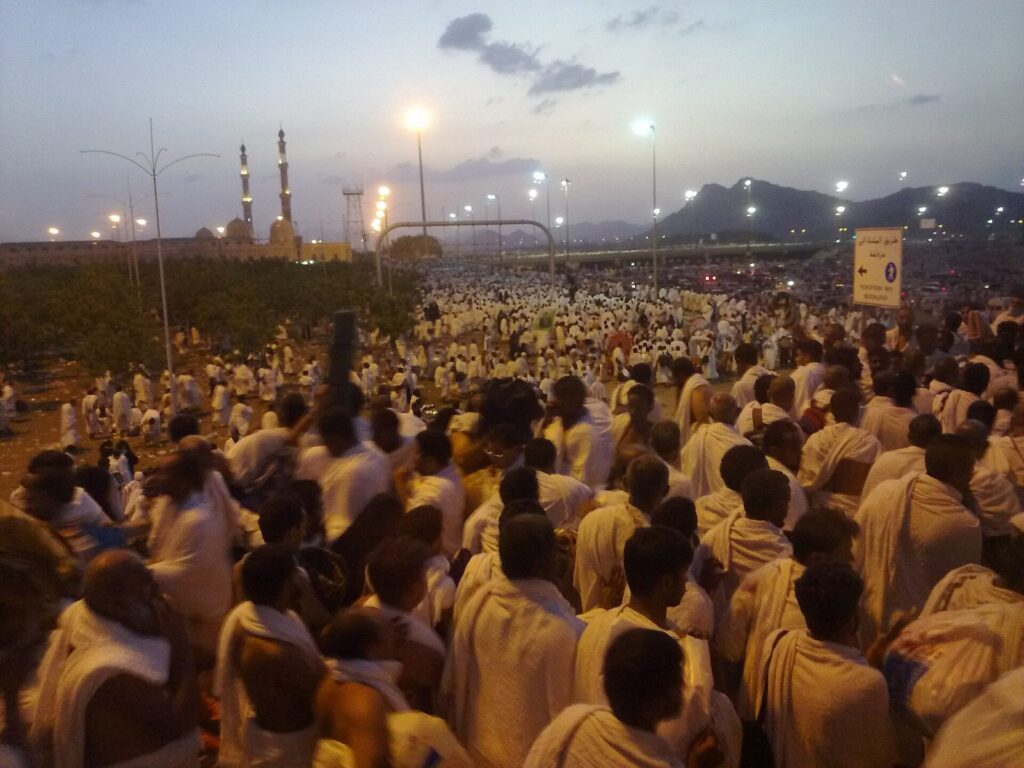
Arafat is a wide plain located to the east of Makkah, beyond Muzdalifah, and it lies outside the boundaries of the Haram. The standing at Arafat means that a person who has entered ihram for Hajj is present within the boundaries of this plain, even for a brief moment, during the period from the start of the midday prayer time on the Day of Arafah until dawn breaks on the morning of Eid. For the standing to be valid, it is not a condition to be on one’s feet, to be at a particular spot or to recite a particular supplication.
The Prophet (peace be upon him) performed the standing at Arafat during the Farewell Hajj, and on this day he addressed his Companions in the speech known as the Farewell Sermon (Muslim). For this reason, Arafat holds a special place in pilgrims’ hearts, both as the essence of Hajj and as the site of one of the most meaningful memories in Islamic history.
What does “the standing at Arafat” mean?
The term “wuquf at Arafat” literally means “standing at Arafat”. In the language of Islamic jurisprudence (fiqh), it refers to a person in ihram for Hajj being within the boundaries of Arafat during the period from the sun’s passing its zenith (zawal) on the Day of Arafah until dawn breaks on the first day of Eid. States such as sleeping, walking, sitting or being inside a vehicle do not prevent the standing.
The Ruling on the Standing at Arafat and Its Importance
The standing at Arafat is an obligatory (fard) act of Hajj and, according to the Hanafi school, one of the two pillars of Hajj; the other is the tawaf of visitation (ziyarah). Without the standing, Hajj is not accomplished, and this deficiency cannot be made up with a sacrifice or any other penalty. The Prophet’s saying “Hajj is Arafat” (Abu Dawud, Tirmidhi) clearly shows that the standing lies at the heart of Hajj.
The Day of Arafah is one of the days on which servants draw closest to their Lord. In a hadith narrated by Muslim, it is reported that the Day of Arafah is the day on which Allah frees the greatest number of His servants from the Fire. For this reason, pilgrims take care to spend every moment of this day in repentance, supplication and remembrance of Allah.
Why is the standing at Arafat so important?
The standing at Arafat is the most fundamental act of worship, determining whether or not the Hajj is valid. While some of the other rites can be performed late or made up with a penalty, a person who cannot perform the standing within its time has missed that year’s Hajj. In this respect, Arafat is the true destination towards which all of the pilgrim’s preparation and journey are directed.
The Time and Duration of the Standing at Arafat
According to the Hanafi school, the time for the standing at Arafat begins on the Day of Arafah when the sun moves past its highest point towards the west, that is, with the start of the midday prayer time, and it continues until dawn breaks on the first day of Eid. A person who is within the boundaries of Arafat during this period has fulfilled the obligation of the standing.
When is the time for the standing at Arafat?
The time for the standing at Arafat is the period from the start of the midday prayer time on the Day of Arafah, the ninth of Dhu al-Hijjah, until dawn breaks on the following day, that is, the first day of Eid al-Adha. As the Gregorian date on which the Day of Arafah falls changes every year, you can take a look at the explanations in our article on when Hajj takes place.
How long does the standing at Arafat last?
For the obligatory standing, being at Arafat for a brief moment within its time is sufficient. However, according to the Hanafi school, it is necessary (wajib) for a pilgrim who begins the standing during the day to remain at Arafat until the sun sets. In practice, groups reach Arafat before midday on the Day of Arafah and set off for Muzdalifah after sunset; the standing therefore actually covers a period of several hours, from midday until evening.
| Topic | Ruling according to the Hanafi school |
|---|---|
| Ruling | Obligatory (fard); a pillar of Hajj |
| Start time | The start of the midday prayer time on the Day of Arafah (zawal) |
| End time | Dawn on the first day of Eid |
| To fulfil the obligation | Being within the boundaries of Arafat, in ihram, for a brief moment within the time |
| Necessary (wajib) | A pilgrim who begins the standing during the day remaining at Arafat until sunset |
| Ritual purity | Not a condition; the standing is valid without wudu, in a state of major ritual impurity (junub) or during menstruation |
| If it is missed | That year’s Hajj has been missed; the pilgrim leaves ihram by performing the acts of Umrah, and the Hajj is made up (qada) later |
The Boundaries of Arafat and Jabal al-Rahmah
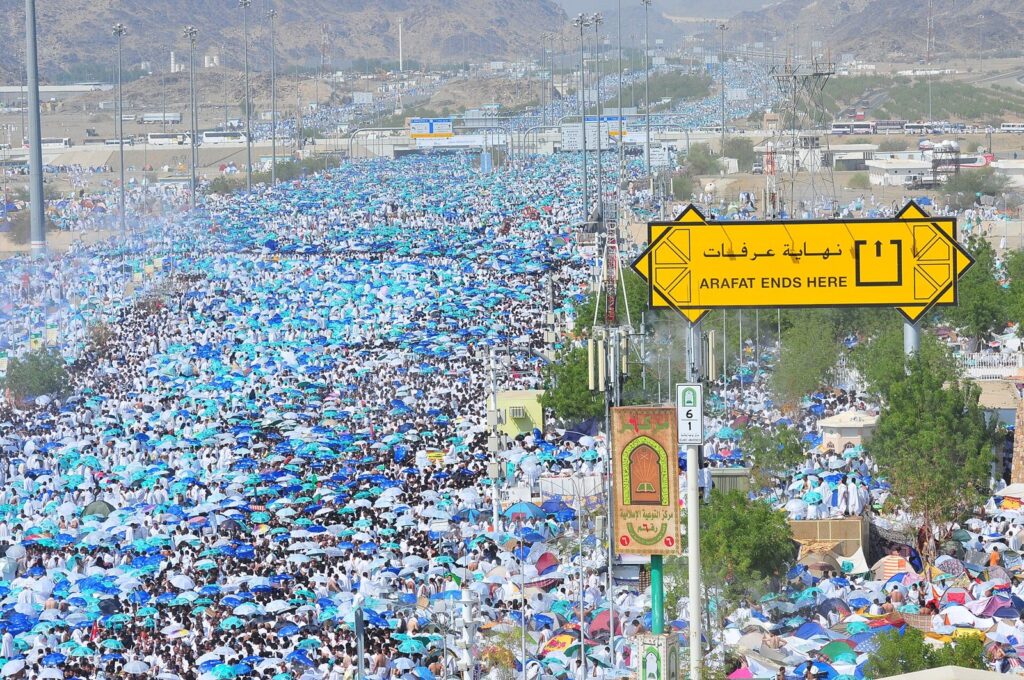
For the standing to be valid, one must be within the boundaries of Arafat. The boundaries of Arafat are marked with large signs, and the groups’ tents are also set up within these boundaries. The valley of Uranah, which adjoins Arafat, is not counted as part of Arafat, and a standing performed there is not valid. It is also known that part of Namirah Mosque at Arafat lies outside the boundary. For this reason, you should not move about other than as directed by your group officials.
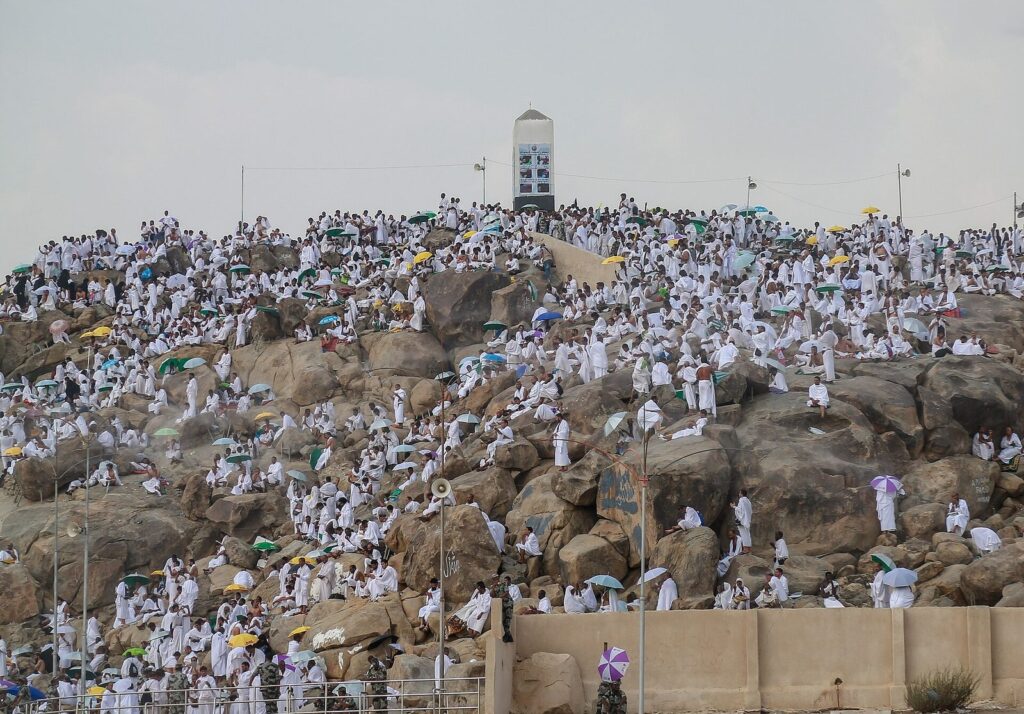
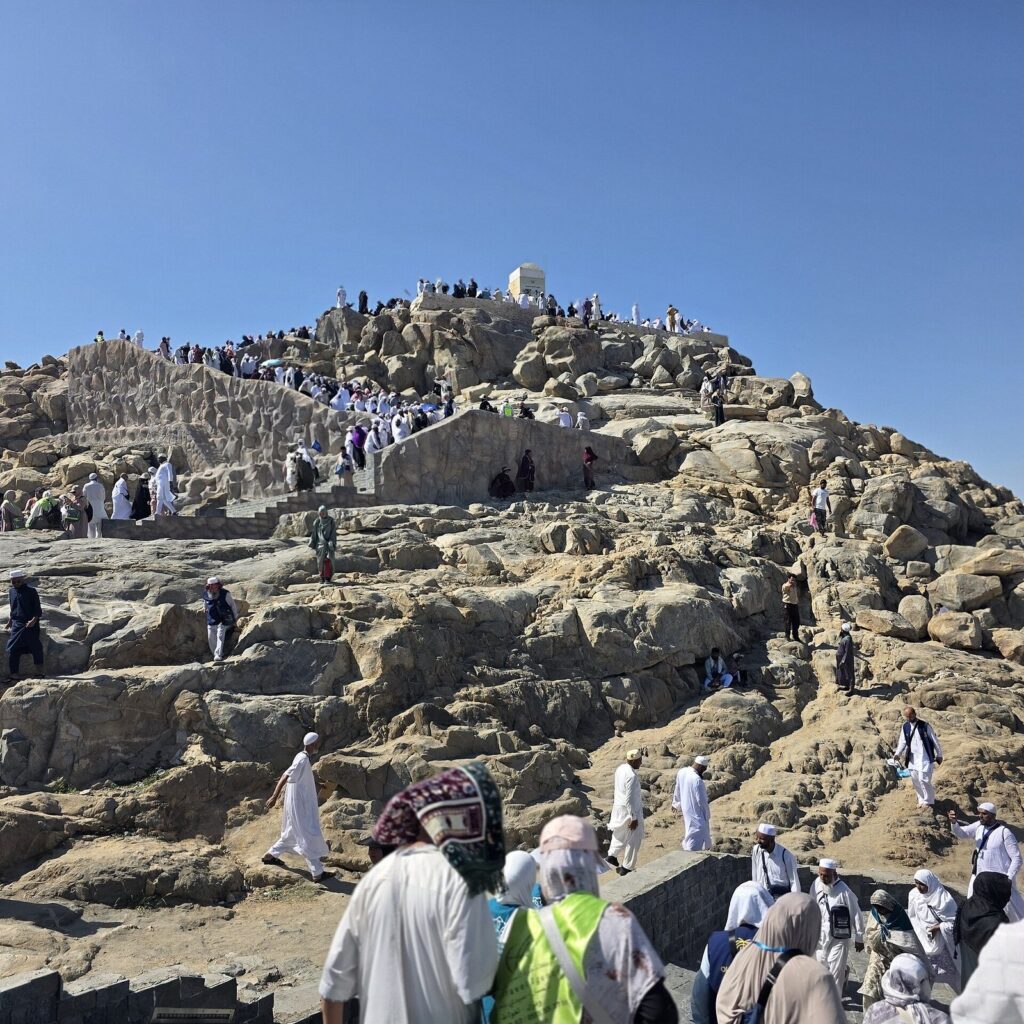
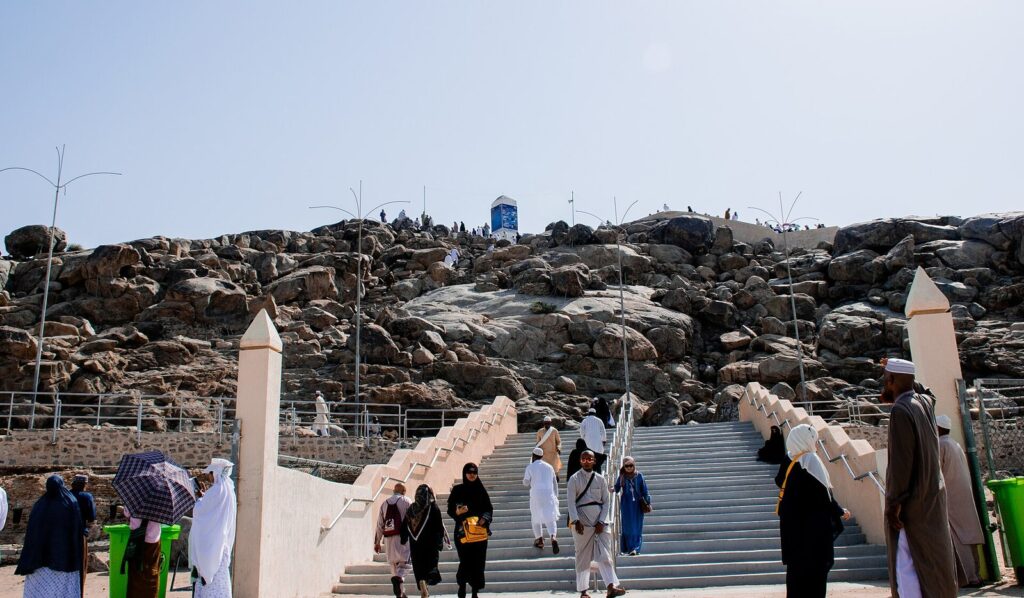
Jabal al-Rahmah (the Mount of Mercy), which has become the symbol of Arafat, is a small hill within the plain. It is known that the Prophet performed his standing at the foot of this hill, facing the qiblah. For more information about the hill and its surroundings, you can take a look at our article on Mount Arafat and Jabal al-Rahmah.
Is it necessary to climb Jabal al-Rahmah?
No. Climbing Jabal al-Rahmah is neither a condition nor a necessary act of the standing. Every place within the boundaries of Arafat is a place of standing; the pilgrim can perform the standing in full in their own tent. Trying to climb the hill, especially during the hot and crowded hours, can put both the person and others in danger.
How Is the Standing at Arafat Performed?
The standing at Arafat has no set form; what matters is being at Arafat within its time and spending that time in worship. In groups, the Day of Arafah generally unfolds as follows:
- Setting off for Arafat: Pilgrims are taken to Arafat, according to the group’s programme, either from Mina, where they spent the Day of Tarwiyah, or directly from Makkah.
- Preparation: If possible, the full ritual bath (ghusl) is taken; pilgrims settle into their tents and make sure they have water and shade.
- The midday and afternoon prayers: The prayers are performed after zawal. According to the Hanafi school, praying the midday (dhuhr) and afternoon (asr) prayers together at the time of the midday prayer (jam’ al-taqdim) is subject to certain conditions; follow the practice of your group’s religious guide.
- The standing: After the prayers, the time is spent, facing the qiblah if possible, in supplication, remembrance of Allah, the talbiyah, seeking forgiveness (istighfar), sending blessings upon the Prophet (salawat) and reciting the Qur’an.
- Waiting for sunset: Pilgrims remain within the boundaries of Arafat until the sun sets.
- Setting off for Muzdalifah: After sunset, pilgrims move on to Muzdalifah without praying the maghrib prayer; the maghrib and isha prayers are prayed together at Muzdalifah at the time of isha.
Are the midday and afternoon prayers combined at Arafat?
Praying the midday and afternoon prayers together at the time of the midday prayer at Arafat is based on the practice of the Prophet. In the Hanafi school, it is known that this combining has conditions, such as being in ihram and praying the prayers behind the imam, and that Imam Abu Hanifah and his students held differing views on the details of these conditions. Ask your religious guide what practice your group will follow, and follow their directions.
What are the necessary acts of the standing at Arafat?
According to the Hanafi school, the necessary (wajib) act relating to the standing at Arafat is that a pilgrim who begins the standing during the day remains within the boundaries of Arafat until the sun sets. A person who leaves Arafat before sunset is required to offer a sacrifice as a penalty; however, if they return before sunset, this penalty no longer applies. A person who is only able to reach the standing at night is not required to pay a penalty for this reason.
What are the Sunnahs of the standing at Arafat?
Among the Sunnahs and etiquette of the standing are taking the full ritual bath (ghusl) for the standing, reaching Arafat before midday, listening to the imam’s sermon, performing the standing facing the qiblah and in a state of wudu if possible, increasing supplication and remembrance of Allah, and setting off calmly for Muzdalifah after sunset. Pilgrims are advised not to fast on the Day of Arafah so that they can preserve their strength.
Suggestions for Making the Most of Your Time at Arafat
The hours spent at Arafat are among the most precious times in a pilgrim’s life. Planning these hours in advance prevents the time from being wasted because of tiredness and the heat.
- Prepare in advance a list of the people you want to pray for and the intentions you want to pray about.
- Begin with repentance and seeking forgiveness; take stock of the past and renew your intentions for the future.
- Frequently repeat the remembrance of tawhid (declaring the oneness of Allah), which stands out on the Day of Arafah.
- Read the Holy Qur’an and reflect on the meaning of the verses you read.
- Repeat the talbiyah, takbir, tasbih and salawat at intervals.
- Take care not to break up your time with distractions such as chatting, your phone or taking photos.
- Protect yourself from the sun, drink water regularly and do not overexert yourself.
You can find the remembrances and supplications that can be recited at Arafat, with their transliterations and meanings, in our article on Hajj supplications. Reciting a particular supplication is not compulsory; a person may also pray in their own language, however it comes from the heart. For other places where supplications are hoped to be accepted, you can also take a look at our article on places where supplications are accepted.
How to Prepare for the Day of Arafah
The day to be spent at Arafat should be planned from the previous evening. Groups usually spend the Day of Tarwiyah in Mina and set off for Arafat on the morning of the Day of Arafah; because of the crowds, some groups may be taken directly from Makkah to Arafat. Finding out in advance which plan will be followed and what the departure time is will save you from rushing in the morning crush.
You do not need to carry many belongings for the hours you will spend in the tents at Arafat; however, you should not leave out certain basic necessities. You can prepare a light bag and take the following with you:
- A small bottle of water and light, salty snacks,
- An umbrella or a cover that protects you from the sun,
- Unscented wet wipes and your personal medication,
- A pocket-sized copy of the Holy Qur’an or a booklet of supplications,
- The list of supplications you have prepared in advance,
- Your group ID card and a charger for your phone.
Spending the night before the Day of Arafah resting as much as possible makes it easier to devote the following day to worship, alert and full of energy. Going to sleep early rather than chatting until late at night makes the hours at Arafat more fruitful.
Special Situations and Common Questions
The standing at Arafat gives rise to many questions about ritual purity and health. Below, we summarise the most frequently asked of these according to the Hanafi school.
Can the standing at Arafat be performed in a state of major ritual impurity (junub)?
Yes. For the standing at Arafat to be valid, it is not a condition to have wudu or to have taken ghusl. A person who is junub, a person without wudu or a woman who is menstruating can also perform the standing, and their standing is valid. Nevertheless, if possible, taking ghusl and performing the standing in a state of cleanliness is in keeping with the Sunnah.
Is the standing valid for someone who passes through Arafat while asleep or unaware?
According to the Hanafi school, the standing of a person who is within the boundaries of Arafat in ihram during the time of the standing is valid, even if they are asleep, unconscious or unaware that they are at Arafat. Nevertheless, spending the standing consciously, in supplication and remembrance of Allah, is what befits the spirit of this act of worship.
What should someone who misses the standing at Arafat do?
A person who is unable to perform the standing at Arafat within its time has missed that year’s Hajj. According to the Hanafi school, this person leaves ihram by performing the acts of Umrah, that is, tawaf and sa’i, followed by shaving or trimming the hair, and makes up (qada) their Hajj in a later year. A pilgrim who faces such a situation should consult their group’s religious guide and Diyanet officials without delay.
How do sick pilgrims perform the standing?
The Saudi authorities and organisations may make special arrangements so that pilgrims who are in hospital or whose health is seriously affected can be brought to Arafat during the time of the standing. As no particular action is required for the standing, a sick pilgrim can also perform it on a stretcher or inside a vehicle. In such cases, the directions of the group officials should be followed.
Important: Do not become separated from your group on the way to Arafat or on the way back. Pay attention to the signs marking the boundaries of Arafat, take care not to leave your tent during the hot hours, and do not go outside the boundaries before sunset. Whenever you are unsure about the standing, consult your group’s religious guide and Diyanet’s explanations.
After Arafat: Muzdalifah and the Day of Eid
At sunset, pilgrims set off from Arafat for Muzdalifah. At Muzdalifah, the maghrib and isha prayers are prayed together, the night is spent there, and on the morning of Eid, after dawn, the standing at Muzdalifah is performed. Pilgrims then move on to Mina and stone the large pillar; we explain the details of this act of worship in our article on stoning the Jamarat. To see all the days of Hajj in order, you can also take a look at our guide on how to perform Hajj.
The standing at Arafat is the heart of Hajj and the most special time, when the pilgrim is alone with their Lord. At RotaNur, we are happy to explain how the Arafat and Mina programmes are planned and to answer all your questions about preparing for Hajj. You can explore our Hajj tours, which also include services at Arafat and Mina, and send us your questions through our contact page or our WhatsApp line. May Allah grant all Hajj candidates an accepted (mabrur) Hajj in which their supplications at Arafat are answered.
Frequently Asked Questions
On what date does the Day of Arafah fall in 2027?
The 2027 Hajj is expected to fall in mid-May 2027; the Day of Arafah will also fall in this period, one day before Eid al-Adha. As the date is determined by the start of the month of Dhu al-Hijjah in the Hijri calendar, the exact day will be confirmed by Diyanet’s calendar and by announcements from the Saudi authorities. For the Hajj calendar and the sequence of the days of Dhu al-Hijjah, take a look at our article on when Hajj takes place.
Is it appropriate for pilgrims to fast on the Day of Arafah?
Pilgrims who are at Arafat are advised not to fast on the Day of Arafah, because being strong enough for the standing, supplication and travel is the priority on this day. It is reported that the Prophet was not fasting at Arafat during the Farewell Hajj (Bukhari, Muslim). For Muslims who are not on Hajj, however, fasting on the Day of Arafah is a virtuous voluntary (nafl) act of worship. If you have doubts about your health, consult your doctor; for religious questions, refer to Diyanet’s current explanations.
When do the takbirs of Tashriq begin on the Day of Arafah?
According to the Hanafi school, the takbirs of Tashriq begin with the obligatory (fard) part of the dawn prayer on the Day of Arafah and continue until the obligatory part of the afternoon prayer on the fourth day of Eid. It is necessary (wajib) to recite the takbir of Tashriq after every obligatory prayer performed during this period. The takbirs also apply to those who are not on Hajj; everyone who prays, whether in congregation or alone, recites the takbir, while it is considered appropriate for women to recite it quietly. For details, you can refer to Diyanet’s explanations.
How do pilgrims get to Arafat?
Transport to Arafat is provided, according to the plan of the organisation the pilgrims belong to, either by coach or by the Mashair metro, which runs between Mina, Muzdalifah and Arafat during the days of Hajj. Which group travels by which vehicle and at what time is determined according to the arrangements of the Saudi authorities. For this reason, you should not move about on your own, and you should keep to the times and meeting points given by your group officials. For details of the services, you can explore our Hajj tours.
What should you pay attention to so as not to get lost at Arafat?
To avoid getting lost at Arafat, you need to carry your Nusuk card, your group ID card and your tent details with you at all times. Learn the location of your tent and the signs near it as soon as you arrive; when you step away for wudu or to use the facilities, take a companion with you. Keep your phone charged and save the numbers of your group officials. If you do get lost, do not panic; go to the nearest official or an official help point.

Cihat Murat Yüksel is the editor of the RotaNur blog and the founder of Markention. Drawing on the sources of Türkiye's Presidency of Religious Affairs (Diyanet), he turns the questions travellers ask most about preparing for Umrah, Hajj and halal travel into clear, practical guides.
Questions answered in this article
What Is the Standing at Arafat?
Arafat is a wide plain located to the east of Makkah, beyond Muzdalifah, and it lies outside the boundaries of the Haram. The standing at Arafat means that a person who has entered ihram for Hajj is present within the boundaries of this plain, even for a brief moment, during the period from the start of the midday prayer time on the Day of Arafah until dawn breaks on the morning of Eid. For the standing to be valid, it is not a condition to be on one’s feet, to be at a particular spot or to recite a particular supplication.
What does “the standing at Arafat” mean?
The term “wuquf at Arafat” literally means “standing at Arafat”. In the language of Islamic jurisprudence (fiqh), it refers to a person in ihram for Hajj being within the boundaries of Arafat during the period from the sun’s passing its zenith (zawal) on the Day of Arafah until dawn breaks on the first day of Eid. States such as sleeping, walking, sitting or being inside a vehicle do not prevent the standing.
Why is the standing at Arafat so important?
The standing at Arafat is the most fundamental act of worship, determining whether or not the Hajj is valid. While some of the other rites can be performed late or made up with a penalty, a person who cannot perform the standing within its time has missed that year’s Hajj. In this respect, Arafat is the true destination towards which all of the pilgrim’s preparation and journey are directed.
When is the time for the standing at Arafat?
The time for the standing at Arafat is the period from the start of the midday prayer time on the Day of Arafah, the ninth of Dhu al-Hijjah, until dawn breaks on the following day, that is, the first day of Eid al-Adha. As the Gregorian date on which the Day of Arafah falls changes every year, you can take a look at the explanations in our article on when Hajj takes place.
How long does the standing at Arafat last?
For the obligatory standing, being at Arafat for a brief moment within its time is sufficient. However, according to the Hanafi school, it is necessary (wajib) for a pilgrim who begins the standing during the day to remain at Arafat until the sun sets. In practice, groups reach Arafat before midday on the Day of Arafah and set off for Muzdalifah after sunset; the standing therefore actually covers a period of several hours, from midday until evening.
Is it necessary to climb Jabal al-Rahmah?
No. Climbing Jabal al-Rahmah is neither a condition nor a necessary act of the standing. Every place within the boundaries of Arafat is a place of standing; the pilgrim can perform the standing in full in their own tent. Trying to climb the hill, especially during the hot and crowded hours, can put both the person and others in danger.