



Contents 32 sections
- A Brief History of the Kaaba
- The construction by Ibrahim and Ismail
- The rebuilding by the Quraysh and the Black Stone incident
- The periods of Abdullah ibn al-Zubayr and al-Hajjaj
- The rebuilding in the Ottoman period
- The Corners of the Kaaba: The Rukns
- The Black Stone
- The Yemeni Corner
- The Iraqi Corner and the Levantine Corner
- Parts on the Walls of the Kaaba and Around It
- The door of the Kaaba (Bab al-Kaaba)
- The Multazam
- The Mizab ar-Rahmah (the golden spout)
- The Hijr (Hatim)
- The Shadharwan
- Places Around the Kaaba
- The Station of Ibrahim (Maqam Ibrahim)
- The Mataf
- The Zamzam well
- The kiswah (the covering of the Kaaba)
- How Are the Parts of the Kaaba Related to Tawaf?
- Common Questions About the Kaaba
- Can you go inside the Kaaba?
- Is it obligatory to kiss the Black Stone?
- Must the tawaf prayer be performed behind the Station of Ibrahim?
- When is the covering of the Kaaba changed?
- Getting to Know the Kaaba Before You Visit
- Up-to-Date Notes for Those Visiting the Kaaba in 2026–2027
- When the kiswah is changed
- Practical tips by period
- Keep reading
- Frequently Asked Questions
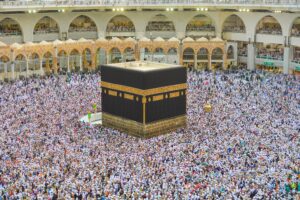
The Kaaba is the qiblah towards which Muslims all over the world turn in prayer, and the centre of tawaf. Everyone who enters Masjid al-Haram for Umrah or Hajj often hears names such as the Black Stone, the Multazam, the Hijr and the Station of Ibrahim. When you get to know the parts of the Kaaba in advance, you can perform tawaf more mindfully, and it also becomes easier to reflect on the history of this blessed structure. In this article, we explain the brief history of the Kaaba and each of its parts in simple language.
A Brief History of the Kaaba
The Holy Quran states that the first house of worship established for mankind is the one in Makkah (Al Imran 3:96). Throughout history, the Kaaba has been repaired and rebuilt many times.
The construction by Ibrahim and Ismail
The Holy Quran relates that Ibrahim and his son Ismail raised the foundations of the Kaaba and prayed, “Our Lord, accept this from us” (al-Baqarah 2:127). The stone on which Ibrahim is narrated to have stood during the construction is known today as the Station of Ibrahim (Maqam Ibrahim).
The rebuilding by the Quraysh and the Black Stone incident
In the years before the prophethood of the Prophet (peace be upon him), the Quraysh rebuilt the damaged Kaaba. When a dispute broke out over which tribe would have the honour of putting the Black Stone back in its place, the Prophet placed the stone on a cloth, had the representatives of the tribes lift the cloth together and then set the stone in its place with his own hands. This wise solution prevented a possible conflict. When the materials the Quraysh had gathered solely from lawful (halal) earnings proved insufficient, they left part of the structure outside; the area known today as the Hijr is connected with this section.
The periods of Abdullah ibn al-Zubayr and al-Hajjaj
Abdullah ibn al-Zubayr had the Kaaba rebuilt after it was damaged during a siege of Makkah in the Umayyad period. Relying on a hadith narrated from Aisha, he brought the Hijr inside the structure and had two doors opened at ground level, one for entering and one for leaving. Later, al-Hajjaj ibn Yusuf, on the orders of the Umayyad caliph Abd al-Malik, returned the Kaaba to the shape it had in the time of the Quraysh; the Hijr was once again left outside, one of the doors was closed and the other was raised.
The rebuilding in the Ottoman period
In the 17th century, during the reign of Murad IV, a great flood in Makkah seriously damaged the walls of the Kaaba. The structure was then rebuilt, remaining faithful to its original form. The Kaaba we see today largely bears the marks of this construction; various maintenance and repair works have also been carried out in later periods.
The Corners of the Kaaba: The Rukns
The four corners of the Kaaba are each called a “rukn”, and each one is named after the region it faces. Knowing these corners makes it easier to understand where you are during tawaf.
The Black Stone
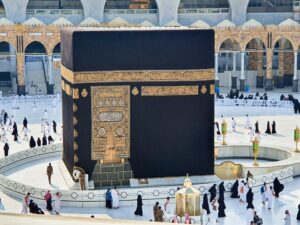
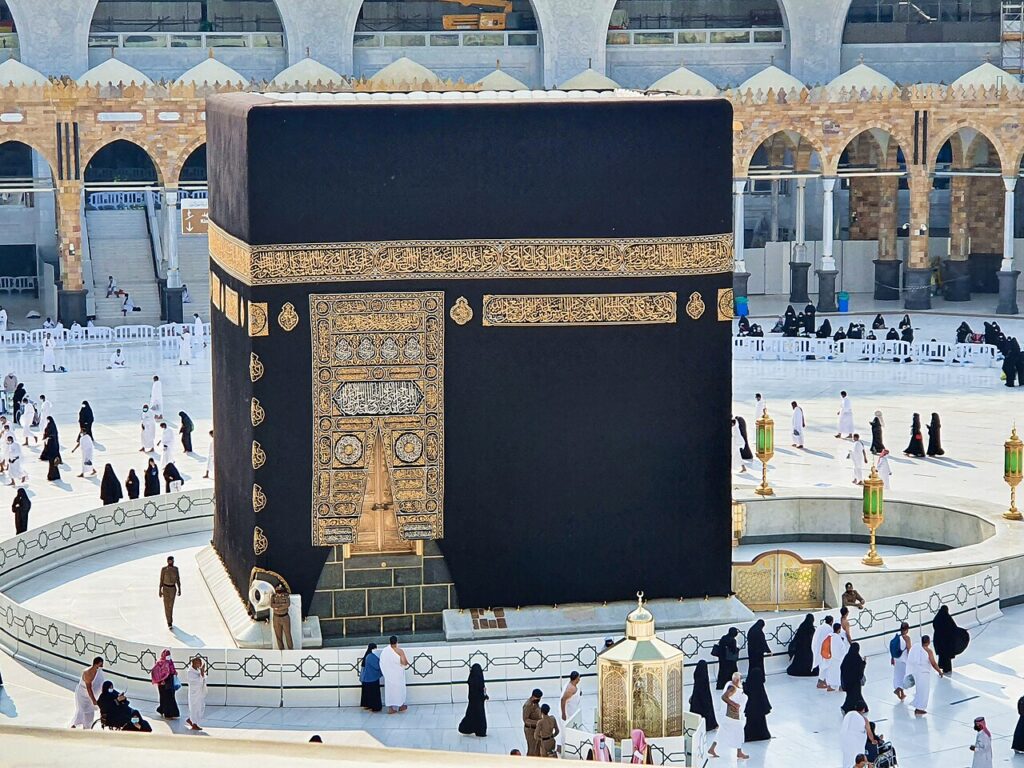
The Black Stone (al-Hajar al-Aswad) is the black stone set in a silver frame at the eastern corner of the Kaaba; the corner where it is located is also called the Black Stone Corner (ar-Rukn al-Aswad). Tawaf begins in line with this stone, and each circuit (shawt) is completed here again. Kissing the stone or touching it with the hand (istilam) is Sunnah; however, since it is not appropriate to cause harm to others in the crowd, it is sufficient to point to it with your hand from a distance and say “Bismillâhi Allâhu ekber” (Bismillah, Allahu akbar). It is known that at one point in history the stone was carried away for a time by the Qarmatians and later returned to its place.
The Yemeni Corner
The Yemeni Corner (ar-Rukn al-Yamani) is the south-western corner of the Kaaba, facing the direction of Yemen. During tawaf, it is Sunnah to touch this corner with your hand if you get the chance; in the crowd, however, there is no need to point to it from a distance. Reciting the supplication “Rabbenâ âtinâ fi’d-dünyâ haseneten ve fi’l-âhireti haseneten ve kınâ azâbe’n-nâr” (Rabbana atina fid-dunya hasanatan wa fil-akhirati hasanatan wa qina adhaban-nar) (al-Baqarah 2:201) between the Yemeni Corner and the Black Stone is a beautiful Sunnah.
The Iraqi Corner and the Levantine Corner
The north-eastern corner of the Kaaba is called the Iraqi Corner (ar-Rukn al-Iraqi), and the north-western corner is called the Levantine or Syrian Corner (ar-Rukn ash-Shami). It is narrated that the Prophet (peace be upon him) did not touch these two corners during tawaf, because in the Quraysh construction they did not rest on the foundations laid by Ibrahim. The Hijr lies between these two corners.
Parts on the Walls of the Kaaba and Around It
Besides the corners, the door of the Kaaba, its spout, its base and the Hijr on its northern side are also known by their own names.
The door of the Kaaba (Bab al-Kaaba)
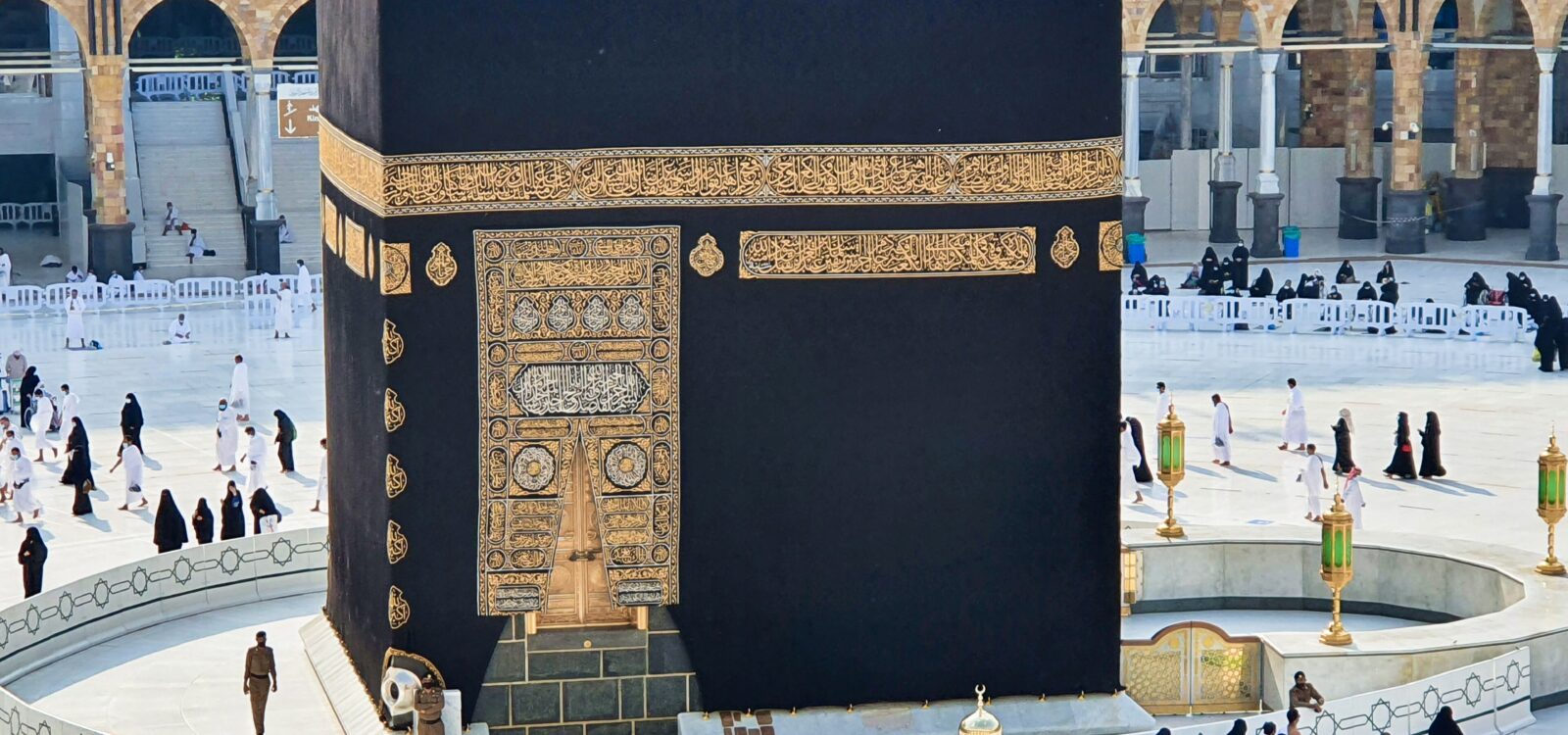
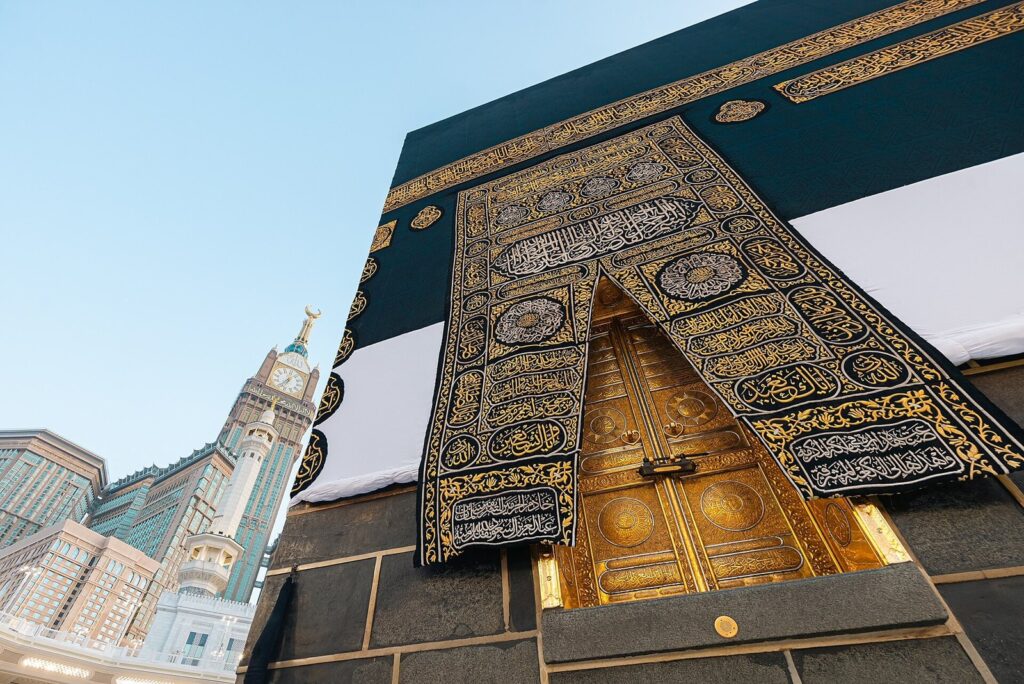
The door of the Kaaba is set high above the ground in the wall between the Black Stone and the Iraqi Corner. Plated with gold and decorated with verses, the door is opened on special occasions such as the washing of the Kaaba. It is generally not possible for Umrah and Hajj visitors to go inside.
The Multazam
The Multazam is the short section of wall between the Black Stone and the door of the Kaaba. The word means “the place that is clung to”, and it is known as one of the virtuous places where supplications are made. At busy times, rather than pushing to reach the Multazam, it is more appropriate to wait for a suitable moment or to make your supplication from where you are.
The Mizab ar-Rahmah (the golden spout)
The Mizab ar-Rahmah (the Spout of Mercy) is the spout on the northern side of the Kaaba that channels rainwater from the roof into the Hijr. Because of its gold plating it is popularly known as the “golden spout”, and it has been renewed in different periods. Visitors who pray and make supplication in the Hijr take a particular interest in the section just below the spout.
The Hijr (Hatim)
The Hijr, also known as the Hijr Ismail or the Hatim, is the area on the northern side of the Kaaba, between two of its corners, enclosed by a low semicircular wall. Part of this area is counted as belonging to the original Kaaba. For this reason, tawaf is performed by walking around the outside of the Hijr; a circuit made by passing through the Hijr remains incomplete. Since the hadith narrated from Aisha states that the Hijr is part of the House (al-Bayt), praying here when possible is regarded as virtuous; entry is regulated from time to time by the staff.
The Shadharwan
The Shadharwan is the sloping marble base that protrudes outwards at the bottom of the walls of the Kaaba; the rings at the lower edge of the Kaaba’s covering are also fastened to it. Because some scholars count the Shadharwan as part of the Kaaba, the cautious course is not to step onto it during tawaf and to walk outside this base as well.
Places Around the Kaaba
Some places in the immediate surroundings of the Kaaba are also directly connected with tawaf and with visiting.
The Station of Ibrahim (Maqam Ibrahim)
The Station of Ibrahim is the stone bearing footprints on which Ibrahim is narrated to have stood while building the Kaaba. Today it stands opposite the door of the Kaaba, inside a protective casing. The Holy Quran says, “Take the Station of Ibrahim as a place of prayer” (al-Baqarah 2:125). If possible, it is virtuous to perform the two rak’ahs of the tawaf prayer offered after tawaf behind this station.
The Mataf
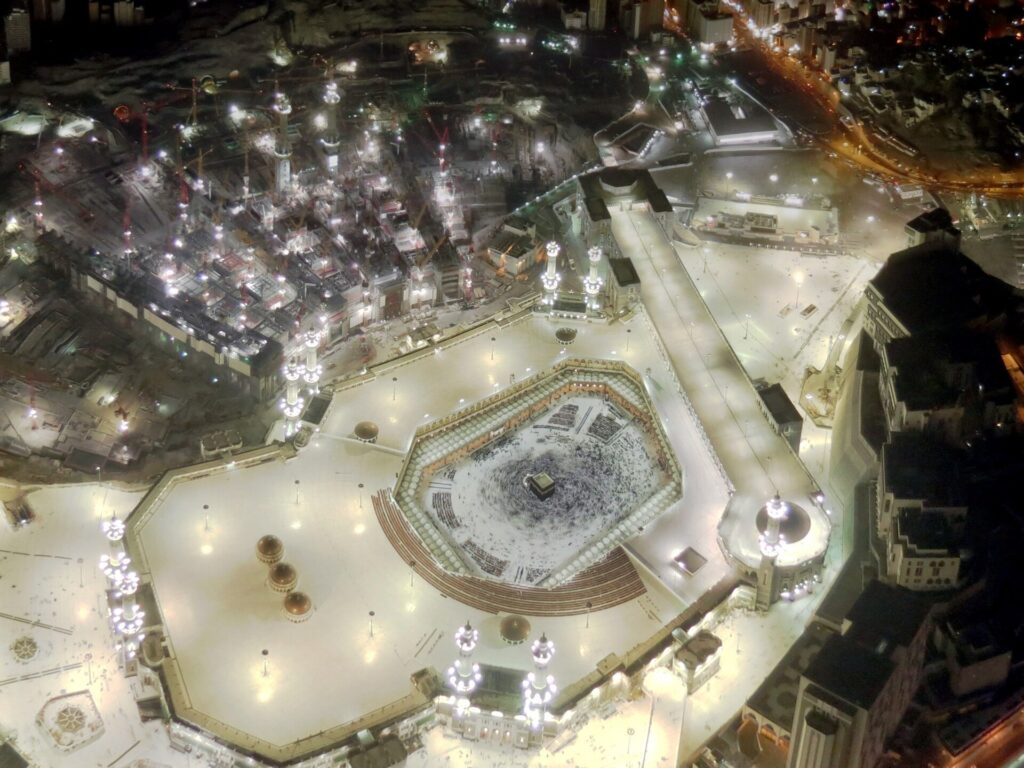
The Mataf is the area around the Kaaba where tawaf is performed. Thanks to the expansions of Masjid al-Haram, tawaf can now be performed on the upper floors as well as on the ground floor. Although the tawaf distance is longer on the upper floors, they can be a comfortable option for those who are affected by the crowds. Which floors are open for tawaf at which times is regulated by the staff.
The Zamzam well
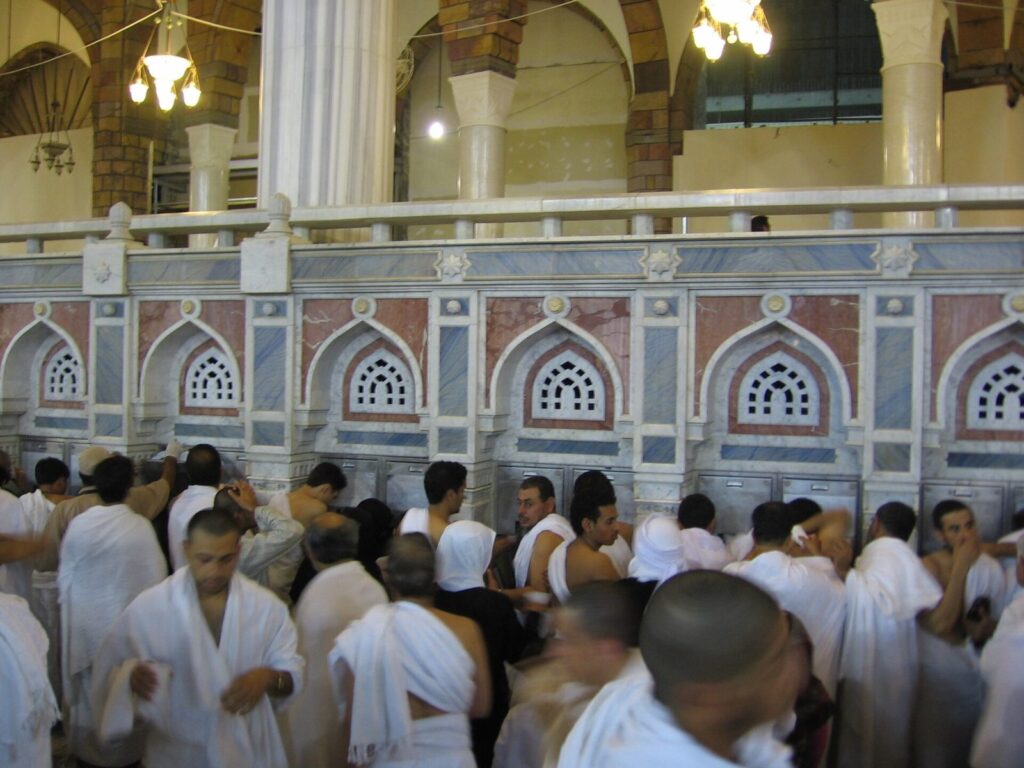
The Zamzam well is located on the eastern side of the Kaaba, beneath the Mataf. In the past, it was possible to go down to the site of the well through a separate entrance; today this area is not open to visitors. Zamzam water can be drunk from the containers at many points in the Haram. It is narrated that the Prophet (peace be upon him) said, “Zamzam is for whatever purpose it is drunk” (Ibn Majah).
The kiswah (the covering of the Kaaba)
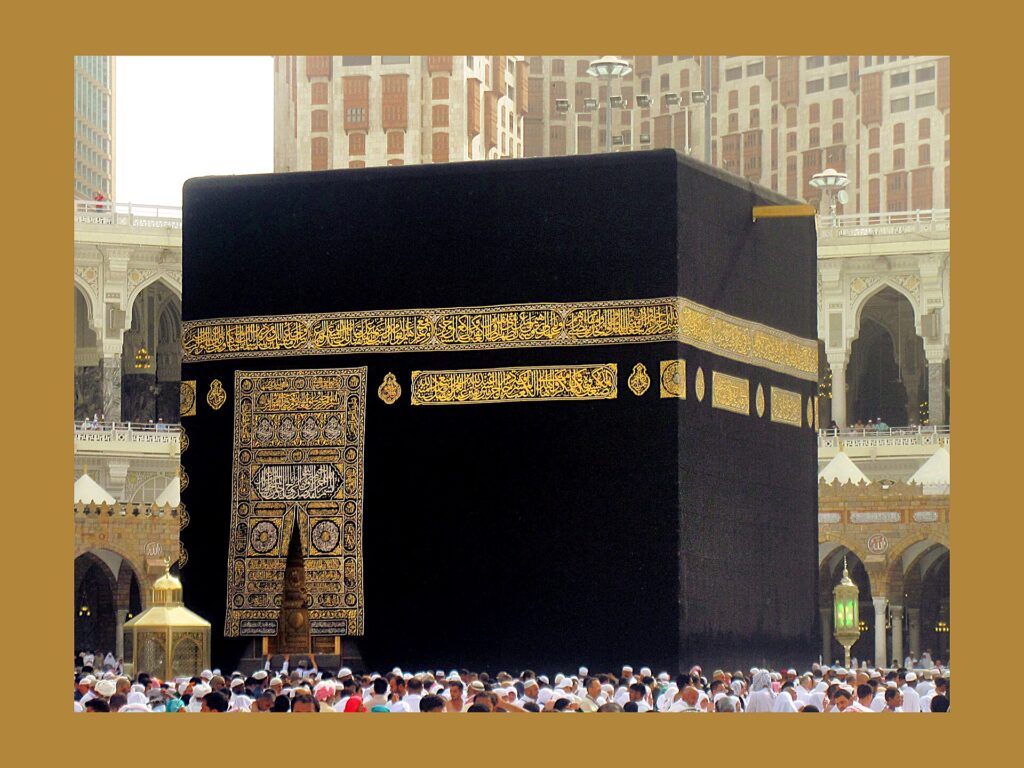
The kiswah is the black covering that drapes the Kaaba, with verses embroidered on it in gold thread. The embroidered band that encircles the upper part of the covering is known as the “hizam” (belt). The tradition of covering the Kaaba goes back a very long way. In the Ottoman period, carefully preparing the kiswah and sending it to Makkah with ceremonies became a deep-rooted tradition, and this spirit of reverence for and service to the Kaaba has continued in different forms to the present day. Today the kiswah is renewed every year at a set time.
How Are the Parts of the Kaaba Related to Tawaf?
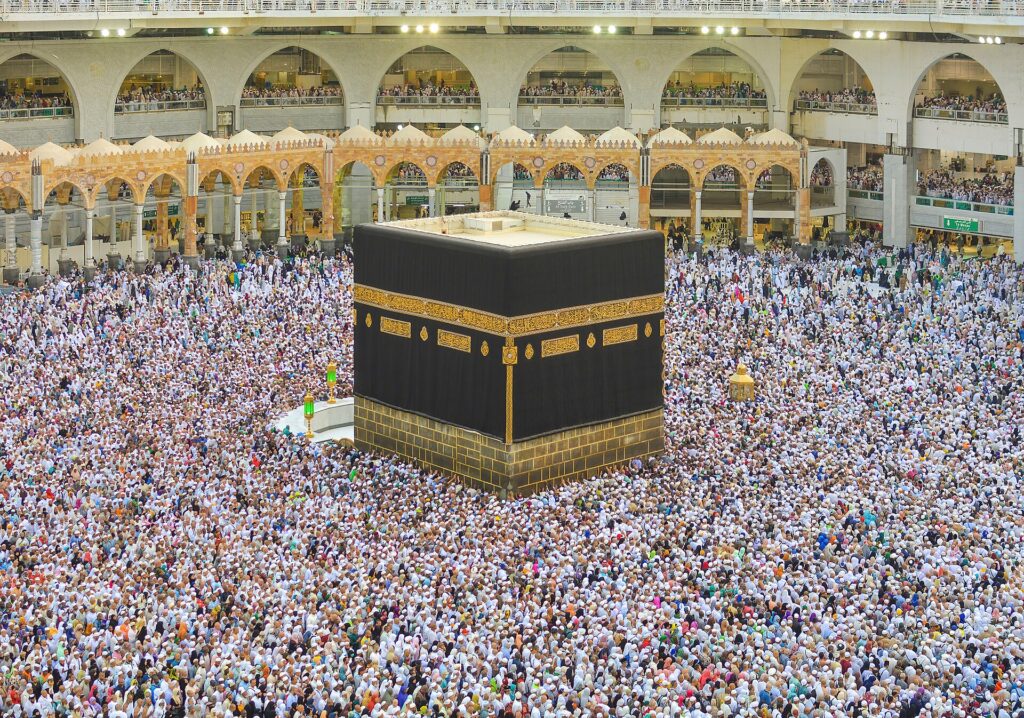
Tawaf begins in line with the Black Stone and is performed as seven circuits with the Kaaba on your left. In each circuit you pass the door of the Kaaba, the Iraqi Corner, the outside of the Hijr, the Levantine Corner and the Yemeni Corner, and arrive back in line with the Black Stone. When tawaf is finished, two rak’ahs of the tawaf prayer are performed, and then Zamzam is drunk.
- Come in line with the Black Stone and make the intention (niyyah) for tawaf; the markers in the Haram help you find the starting point.
- Greet the Black Stone by pointing to it with your hand from a distance (istilam) and begin tawaf.
- Walk with the Kaaba on your left; do not pass through the Hijr.
- Between the Yemeni Corner and the Black Stone, recite the supplication “Rabbenâ âtinâ”.
- After completing the seven circuits, perform the tawaf prayer and drink Zamzam.
You can find all the steps of Umrah in our article on how to perform Umrah, and the supplications that can be recited during tawaf and sa’i in our article on supplications to recite during Umrah.
Common Questions About the Kaaba
Can you go inside the Kaaba?
The door of the Kaaba is opened only on special occasions and for a limited number of people. It is generally not possible for Umrah or Hajj visitors to go inside. Those who wish to attain the virtue of praying inside the Kaaba can pray in the Hijr when they get the chance.
Is it obligatory to kiss the Black Stone?
No, kissing or touching the Black Stone is not a condition of tawaf. In the crowd, it is sufficient to greet it by pointing with your hand from a distance. Pushing in a way that harms others is not the right way to behave, even when it is done with the intention of fulfilling the Sunnah.
Must the tawaf prayer be performed behind the Station of Ibrahim?
No. If possible, performing it behind the Station of Ibrahim is virtuous, but this is not a condition. When it is crowded, the tawaf prayer can be performed at any suitable place in Masjid al-Haram. What matters is not to obstruct the flow of those performing tawaf.
When is the covering of the Kaaba changed?
The kiswah is renewed every year on a set date. As the timing and procedure of the change are determined by the Saudi authorities, it is best to follow the official announcements for up-to-date information.
Getting to Know the Kaaba Before You Visit
Every corner of the Kaaba and every place around it bears traces of the lives of the prophets and of Islamic history. Learning about these parts in advance makes it easier to find your bearings the moment you first enter the Haram and to perform your worship in greater peace. For the other blessed places in Makkah, you can also take a look at our article on places to visit in Makkah.
Up-to-Date Notes for Those Visiting the Kaaba in 2026–2027
Although getting to know the Kaaba and the places around it matters just as much in every period, visiting arrangements, crowd management and some traditions can change over time. Below we have gathered the key current points for visitors entering the new Umrah season with the Hijri year 1448, which began in mid-June 2026.
When the kiswah is changed
For a long time the covering of the Kaaba was changed on the Day of Arafah, but since 2022 it has been renewed every year at the start of the Hijri year, that is, on 1 Muharram. In line with this practice, the kiswah was also renewed at the start of the Hijri year 1448; the next change is expected to take place at the start of the Hijri year 1449. For the exact date, it is best to follow the announcements of the Saudi authorities.
Practical tips by period
As the crowds in the Haram vary from period to period, the chance of getting close to points such as the Black Stone, the Yemeni Corner, the Hijr and the Station of Ibrahim varies to the same extent. The tips below can help you see the parts of the Kaaba more comfortably and complete your tawaf in peace, depending on the period in which you travel.
- The three sacred months and the blessed nights (kandil) (December 2026 – January 2027): The number of worshippers in the Haram may increase; rather than pushing around the Black Stone and the Multazam, choose to greet from a distance and to make your supplications from where you are.
- The mid-year school holiday in Türkiye (second half of January 2027): Families travelling with children can make the visit educational by explaining the corners of the Kaaba, the Hijr and the Station of Ibrahim through photographs before the journey.
- Ramadan (expected to begin in the first half of February 2027): The ground floor of the Mataf can be very crowded; performing tawaf on the upper floors offers a more comfortable option, especially for elderly people. Entry to the Hijr may also be restricted by the staff during this period.
- The Hajj period (expected to fall in mid-May 2027): Entry to the holy sites is restricted for those without a Nusuk card and a Hajj permit; plan your Umrah with this calendar in mind.
In previous years, the issuing of new Umrah visas was temporarily suspended before Hajj, from the middle of the month of Shawwal; a similar practice can be expected in 2027. For this reason, those thinking of travelling in the spring months need to confirm the current conditions with official sources and travel agencies before their journey. To decide which period suits you, you can refer to our article on when to go for Umrah, and for accommodation options close to the Haram, to our Makkah hotels page.
Keep reading
- The Zamzam Well: Its Story, Location and Present Condition
- The Prophet’s Mosque (Masjid an-Nabawi): Its History, Gates and Visiting
- Where Is the Cave of Hira? Jabal an-Nour and the Story of the First Revelation
If you would like to plan your Umrah journey with a guide, you can explore RotaNur’s Umrah tours, and for any questions on your mind you can reach us through our contact page or our WhatsApp line. May Allah grant us all the chance to visit His House (Baytullah).
Frequently Asked Questions
Why is the door of the Kaaba set high above the ground?
The height of the Kaaba’s door above the ground goes back to the construction carried out by the Quraysh. According to the narration of Aisha, the Prophet (peace be upon him) stated that his people had raised the door so that they could let in whomever they wished and keep out whomever they did not (Bukhari, Muslim). In the time of Abdullah ibn al-Zubayr the door was lowered to ground level, and in the time of al-Hajjaj it was raised again. Today, on the special occasions when it is opened, the door is reached by a mobile staircase that is brought up to it.
Who holds the key to the Kaaba?
The key to the Kaaba is traditionally held by the Banu Shaybah (the Shaybi family). According to the sources of the sirah, at the conquest of Makkah the Prophet (peace be upon him) gave the key of the Kaaba back to Uthman ibn Talha, and this service was left to that family. The presence of a member of this family on special occasions, such as the opening of the door of the Kaaba and the washing of its interior, is a tradition that has been maintained for centuries.
Can you touch the covering of the Kaaba while in ihram?
Touching the covering of the Kaaba is not in itself considered one of the ihram restrictions; however, care is needed, because fragrance is applied from time to time to the covering and to the Black Stone. According to the Hanafi school, applying fragrance while in ihram is forbidden, and a person whose hand picks up fragrance may be liable to a penalty depending on the circumstances. For this reason, greeting from a distance in the crowd is the more cautious course. For details, see our article on ihram restrictions.
How do you make supplication at the Multazam?
There is no specific supplication text that must be recited at the Multazam; you may make whatever supplication you wish in your own language. If the crowd allows, you can approach this wall between the Black Stone and the door of the Kaaba; if it does not, you can make your supplication from where you are. Pushing and cutting across the flow of those performing tawaf is not appropriate; beginning your supplication with praise of Allah (hamd) and blessings on the Prophet (salawat) is good etiquette. For other places where supplications are hoped to be accepted, see our article on places where supplications are accepted.
Why is the Black Stone in a silver frame?
Because of the damage it has suffered throughout history, the Black Stone has been placed in a silver frame to hold its pieces together and protect it. The period in which the Qarmatians carried the stone away for a time is also remembered among these difficult episodes. The frame has been renewed in different periods. Visitors can see the stone through the opening in the middle of the frame; in the crowd, it is sufficient to greet it by pointing with your hand from a distance.

Cihat Murat Yüksel is the editor of the RotaNur blog and the founder of Markention. Drawing on the sources of Türkiye's Presidency of Religious Affairs (Diyanet), he turns the questions travellers ask most about preparing for Umrah, Hajj and halal travel into clear, practical guides.
Questions answered in this article
How Are the Parts of the Kaaba Related to Tawaf?
Tawaf begins in line with the Black Stone and is performed as seven circuits with the Kaaba on your left. In each circuit you pass the door of the Kaaba, the Iraqi Corner, the outside of the Hijr, the Levantine Corner and the Yemeni Corner, and arrive back in line with the Black Stone. When tawaf is finished, two rak’ahs of the tawaf prayer are performed, and then Zamzam is drunk.
Can you go inside the Kaaba?
The door of the Kaaba is opened only on special occasions and for a limited number of people. It is generally not possible for Umrah or Hajj visitors to go inside. Those who wish to attain the virtue of praying inside the Kaaba can pray in the Hijr when they get the chance.
Is it obligatory to kiss the Black Stone?
No, kissing or touching the Black Stone is not a condition of tawaf. In the crowd, it is sufficient to greet it by pointing with your hand from a distance. Pushing in a way that harms others is not the right way to behave, even when it is done with the intention of fulfilling the Sunnah.
Must the tawaf prayer be performed behind the Station of Ibrahim?
No. If possible, performing it behind the Station of Ibrahim is virtuous, but this is not a condition. When it is crowded, the tawaf prayer can be performed at any suitable place in Masjid al-Haram. What matters is not to obstruct the flow of those performing tawaf.
When is the covering of the Kaaba changed?
The kiswah is renewed every year on a set date. As the timing and procedure of the change are determined by the Saudi authorities, it is best to follow the official announcements for up-to-date information.