








Contents 23 sections
- What Is the Ruling on Umrah?
- The obligatory and necessary acts of Umrah
- Miqat Points and Entering Ihram
- Where do those flying from Türkiye to Jeddah enter ihram?
- What to do before entering ihram
- How are the intention and talbiyah made?
- What Are the Ihram Restrictions?
- How Is Tawaf Performed?
- The Black Stone line and istilam
- Idtiba and raml for men
- The tawaf prayer and Zamzam
- Completing Umrah with Sa’i and Shaving
- How is sa’i performed?
- Shaving and leaving ihram
- Notes for Women
- What Are the Common Mistakes in Umrah?
- Visiting Madinah and the Rawdah Permit
- How do you get a permit to visit the Rawdah?
- Current Notes for Those Performing Umrah in the 2026–2027 Season
- Keep track of the last Umrah dates before Hajj
- What to prepare before you set off
- Keep reading
- Frequently Asked Questions
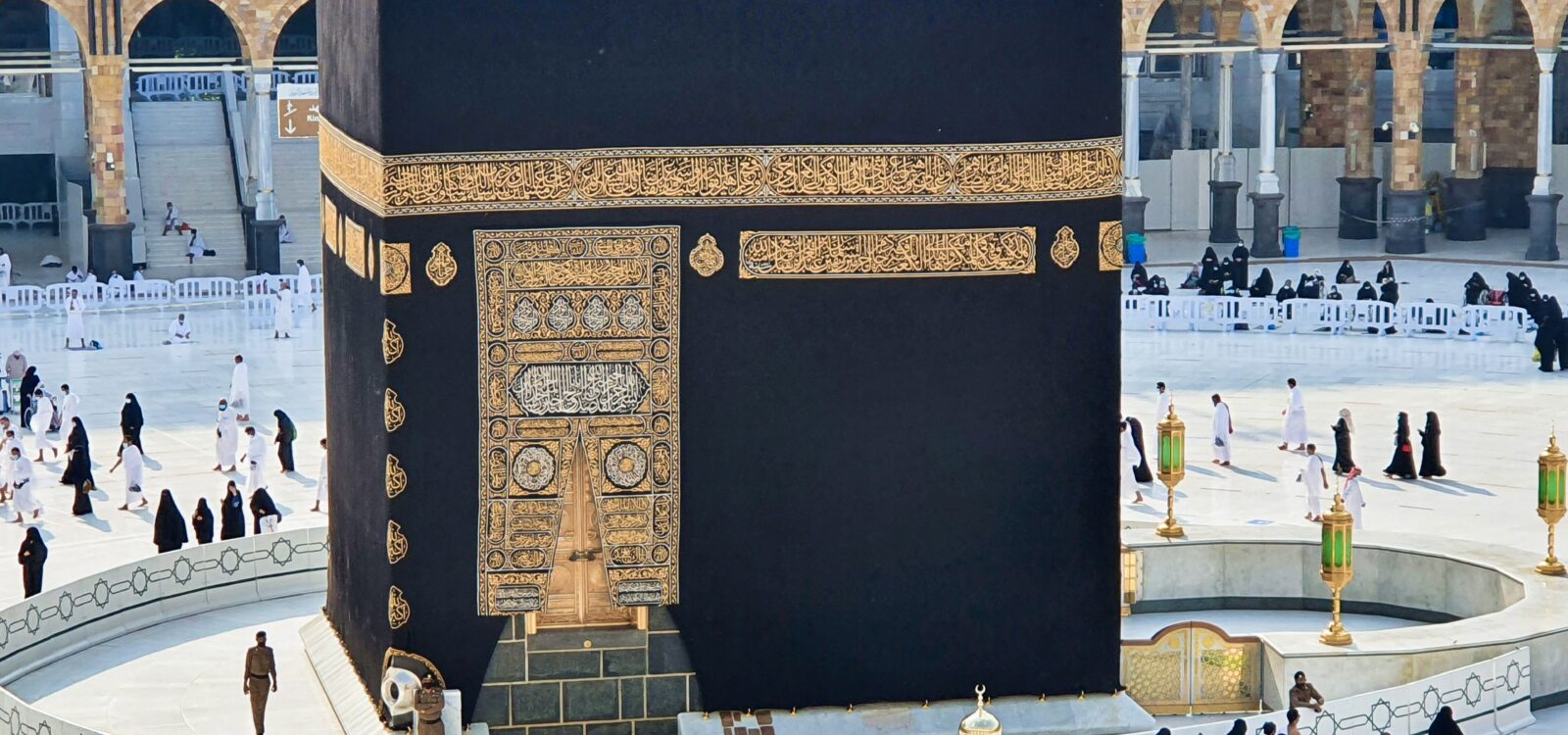
How to perform Umrah is the first question that comes to mind for almost everyone travelling to the Kaaba for the first time. Umrah is an act of worship that can be performed for most of the year; it consists of entering ihram at the miqat, performing tawaf around the Kaaba, performing sa’i between Safa and Marwah, and leaving ihram by shaving or trimming the hair. In this guide, based on the guidance of Diyanet (Türkiye’s Presidency of Religious Affairs), we explain every step in plain language and in order, from the ruling on Umrah and the ihram restrictions to tawaf and shaving.
What Is the Ruling on Umrah?
According to the Hanafi school, Umrah is an emphasised Sunnah to be performed once in a lifetime. According to the Shafi’i and Hanbali schools, however, it is obligatory (fard) once in a lifetime for those who are able. Also popularly known as the “lesser Hajj”, Umrah does not take the place of the obligatory Hajj.
We cover the differences in ruling, timing and rites between the two acts of worship in detail in our article on the differences between Hajj and Umrah.
The obligatory and necessary acts of Umrah
Umrah has two obligatory (fard) acts: ihram and tawaf. Ihram is the precondition of Umrah, while tawaf is its pillar. The necessary (wajib) acts of Umrah are the sa’i performed between Safa and Marwah and the shaving or trimming of the hair (halq/taqsir) done to leave ihram. If one of the obligatory acts is not fulfilled, the Umrah is not complete; leaving out a necessary act without a valid excuse requires a penalty sacrifice (dam). For the details of situations that require a penalty, we recommend consulting Diyanet’s current fatwas.
Miqat Points and Entering Ihram
The miqat is the boundary that those coming to Makkah with the intention of Umrah or Hajj must not cross without being in ihram. The five miqat points set by the Prophet (peace be upon him) are as follows:
- Dhul Hulayfah (Abyar Ali): The miqat for those coming from the direction of Madinah. Those travelling on to Makkah after visiting Madinah usually enter ihram here.
- Al-Juhfah: The miqat for those coming from the direction of the Levant (Sham), Egypt and Türkiye. Today, most people coming from this direction enter ihram at nearby Rabigh.
- Qarn al-Manazil: The miqat for those coming from the direction of Najd.
- Yalamlam: The miqat for those coming from the direction of Yemen.
- Dhat Irq: The miqat for those coming from the direction of Iraq.
Where do those flying from Türkiye to Jeddah enter ihram?
Because Jeddah lies inside the miqat boundaries, those flying directly from Türkiye to Jeddah and travelling on to Makkah from there must enter ihram before the plane reaches the level of the miqat. As changing clothes on the plane is difficult, the ihram garments can be put on at home or at the airport. The intention and talbiyah, however, are made on the plane before the level of the miqat is reached; travellers are usually reminded of this moment by the guide or the cabin crew.
What to do before entering ihram
- Trim the nails, remove unwanted body hair and take a full ritual bath (ghusl); if this is not possible, performing wudu is sufficient.
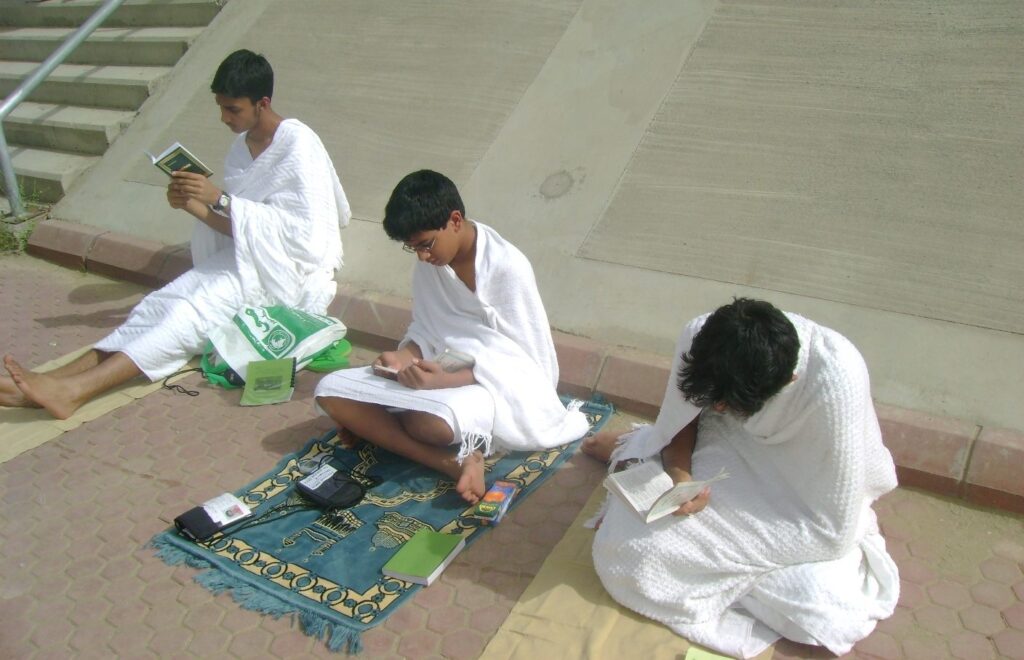
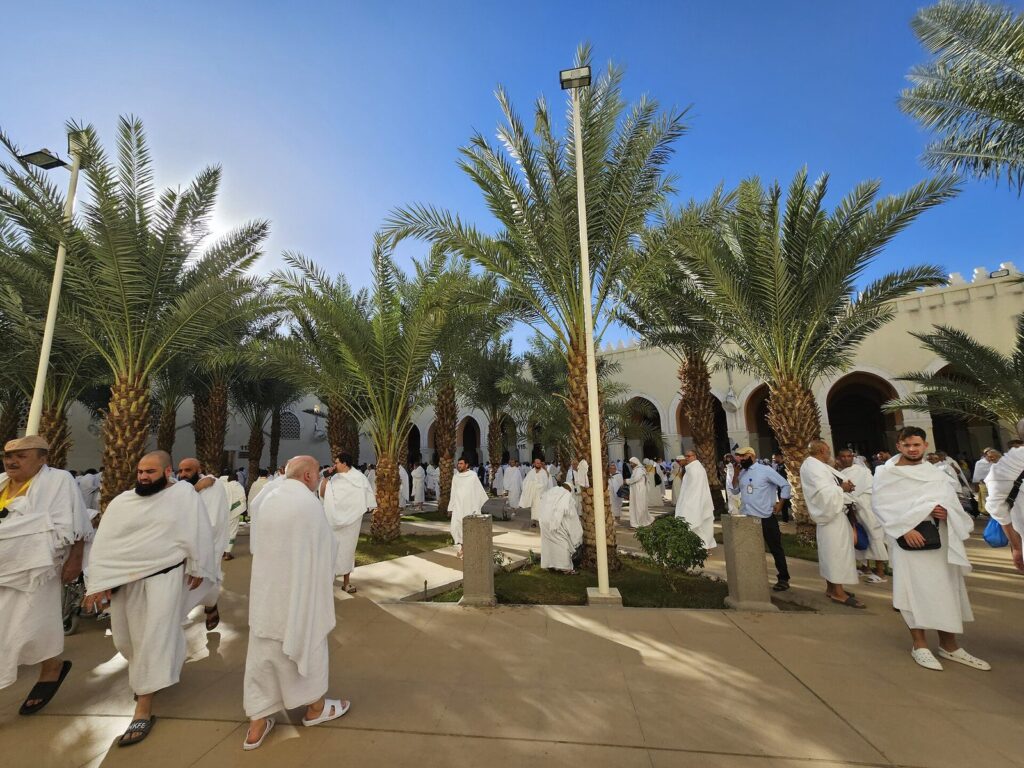
- Men wrap themselves in two unstitched pieces of ihram cloth: one is wrapped from the waist down (izar), and the other is placed over the shoulders (rida).
- If it is not a disliked (makruh) prayer time, two rak’ahs of ihram prayer are performed.
You can find essentials such as ihram garments, ihram belts and unscented hygiene products on our Umrah essentials page, and for thorough preparation you can take a look at our Umrah packing list.
How are the intention and talbiyah made?
The intention (niyyah) is made in the heart and spoken with the tongue, with a meaning along the lines of: “O Allah, I intend to perform Umrah for Your sake; make it easy for me and accept it from me.” The talbiyah is recited immediately after the intention, and from this moment on the person is considered to be in ihram. The talbiyah is repeated frequently until one reaches Masjid al-Haram and begins tawaf.
The talbiyah is as follows: “Labbayk Allahumma labbayk. Labbayka la sharika laka labbayk. Innal-hamda wan-ni’mata laka wal-mulk. La sharika lak.”
What Are the Ihram Restrictions?
A person who has entered ihram refrains from certain acts until they leave ihram by shaving or trimming the hair. Violating these restrictions without a valid excuse may, depending on the type of violation, require penalties such as charity (sadaqah) or a sacrifice.
- Cutting or plucking the hair of the head, the beard or the body, and cutting the nails
- Applying fragrance to the body, clothing or ihram garments; using scented soap, shampoo and wet wipes
- For men: wearing stitched clothing, covering the head, and wearing shoes that cover the heel and the top of the foot
- For women: covering the face in such a way that the cloth touches it
- Hunting land animals, and picking trees and plants within the Haram boundaries
- Intimacy between spouses, vulgar speech, arguing and fighting
How Is Tawaf Performed?
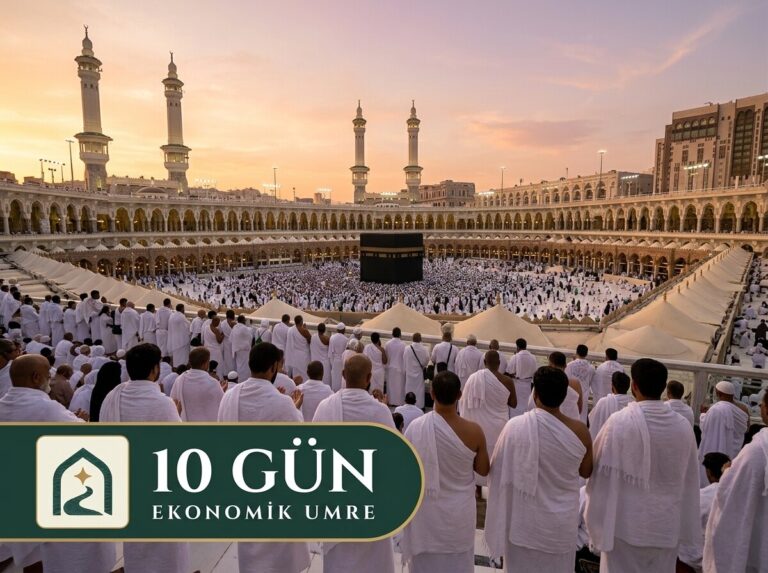
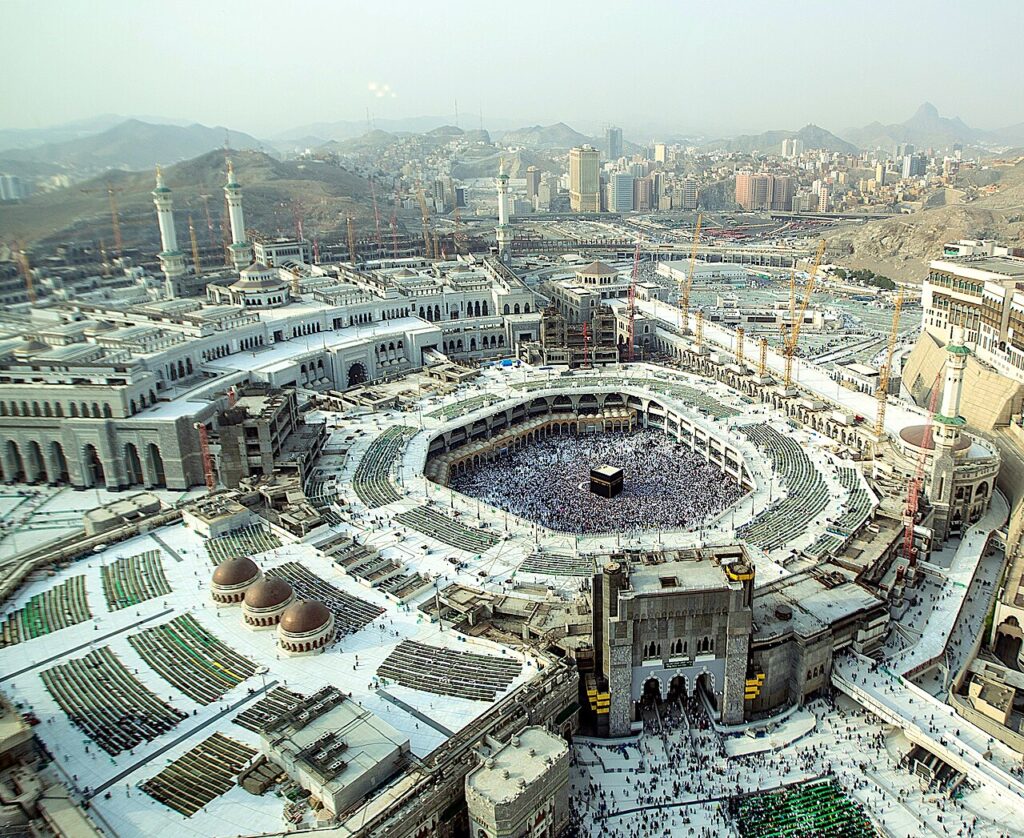
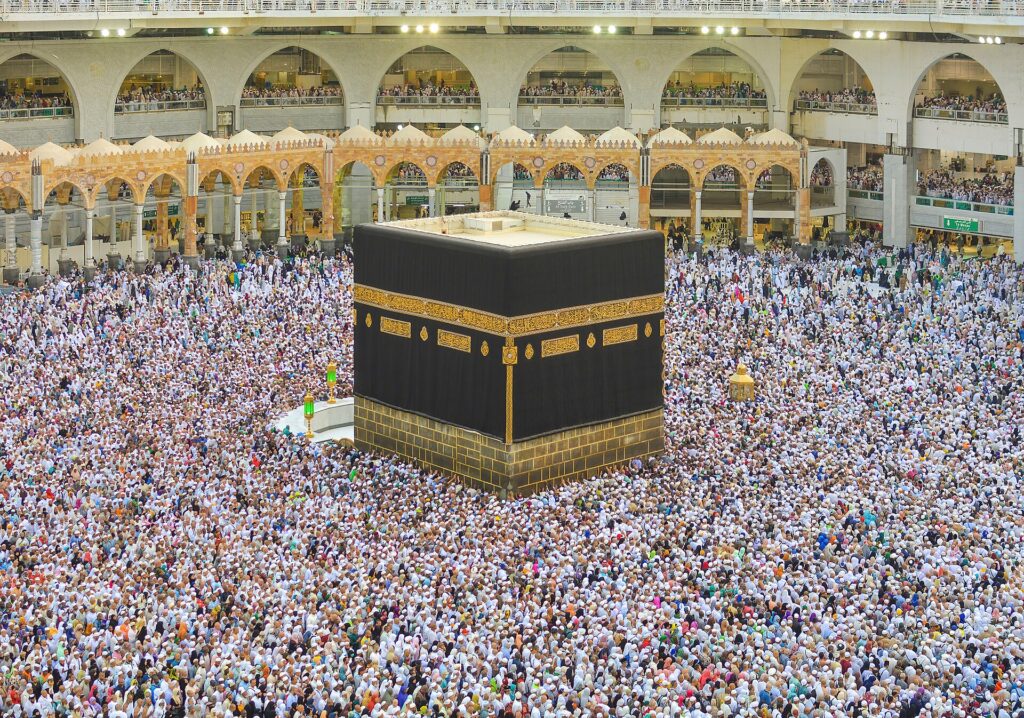
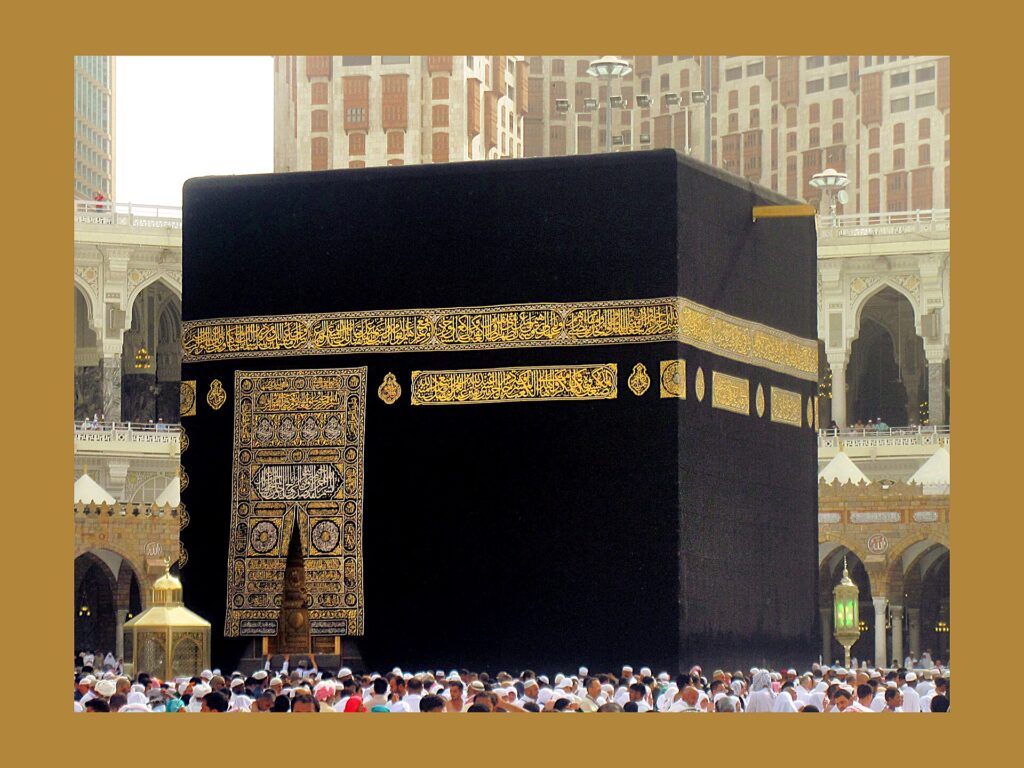
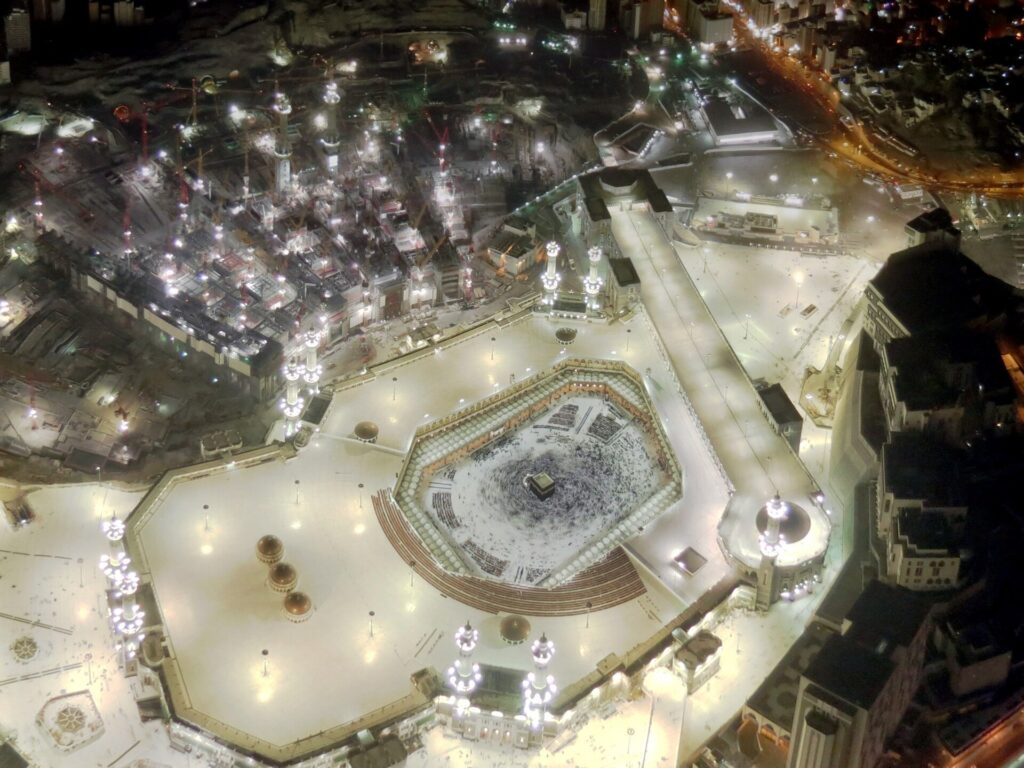
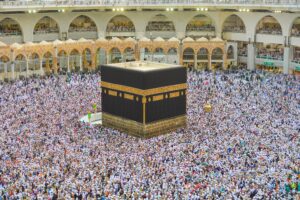
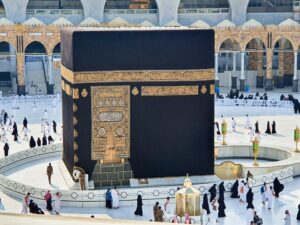
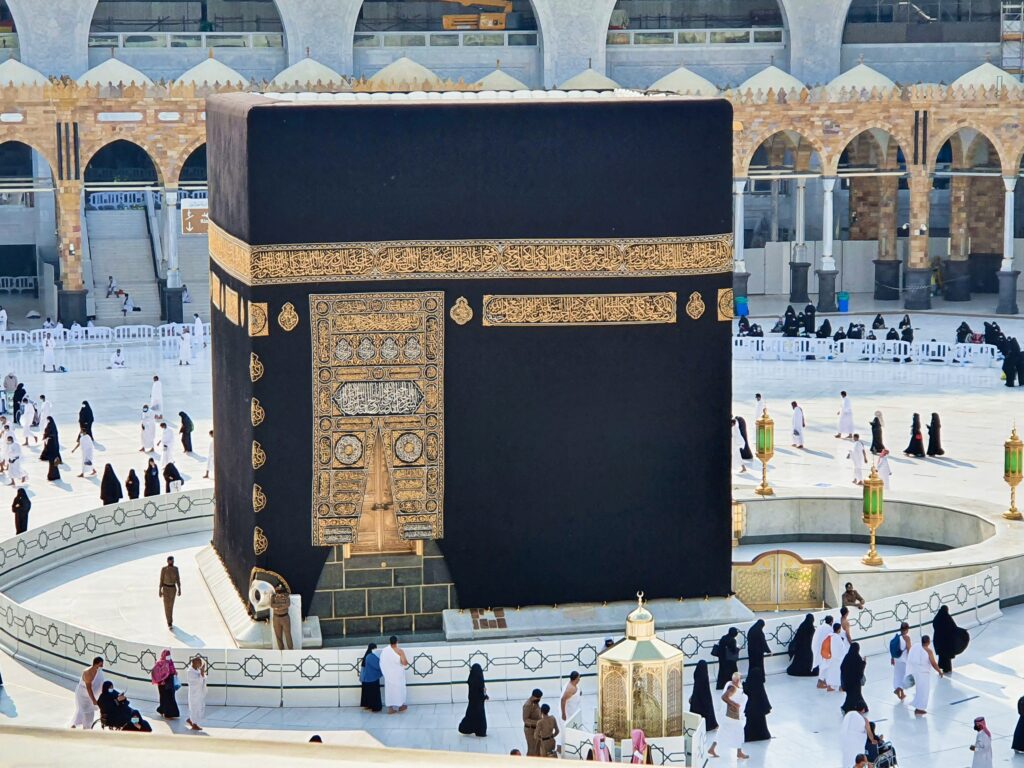
Tawaf means walking around the Kaaba seven times, and each circuit is called a shawt. Tawaf is begun in a state of wudu, and one walks with the Kaaba on the left-hand side.
The Black Stone line and istilam
Tawaf begins in line with the corner where the Black Stone is located, and each circuit is completed at this same line. At the start, one turns towards the Black Stone, raises the hands to ear level with the palms facing it, says “Bismillâhi Allâhu ekber” and kisses the hand; this is called istilam. In a crowd there is no need to try to touch the stone; istilam performed by gesturing from a distance is sufficient. Istilam is repeated at the start of each circuit.
Idtiba and raml for men
In a tawaf that will be followed by sa’i, men pass the end of the ihram cloth under the right armpit and throw it over the left shoulder, leaving the right shoulder bare; this is called idtiba. In the first three circuits, men walk briskly with short steps, their shoulders moving slightly; this is called raml. During tawaf, one must walk around the outside of the semicircular area called the Hijr Ismail (Hatim), not through it.
The tawaf prayer and Zamzam
Once the seven circuits are complete, two rak’ahs of tawaf prayer are performed. If possible, this prayer is performed behind the Station of Ibrahim (Maqam Ibrahim); if it is crowded, it is sufficient to perform it at any suitable place in Masjid al-Haram. After the prayer, one drinks Zamzam and, if the opportunity arises, makes supplication at the Multazam, between the Black Stone and the door of the Kaaba.
Completing Umrah with Sa’i and Shaving
After tawaf, the two necessary (wajib) acts of Umrah, sa’i and shaving or trimming the hair, are fulfilled. Once these two steps have also been completed, the Umrah is finished.
How is sa’i performed?
Sa’i means walking back and forth between the hills of Safa and Marwah seven times. It begins at Safa and ends at Marwah; going from Safa to Marwah counts as one circuit, and returning from Marwah to Safa counts as the second. Sa’i is performed after tawaf, and although being in a state of wudu is not a condition, it is recommended.
On climbing Safa, one turns towards the Kaaba, recites the takbir and tahlil, and makes supplication. In the section of the route marked with green lights, men walk at a brisk pace; this is called harwalah. Women continue walking at their normal pace in this section.
Shaving and leaving ihram
After sa’i, one leaves ihram by shaving or trimming the hair. For men, shaving the head completely (halq) is more virtuous; shortening the hair from the ends (taqsir) is also permissible. According to the Hanafi school, taqsir requires cutting a fingertip’s length (one finger joint) from at least a quarter of the head; cutting a few strands is not sufficient. With the shaving or trimming, the ihram restrictions come to an end and the Umrah is complete.
Notes for Women
The steps of Umrah are largely the same for women and men; however, there are differences in some practices.
- Women wear their normal clothing that complies with Islamic dress; their heads are covered and their faces are left uncovered.
- They do not recite the talbiyah aloud; they do not perform raml or idtiba in tawaf, or harwalah in sa’i.
- For the hair-cutting, it is sufficient for them to cut a fingertip’s length from the ends of their hair; they do not shave their heads.
- Women who are menstruating or experiencing postnatal bleeding (nifas) may enter ihram; however, they perform tawaf after they have become pure.
For situations such as menstruation coinciding with an approaching return date, and for matters on which the schools of thought differ, such as wearing gloves, consult Diyanet’s current fatwas. As the age and companion rules for women’s travel change from time to time, confirm the current conditions before you travel.
What Are the Common Mistakes in Umrah?
Most of the mistakes made during Umrah stem from a lack of knowledge and can easily be prevented with a little preparation. The most common are crossing the miqat without ihram, performing tawaf through the Hatim, and not cutting enough of the hair. We recommend reviewing the list below before you set off.
- Missing the level of the miqat on the plane and crossing it without ihram
- Using scented shampoo, soap or wet wipes while in ihram
- Pushing and shoving in order to touch the Black Stone
- Performing tawaf with the Kaaba on the right-hand side, or losing count of the circuits
- Starting sa’i at Marwah, or performing sa’i before tawaf
- Leaving ihram after cutting only a few strands of hair
- Focusing on taking photos during worship and disrupting the flow and one’s devotion
If you fall into doubt about the number of circuits in tawaf or sa’i, it is recommended that you continue on the basis of the lower number.
Visiting Madinah and the Rawdah Permit
Visiting Madinah is not part of Umrah; however, visiting the Prophet’s Mosque (Masjid an-Nabawi), the mosque of our beloved Prophet, is one of the most precious stops of an Umrah journey. Programmes are planned according to whether Madinah is visited before or after Makkah. Those who go to Madinah first enter ihram at the Dhul Hulayfah (Abyar Ali) miqat on their way to Makkah.
How do you get a permit to visit the Rawdah?
To pray in and visit the Rawdah, an appointment (permit) must be obtained through Nusuk, the official application of the Saudi authorities. As appointments are limited, it helps to plan early. Since the way the application works and its rules may change, confirm the current conditions before you travel.
For information about Quba Mosque, Mount Uhud and other places to visit, you can read our article on places to visit in Madinah.
Current Notes for Those Performing Umrah in the 2026–2027 Season
Hajj 2026 was completed at the end of May, and the Hijri year 1448 began in mid-June 2026. The Umrah season, which picked up again after Hajj, covers a long period that extends up to Hajj 2027. When choosing dates during this period, you need to take into account not only your days off but also the crowds in Makkah and Madinah and any arrangements that may be applied before Hajj. The table below summarises the main periods we at RotaNur consider when planning programmes; the dates are approximate. For those going for the first time, choosing quieter periods makes it easier to perform the rites without rushing.
| Period | Approximate timing | Planning note |
|---|---|---|
| Autumn period | September – November 2026 | Generally a relatively quiet period; as temperatures are still high in September and October, it helps to plan acts of worship for the cooler hours. |
| The three sacred months and holy nights | December 2026 – January 2027 | The holy nights of Raghaib, Mi’raj and Bara’ah fall within this period; as demand rises, early planning is needed. |
| Semester break | Second half of January 2027 | Convenient for families and teachers; places can fill up quickly. |
| Ramadan | First half of February 2027 – early March 2027 | The last ten days are the busiest time; a calm pace suited to a day of fasting should be chosen. |
| Pre-Hajj period | After Eid al-Fitr | In previous years, the issuing of new Umrah visas was temporarily suspended from the middle of Shawwal onwards. |
Keep track of the last Umrah dates before Hajj
Hajj 2027 is expected to fall in mid-May 2027; the exact date will become clear with the Diyanet calendar and the announcement of the Saudi authorities. In previous years, the issuing of new Umrah visas was temporarily suspended before the Hajj season, and Umrah resumed after Hajj. As a similar practice may come onto the agenda for 2027, those planning Umrah for after Ramadan need to confirm current conditions with official sources and travel agencies. During the Hajj period, entry to the holy sites is restricted for those without a Nusuk card and a Hajj permit; we should also remind you that Hajj cannot be performed on an Umrah visa.
What to prepare before you set off
- The Nusuk app: Visits to the Rawdah are made by appointment through Nusuk, and limits may be placed on how often appointments can be made. Installing the app and setting up your account before you set off saves time on the ground.
- Intercity transport: The Haramain High-Speed Railway runs between Makkah and Madinah via Jeddah. On tour programmes, the mode of transport is determined by the flow of the programme; those planning independently will benefit from arranging their travel days accordingly.
- Free-day visits: The Hira Cultural District at the foot of Jabal al-Nour is open to visitors, together with its Revelation Exhibition. You can visit it in your free time after completing your Umrah; as visiting hours and entry conditions may change, it is worth getting information before you go.
- Health preparation: Saudi Arabia’s vaccination requirements may change from period to period. For questions about vaccinations and chronic conditions, consult your family doctor or the travel health centres of Türkiye’s Ministry of Health; you can find the general framework in our Umrah vaccination guide.
Whichever period you choose, reading the calendar correctly is as much a part of a peaceful Umrah as refreshing your knowledge of the rites. We compare the advantages and crowd levels of each period in detail in our article on when to go for Umrah. If you are undecided about dates, our team will be happy to help you choose the period that best suits your expectations.
Keep reading
- How to Perform Tawaf: Step-by-Step Tawaf and the Supplications to Recite
- How to Wear and Tie Ihram: A Guide for Men and Women
- What Are the Ihram Restrictions? Prohibitions, Penalties and Points to Note
When performed with correct knowledge and peace of heart, Umrah is a journey that leaves a deep mark on a person’s life. At RotaNur, we regard guidance on the rites as an integral part of the journey on our Umrah tours. For any question on your mind, you can reach us through our contact page or our WhatsApp line; we will be glad to help.
Frequently Asked Questions
How many hours does Umrah take?
Although it varies with the crowds, once you have entered ihram, the tawaf, the tawaf prayer, sa’i and shaving or trimming are usually completed within a few hours. Tawaf takes less time on the ground floor of the mataf, while the walking distance becomes noticeably longer on the upper floors. The time needed may increase during busy periods such as Ramadan and the semester break; if you are travelling with elderly relatives, allowing for breaks and choosing the hours when crowds are thinner will reduce fatigue.
Can you take a break between tawaf and sa’i?
Yes. According to the Hanafi school, taking a break between tawaf and sa’i does not affect the validity of the sa’i; what is in line with the Sunnah, however, is to move on to sa’i without waiting too long after performing the tawaf prayer and drinking Zamzam. You may take a break because of fatigue, prayer time or crowds. Remember that you are still in ihram during this time; the ihram restrictions continue until sa’i and shaving or trimming have been completed and you leave ihram.
Can you perform more than one Umrah on the same trip?
Yes. According to the Hanafi school, it is permissible to perform more than one Umrah on the same trip. A person staying in Makkah who wishes to perform a new Umrah goes outside the Haram boundary and enters ihram; for this purpose, the Aisha Mosque at Tan’im is the most common choice. The Umrah is then completed with tawaf, sa’i and shaving or trimming. We recommend that you plan any repeat Umrahs in line with the flow of the programme, looking after your health and without rushing your acts of worship.
Can Umrah be performed on any day of the year?
Umrah can be performed at almost any time of the year; however, according to the Hanafi school, performing Umrah on the Day of Arafah and during the four days of Eid al-Adha is makruh tahriman (strongly disliked). In addition, as the Saudi authorities may temporarily suspend the issuing of new Umrah visas before the Hajj season, those planning Umrah in the spring months need to confirm current conditions. You can find notes on the Hajj 2027 calendar in our article when is Hajj.
Is someone who has performed Umrah called a hajji?
In the terminology of Islamic jurisprudence, no; a hajji is someone who has performed Hajj, while a person who performs Umrah is referred to as a mu’tamir. Although people returning from Umrah are sometimes called hajji out of respect in everyday speech, Umrah does not take the place of the obligatory Hajj. A person who meets the conditions for Hajj is not released from this obligation by going on Umrah; we explain what these conditions are in our article on who Hajj is obligatory for.

Cihat Murat Yüksel is the editor of the RotaNur blog and the founder of Markention. Drawing on the sources of Türkiye's Presidency of Religious Affairs (Diyanet), he turns the questions travellers ask most about preparing for Umrah, Hajj and halal travel into clear, practical guides.
Questions answered in this article
What Is the Ruling on Umrah?
According to the Hanafi school, Umrah is an emphasised Sunnah to be performed once in a lifetime. According to the Shafi’i and Hanbali schools, however, it is obligatory (fard) once in a lifetime for those who are able. Also popularly known as the “lesser Hajj”, Umrah does not take the place of the obligatory Hajj.
Where do those flying from Türkiye to Jeddah enter ihram?
Because Jeddah lies inside the miqat boundaries, those flying directly from Türkiye to Jeddah and travelling on to Makkah from there must enter ihram before the plane reaches the level of the miqat. As changing clothes on the plane is difficult, the ihram garments can be put on at home or at the airport. The intention and talbiyah, however, are made on the plane before the level of the miqat is reached; travellers are usually reminded of this moment by the guide or the cabin crew.
How are the intention and talbiyah made?
The intention (niyyah) is made in the heart and spoken with the tongue, with a meaning along the lines of: “O Allah, I intend to perform Umrah for Your sake; make it easy for me and accept it from me.” The talbiyah is recited immediately after the intention, and from this moment on the person is considered to be in ihram. The talbiyah is repeated frequently until one reaches Masjid al-Haram and begins tawaf.
What Are the Ihram Restrictions?
A person who has entered ihram refrains from certain acts until they leave ihram by shaving or trimming the hair. Violating these restrictions without a valid excuse may, depending on the type of violation, require penalties such as charity (sadaqah) or a sacrifice.
How Is Tawaf Performed?
Tawaf means walking around the Kaaba seven times, and each circuit is called a shawt. Tawaf is begun in a state of wudu, and one walks with the Kaaba on the left-hand side.
How is sa’i performed?
Sa’i means walking back and forth between the hills of Safa and Marwah seven times. It begins at Safa and ends at Marwah; going from Safa to Marwah counts as one circuit, and returning from Marwah to Safa counts as the second. Sa’i is performed after tawaf, and although being in a state of wudu is not a condition, it is recommended.