













Contents 23 sections
- What Is Ihram? A Garment or a State?
- Why is the ihram garment unstitched?
- How Do Men Wear Ihram?
- How is ihram tied: should you knot it?
- Is it permissible to use an ihram belt?
- What Do You Wear Under Ihram?
- Can you wear underwear under ihram?
- What slippers or shoes can be worn in ihram?
- How Do Women Enter Ihram?
- Do women have to wear white in ihram?
- Can women wear gloves in ihram?
- Can women cover their face in ihram?
- Preparations Before Entering Ihram
- Can you use a hat or an umbrella while in ihram?
- Wearing Ihram on the Plane and at the Airport
- Where do you put on ihram?
- Do children wear ihram?
- Do you pray after putting on ihram?
- Choosing and Caring for Ihram Cloth
- How do you wash ihram?
- Arranging Ihram During Tawaf: Idtiba
- Common Mistakes When Wearing Ihram
- Frequently Asked Questions
How to wear ihram is one of the topics that men going on Umrah or Hajj for the first time find most challenging; wrapping two pieces of white cloth correctly may not be easy on the first attempt. In this guide, we explain in practical terms what ihram means, how men put on and secure the ihram garments step by step, what may and may not be worn under ihram, how women enter ihram, and how to choose and care for ihram cloth. On religious rulings, we have followed the approach of Diyanet (Türkiye’s Presidency of Religious Affairs) and the Hanafi school, and we note separately the matters on which the schools of thought differ.
What Is Ihram? A Garment or a State?
In everyday language, the word “ihram” brings two pieces of white cloth to mind for most of us; in Islamic jurisprudence, however, ihram means making the intention for Hajj or Umrah and reciting the talbiyah, thereby temporarily forbidding oneself certain otherwise permissible (halal) acts. For men, the white garments are the outward expression of this state. In short, putting on the garments does not by itself mean entering ihram; a person who has put on the garments but has not made the intention is not yet considered to be in ihram.
This distinction matters in practice. The garments can be put on at home, at the hotel or at the airport; the intention and talbiyah, however, are made before the miqat boundary is crossed. We cover how to make the intention and the words to be recited separately in our article on the intention for ihram. In this article, we focus more on the “getting dressed” side of things.
Why is the ihram garment unstitched?
The fact that men do not wear stitched clothing in ihram is based on the practice the Prophet (peace be upon him) taught when he listed the garments a person in ihram may not wear (Bukhari, Muslim). “Stitched” here means clothing that has been cut and sewn to fit the body or a limb; a simple hem stitch along the edge of the cloth does not invalidate ihram.
How Do Men Wear Ihram?
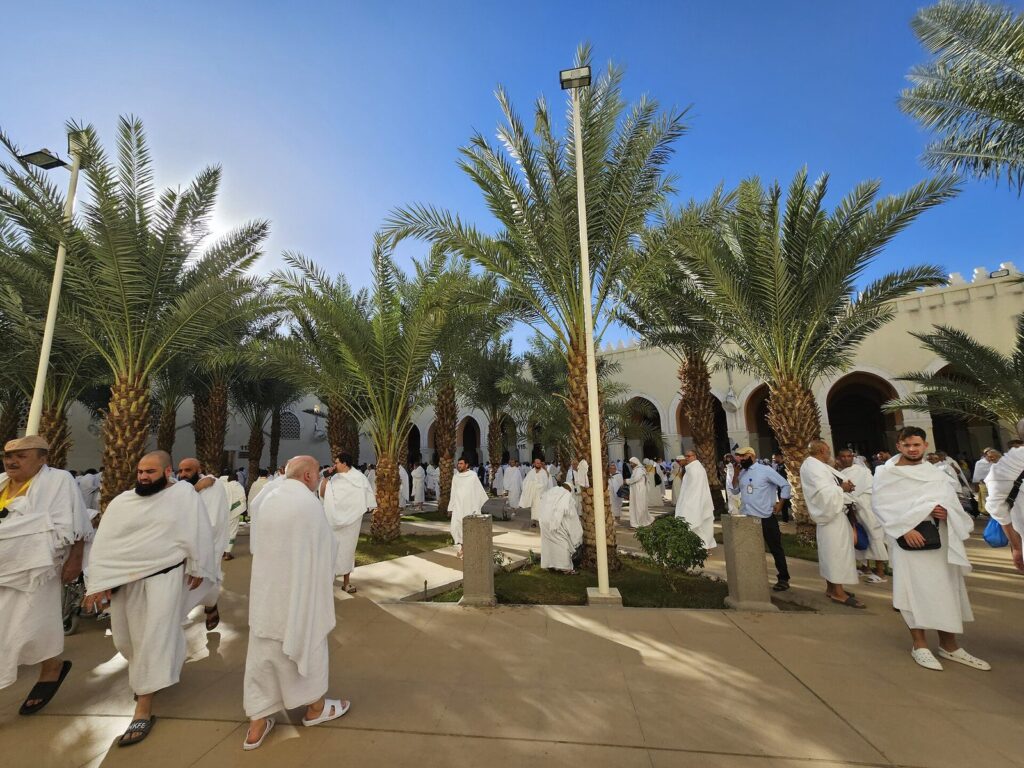
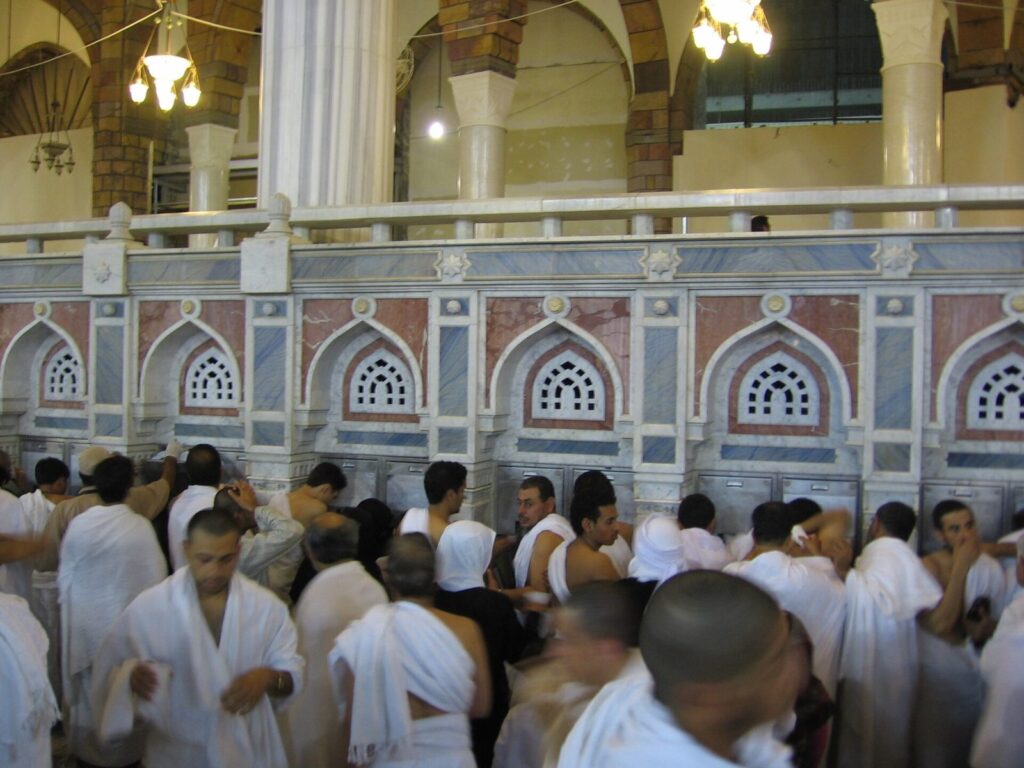
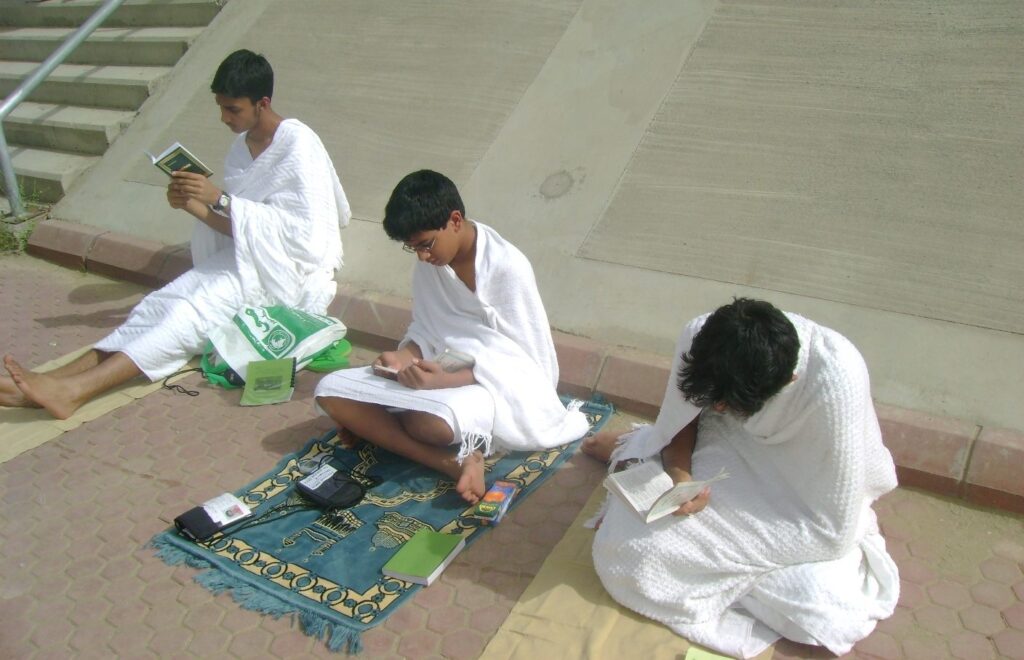
Men’s ihram consists of two pieces: the piece covering the body from the waist down is called the izar, and the piece covering the shoulders and upper body is called the rida. Rehearsing the steps below once at the hotel or at home will make things much easier and keep you from getting flustered before the miqat.
- After performing ghusl or wudu, dry yourself and take off all of the stitched clothing you are wearing.
- Bring the izar from behind you around your waist, with its long edge horizontal; make sure the lower edge falls below your knees.
- Bring one end of the cloth to the front of your stomach and wrap it tightly so that the other end comes over it.
- Secure the upper edge by rolling it inwards a few times so that it stays above your navel.
- Fasten the ihram belt over the izar and tighten the buckle; the belt both holds the cloth in place and serves as a pocket for money, your phone and your passport.
- Place the rida over your back and onto both shoulders like a shawl, and bring its ends together at the front.
- Take a few steps and bend down to check that the cloth does not slip and that your awrah stays covered.
How is ihram tied: should you knot it?
To secure the izar, it is recommended to roll and wrap it and fasten a belt over it rather than knotting the ends. Joining the garments together with safety pins, clips or press studs is not considered appropriate, as this is likened to stitched clothing; for this reason, a belt is the most practical and trouble-free solution. For the rida, too, rather than tying a knot, it is enough to hold the ends by hand or throw them over the shoulder.
Is it permissible to use an ihram belt?
Yes. According to the Hanafi school, it is permissible for a person in ihram to use a waist belt, a waist bag, a watch, glasses and a ring; these do not count as worn clothing. It is not a problem if the belt is stitched either. What matters is that the belt is fastened over the izar and does not wrap the body like a garment.
What Do You Wear Under Ihram?
The question most often asked by men who are about to wear ihram for the first time is whether anything can be worn under the garments. For men, the answer is clear: no stitched clothing of any kind is worn under the ihram garments. Although this may feel strange at first, with a thickly woven, well-wrapped izar and a belt you can move around comfortably all day long.
Can you wear underwear under ihram?
No. While in ihram, men may not wear stitched clothing such as underwear, leggings or shorts. If such clothing is worn through forgetfulness or ignorance, it must be taken off as soon as this is noticed; as it may require a penalty depending on how long it was worn, you can find the details in our article on ihram restrictions.
For the chafing and rubbing that can develop on the inner thighs during long walks, using an unscented anti-chafing cream or petroleum jelly is a good solution. Choosing an izar that is wide enough and letting its lower edge fall slightly below the knees also reduces friction.
What slippers or shoes can be worn in ihram?
According to the Hanafi school, men wear slippers or sandals that leave the protruding bone on the top of the foot and the heel uncovered; shoes that fully enclose the foot, and socks, are not worn. As the floors of Masjid al-Haram call for long periods of walking, choosing slippers with soft, non-slip soles that you have already got used to helps prevent sore feet.

How Do Women Enter Ihram?
There is no special ihram garment for women. Women enter ihram in their normal clothing that complies with Islamic dress, is loose-fitting and allows them to move comfortably; they may wear stitched clothing, socks and closed shoes. The head is covered, while the face and hands are left uncovered. We cover other aspects of women’s Umrah journeys in detail in our Umrah guide for women.
In practice, it is helpful to wear an underscarf cap beneath the headscarf so that no hair shows, to choose closed, lace-free shoes that stay comfortable during long walks, and to opt for thin, light-coloured fabrics for protection from the heat. Scented perfume, deodorant and cream are not used in women’s ihram either; in this respect, women are subject to the same rules as men.
Do women have to wear white in ihram?
No, women are not required to wear white in ihram; any colour that complies with Islamic dress and does not attract attention may be worn. The fact that many women prefer white or light colours comes down to practical reasons, such as the hot climate and being able to find one another easily within a large group.
Can women wear gloves in ihram?
The schools of thought differ on this matter. According to the Hanafi school, it is considered permissible for women to wear gloves while in ihram, whereas the Shafi’i and Hanbali schools do not consider it appropriate. To find out the ruling that applies to your own situation, we recommend consulting Diyanet’s current fatwas.
Can women cover their face in ihram?
For a woman in ihram, covering her face in such a way that the cloth comes into direct contact with the face is one of the ihram restrictions. Those who wish to protect themselves from the sun or the crowds may let a cloth hang down from a brimmed hat or head covering in a way that does not touch the face.
Preparations Before Entering Ihram
A few steps before putting on the ihram garments help you both act in line with the Sunnah and stay comfortable throughout your time in ihram. You can review the list below the day before your journey:
- Trimming the nails and the moustache and removing unwanted body hair
- Taking a full ritual bath (ghusl); if this is not possible, performing wudu
- Applying fragrance to the body before entering ihram if one wishes, but not applying fragrance to the garments
- Packing unscented soap, shampoo, deodorant and wet wipes in a separate bag
- Placing your passport, phone and cards in the ihram belt
- Performing two rak’ahs of ihram prayer if it is not a disliked (makruh) prayer time
- Putting a spare ihram set in your hand luggage
You can get essentials such as unscented care products, ihram sets and belts from our Umrah essentials page.
Can you use a hat or an umbrella while in ihram?
While in ihram, men may not cover their heads with anything worn on the head, such as a hat, a skullcap or a turban. On the other hand, it is permissible to use an umbrella that does not touch the head, or to stand under a tent or a canopy. In the summer heat of Makkah, an umbrella is the most practical form of protection for men in ihram.
Wearing Ihram on the Plane and at the Airport
Passengers flying directly from Türkiye to Jeddah must already have entered ihram before the plane reaches the level of the miqat. Changing into the garments in the narrow aisle and busy toilets of a plane is quite difficult; for this reason, it is much more practical to put on the ihram garments at home, at the hotel or at the departure airport. The intention and talbiyah, however, are made on the plane as it approaches the level of the miqat.
Those who will go to Madinah first and then travel on to Makkah set off from Türkiye in their normal clothes and enter ihram at the Dhul Hulayfah miqat on the road from Madinah. Finding out which city your programme starts in determines whether you should pack your ihram garments in your hand luggage or in your suitcase.
Where do you put on ihram?
The ihram garments can be put on anywhere before the miqat boundary: at home, at the hotel, at the airport or at the miqat mosque. What matters is that the intention and talbiyah are made before the miqat boundary is crossed. For those travelling by air, the prayer rooms and spacious toilets at airports are suitable places for this.
Do children wear ihram?
Children who have not yet reached puberty can also enter ihram with the help of their families; boys are dressed in a small-sized ihram set, while girls enter ihram in their normal, covered clothing. As children are not expected to observe the ihram restrictions fully, it is enough for parents to be patient and understanding and to set up a routine that does not tire the child.
Do you pray after putting on ihram?
After the garments have been put on, it is Sunnah to perform two rak’ahs of ihram prayer if it is not a disliked (makruh) prayer time. Those entering ihram on the plane can perform the prayer at the airport; not having the opportunity to perform the prayer does not prevent one from entering ihram.

Choosing and Caring for Ihram Cloth
Ihram garments are made in different fabrics and thicknesses. The right choice depends on the season of your journey, how much you sweat and how long you will remain in ihram. The table below summarises the common options:
| Fabric type | Key feature | Who is it suitable for? |
|---|---|---|
| Towelling cotton | Thick, absorbs sweat, does not show the contours of the body | First-time travellers and those travelling in the cooler season |
| Thin cotton | Light and breathable, dries quickly | Those travelling in the summer months |
| Microfibre blend | Very light, takes up little space when folded | Those who want to save luggage space |
| Thick winter type | Gives protection in air-conditioned spaces and on cool nights | The winter months and those who feel the cold easily |
It is recommended (mustahabb) for ihram garments to be white; it is also important that they are not see-through, so that the awrah does not show when the cloth gets wet or sweaty. Holding the cloth up to the light before buying it is a good way to check this.
Choosing the right size is at least as important as the fabric. For tall or broadly built travellers, a standard-size izar may not wrap far enough around the waist and may come open while walking. For this reason, we recommend that you try the cloth by wrapping it around your waist before buying it if possible, and that shorter travellers choose a length that does not drag on the ground. Carrying at least two sets throughout the journey makes things easier when it comes to washing and unexpected stains.
How do you wash ihram?
Ihram garments may be washed and changed while you are in ihram; there is nothing wrong with this. However, scented detergent, fabric softener or perfumed soap should not be used while in ihram. Washing by hand with unscented soap and drying in the shade, or changing into a spare set, is the most practical solution. Remember that hotel laundries may use scented products.
Arranging Ihram During Tawaf: Idtiba
Another detail that men should know when wearing ihram is idtiba. In a tawaf that will be followed by sa’i, such as the tawaf of Umrah, men pass the middle of the rida under the right armpit and throw both ends over the left shoulder, so that the right shoulder is left bare. This arrangement is applied only for the duration of tawaf. Once tawaf is over, the rida is adjusted again to cover both shoulders, and the tawaf prayer is performed with the shoulders covered.
Switching to idtiba from the moment you put on ihram is a common mistake; the Sunnah is to do this when starting tawaf. We explain the other practical details of tawaf step by step in our article how to perform tawaf.
Common Mistakes When Wearing Ihram
Some mistakes that could be prevented with a little preparation can make your time in ihram harder than it needs to be. The most common ones can be listed as follows:
- Wrapping the izar loosely without using a belt, so that the cloth slips while walking
- Leaving the lower edge of the cloth above the knees
- Wearing underwear or shorts under ihram out of forgetfulness
- Pulling the blanket over the head and face while sleeping
- Using scented wet wipes or perfumed cream
- Walking in trainers that fully enclose the foot
Important: Putting on the ihram garments does not by itself mean entering ihram; the ihram restrictions begin the moment you make the intention and recite the talbiyah. Take care not to cross the miqat boundary without making the intention, and whenever you are in doubt, consult your guide or Diyanet’s current fatwas.
Wearing ihram correctly is the first step towards experiencing the rest of your Umrah in peace and comfort. At RotaNur, on our Umrah tours we hold an ihram rehearsal and a briefing on the rites before departure, and we are at our travellers’ side at the moment of the miqat. For any questions on your mind, you can always reach us through our contact page.
Frequently Asked Questions
Can you take a shower while in ihram?
Yes, it is permissible to take a shower and wash while in ihram; you may also wash to cool down in the heat of Makkah. While doing so, only unscented soap and shampoo should be used, the head and beard should not be rubbed hard so that no strands of hair or beard come out, and no comb should be used. Also take care not to apply scented lotion or deodorant after your shower. Whenever you are in doubt, you can consult Diyanet’s current fatwas.
Can you cover yourself while sleeping in ihram?
Yes, a person in ihram may cover their body with a blanket or duvet while sleeping; this is not considered to be wearing clothing. However, according to the Hanafi school, men must leave their heads and faces uncovered, and women their faces. Resting the head on a pillow does not count as covering it. In air-conditioned hotel rooms, keeping the blanket at shoulder level or wrapping the body in a spare ihram cloth is a practical way to avoid getting cold.
Can you wear a face mask in ihram?
The ruling on wearing a mask differs between the schools of thought. According to the Hanafi school, since a man in ihram is forbidden to cover his head and face and a woman to cover her face, a mask that covers the face may require a penalty depending on how long it is worn. In the Shafi’i school, on the other hand, a man covering his face is not regarded as falling under the restriction. If you need to wear a mask for health reasons, consult your doctor, and for the ruling, consult Diyanet’s current fatwas.
When and where should you buy an ihram set?
It is best to buy your ihram set in Türkiye a few weeks before setting off; that way you can try it on at home and see whether the size and fabric suit you. You can get ihram sets, belts and unscented care products from our Umrah essentials page. Ihram garments can also be found in Makkah and Madinah; however, if you are flying directly to Jeddah, you will enter ihram on the plane, so you need to have the set with you when you set off.
When do you leave ihram?
In Umrah, you leave ihram when you shave or trim your hair after sa’i, and all of the restrictions come to an end. In Hajj, however, leaving ihram happens in two stages: according to the Hanafi school, with the shaving or trimming done during the days of Eid al-Adha, all restrictions except intimacy between spouses are lifted, and this restriction also ends after the Tawaf al-Ziyarah. We explain the order of the days of Hajj step by step in our article how to perform Hajj.

Cihat Murat Yüksel is the editor of the RotaNur blog and the founder of Markention. Drawing on the sources of Türkiye's Presidency of Religious Affairs (Diyanet), he turns the questions travellers ask most about preparing for Umrah, Hajj and halal travel into clear, practical guides.
Questions answered in this article
What Is Ihram? A Garment or a State?
In everyday language, the word “ihram” brings two pieces of white cloth to mind for most of us; in Islamic jurisprudence, however, ihram means making the intention for Hajj or Umrah and reciting the talbiyah, thereby temporarily forbidding oneself certain otherwise permissible (halal) acts. For men, the white garments are the outward expression of this state. In short, putting on the garments does not by itself mean entering ihram; a person who has put on the garments but has not made the intention is not yet considered to be in ihram.
Why is the ihram garment unstitched?
The fact that men do not wear stitched clothing in ihram is based on the practice the Prophet (peace be upon him) taught when he listed the garments a person in ihram may not wear (Bukhari, Muslim). “Stitched” here means clothing that has been cut and sewn to fit the body or a limb; a simple hem stitch along the edge of the cloth does not invalidate ihram.
How Do Men Wear Ihram?
Men’s ihram consists of two pieces: the piece covering the body from the waist down is called the izar, and the piece covering the shoulders and upper body is called the rida. Rehearsing the steps below once at the hotel or at home will make things much easier and keep you from getting flustered before the miqat.
How is ihram tied: should you knot it?
To secure the izar, it is recommended to roll and wrap it and fasten a belt over it rather than knotting the ends. Joining the garments together with safety pins, clips or press studs is not considered appropriate, as this is likened to stitched clothing; for this reason, a belt is the most practical and trouble-free solution. For the rida, too, rather than tying a knot, it is enough to hold the ends by hand or throw them over the shoulder.
Is it permissible to use an ihram belt?
Yes. According to the Hanafi school, it is permissible for a person in ihram to use a waist belt, a waist bag, a watch, glasses and a ring; these do not count as worn clothing. It is not a problem if the belt is stitched either. What matters is that the belt is fastened over the izar and does not wrap the body like a garment.
What Do You Wear Under Ihram?
The question most often asked by men who are about to wear ihram for the first time is whether anything can be worn under the garments. For men, the answer is clear: no stitched clothing of any kind is worn under the ihram garments. Although this may feel strange at first, with a thickly woven, well-wrapped izar and a belt you can move around comfortably all day long.