












Contents 22 sections
- Can Women Go on Umrah Alone?
- According to Diyanet, can women go on Umrah without a mahram?
- Who can women go on Umrah with?
- Who Is a Mahram and Why Does It Matter?
- Can a married woman go on Umrah without her husband’s permission?
- Saudi Arabia’s Practices for Women Travellers
- From what age can women go on Umrah without a mahram?
- Preparing for Umrah as a Woman
- What should women take when going on Umrah?
- Can pregnant women go on Umrah?
- What do women wear in ihram?
- How Do Women Make the Intention for Umrah?
- Can a woman who is menstruating enter ihram?
- Menstruation and Planning Acts of Worship
- Can medication be used to delay menstruation?
- Practices Specific to Women in Tawaf, Sa’i and Shaving
- How do women cut their hair in Umrah?
- How should women perform tawaf in the crowd?
- Women at Masjid al-Haram and the Prophet’s Mosque
- What should women do to avoid getting lost?
- Tips for a Safe and Comfortable Journey
- Frequently Asked Questions
Can women go on Umrah alone is a question with both religious and practical dimensions, and it has become one of the most frequently asked topics in recent years. In this guide, we have brought together how the schools of law and Diyanet (Türkiye’s Presidency of Religious Affairs) approach the question of the mahram, the general framework of Saudi Arabia’s practices for women travellers, the details women need to pay attention to in ihram, the intention, tawaf and sa’i, how to plan acts of worship during menstruation and postnatal bleeding, and practical tips for a safe journey. As the rules can change, we recommend that you treat this article as a starting guide and consult current fatwas and official sources for your own situation.
Can Women Go on Umrah Alone?
The answer to this question should be considered in two separate dimensions: the religious ruling and Saudi Arabia’s entry rules. From a religious point of view, the classical books of Islamic jurisprudence take as their basis that a woman sets out on a long journey with her husband or a mahram, and this approach is based on hadiths that restrict a woman’s long journeys without a mahram (al-Bukhari, Muslim). While the Hanafi school takes a stricter position on this matter, the Shafi’i and Maliki schools allow a woman to travel for the obligatory Hajj and Umrah with a group made up of trustworthy women.
Today, the fact that journeys have become largely safe and that groups travel with institutional organisations has also influenced the assessments on this matter. What is meant by “alone” is usually travelling without an elder of the family, as part of a trustworthy tour group; a completely solitary journey without any organisation is a different situation from both a religious and a practical point of view.
According to Diyanet, can women go on Umrah without a mahram?
The explanations of Diyanet show an approach according to which women may go on Hajj and Umrah without a mahram on journeys where the safety of the route is ensured and which are made with a trustworthy group. However, since the details may vary according to the person’s situation, we recommend that you consult Diyanet’s current fatwas or the Diyanet Alo 190 Communication Centre before making a decision.
Who can women go on Umrah with?
Women can go on Umrah with their husbands, with their mahrams or within a group run by a trustworthy organisation. On journeys made with family members, it is important to have the documents showing the family relationship ready; on journeys made with a tour group, it is important to clarify room sharing and the arrangements for accompaniment in advance.
Who Is a Mahram and Why Does It Matter?
A mahram is a man whom a woman is permanently forbidden to marry because of a tie of blood, milk kinship or marriage. Having a mahram on the journey is an arrangement intended to ensure the woman’s safety and that she is supported when needed. A woman’s husband is not a mahram, but he has the same ruling in terms of accompanying her. The main mahrams are as follows:
- The father, the grandfather and the line of ascendants above them
- The son, the grandson and the line of descendants below them
- The brother and the sons of the brother and of the sister
- The paternal and maternal uncles
- Those who are mahram by marriage, such as the father-in-law, the son-in-law and the stepson
- Those who are mahram through milk kinship, such as the foster father and the foster brother
The sister’s husband, the brother-in-law and cousins are not mahrams. On journeys made with these people, the woman is regarded, from a religious point of view, as travelling without a mahram.
Can a married woman go on Umrah without her husband’s permission?
Since in the Hanafi school Umrah is an act of worship that is Sunnah to perform once in a lifetime, a married woman is advised to plan this journey with her husband’s consent. The husband’s approval is important both for peace in the family and for support during the journey. For the differences in ruling between the obligatory Hajj and voluntary acts of worship, you can consult Diyanet’s current fatwas.
Saudi Arabia’s Practices for Women Travellers
For many years, Saudi Arabia required women Umrah travellers under a certain age to be accompanied by a mahram. With the arrangements made in recent years, women who meet a certain age requirement have been allowed to perform Umrah without a mahram through a trustworthy organisation or with suitable visa types. For young travellers and children, however, the accompaniment requirements may be applied differently.
Since these rules can change according to the visa type, the period and the decisions of the Saudi authorities, we do not give a definitive age or document list here. Before travelling, confirm the current conditions with official sources and your travel agency. We have explained how the visa process generally works in our article on how to get an Umrah visa.
From what age can women go on Umrah without a mahram?
The age limit at which Saudi Arabia allows Umrah without a mahram has changed several times over the years and may change again in the future. For this reason, rather than treating any age figure as a fixed rule, the best course is to find out from your agency the requirement that applies at the time of your application and to prepare your documents accordingly.

Preparing for Umrah as a Woman
Preparation for women travellers involves some differences compared with men. As well as basic documents such as the passport and visa, it is useful to carry documents showing the marital or family relationship if you are travelling with your husband or a mahram. Vaccination and health documents also need to be prepared in full.
Another important aspect of preparation is clarifying expectations. For women travellers, the walking distance from the hotel to the mosque, who the room will be shared with, the group’s daily programme and how the guide will support women travellers should be discussed in advance. Especially for women who will be going abroad for the first time and travelling apart from their families, this information is the foundation of feeling safe throughout the journey. It is also useful for those with health problems to take their medicines with them together with their prescriptions, and to carry a card showing their blood group and the person to contact in an emergency.
What should women take when going on Umrah?
A woman traveller’s suitcase should always include loose-fitting, breathable clothing suitable for modest dress (hijab), an underscarf and spare headscarves, closed shoes suitable for walking and unscented personal care products. For a detailed list, you can take a look at our Umrah packing list.
- A long, loose and non-transparent dress or overcoat (ferace)
- A non-slip underscarf and several spare headscarves
- Socks and soft-soled, laceless shoes
- Unscented soap, shampoo, deodorant and moisturiser
- A small backpack for your shoes and belongings
- Personal medicines and hygiene products
Can pregnant women go on Umrah?
Pregnancy on its own is not an obstacle to Umrah; however, the long flight, the hot climate, the crowds and the long walks place an additional burden on pregnant travellers. Airlines also have flight rules based on the week of pregnancy. For this reason, we recommend that you consult your obstetrician-gynaecologist and find out the airline’s current conditions before making a decision.
What do women wear in ihram?
There is no special ihram garment for women; they enter ihram in their normal clothing that is suitable for modest dress, and there is no required colour. The face and hands are left uncovered, and care is taken that the covering does not touch the face directly. You can find the details of ihram clothing in our article on how to wear ihram.
How Do Women Make the Intention for Umrah?
A woman’s intention is the same as a man’s: before crossing the miqat boundary, the intention (niyyah) to perform Umrah is made in the heart, it is also expressed with the tongue, and the talbiyah is then recited. The only difference is that women recite the talbiyah not out loud but in a voice that only they themselves can hear.
Can a woman who is menstruating enter ihram?
Yes, a woman in a state of menstruation (hayd) or postnatal bleeding (nifas) may take a bath for the purpose of cleanliness, enter ihram, make the intention and recite the talbiyah. In this state the ihram prayer is not performed; however, there is no need to wait until she becomes pure in order to enter ihram. So as not to cross the miqat without ihram, it is important that women in this situation also make their intention on time.
Menstruation and Planning Acts of Worship
One of the things women travellers worry about most is their period starting during their Umrah. According to the Hanafi school, a woman in a state of menstruation or postnatal bleeding cannot perform tawaf and does not enter the mosque until she becomes pure; however, she can continue with supplication (dua), remembrance (dhikr) and other visits. For this reason, when planning the programme, it is useful to leave a few days’ margin before the return date.
The situation of women who do not become pure before their return date is an issue addressed separately in Islamic jurisprudence, on which there are different opinions. If you find yourself in such a situation, we recommend that you inform your guide and consult Diyanet’s current fatwas. It is important to take this flexibility into account when planning how many days your programme will last; we have compared different programme lengths in our article on how many days Umrah takes.
Can medication be used to delay menstruation?
Some women consider using medication that delays their period so as not to disrupt their plan of worship. Although the use of such medication does not constitute a religious obstacle, from a health perspective it is a matter that must be decided under a doctor’s supervision. Do not use any medication before your journey without consulting your obstetrician-gynaecologist.
Practices Specific to Women in Tawaf, Sa’i and Shaving
The steps of Umrah are largely the same for women and men; some practices, however, are specific to men. The table below summarises the differences; we have explained all the steps in order in our how to perform Umrah guide.
| Practice | Men | Women |
|---|---|---|
| Ihram garments | Two unstitched pieces of cloth | Normal clothing suitable for modest dress |
| Talbiyah | In a somewhat raised voice | In a low voice that only she can hear |
| Idtiba and raml | Performed in the tawaf of Umrah | Not performed |
| Harwalah in sa’i | Performed in the section marked with green lights | Continue at a normal walking pace |
| Shaving or trimming the hair | Shaving the head or shortening the hair | Cutting a finger joint’s length from the ends of the hair |
| Tawaf and menstruation | Performed in a state of wudu | Not performed during menstruation or postnatal bleeding |
How do women cut their hair in Umrah?
Women do not shave their heads; according to the Hanafi school, they must cut a finger joint’s length from the ends of the hair on at least a quarter of the head. In practice, the ends of the hair are gathered in the palm and cut with scissors. The cutting can be done by the woman traveller herself, by a female friend or by her mahram; if the person doing the cutting is also in ihram, they must first have completed their own shaving or trimming.
How should women perform tawaf in the crowd?
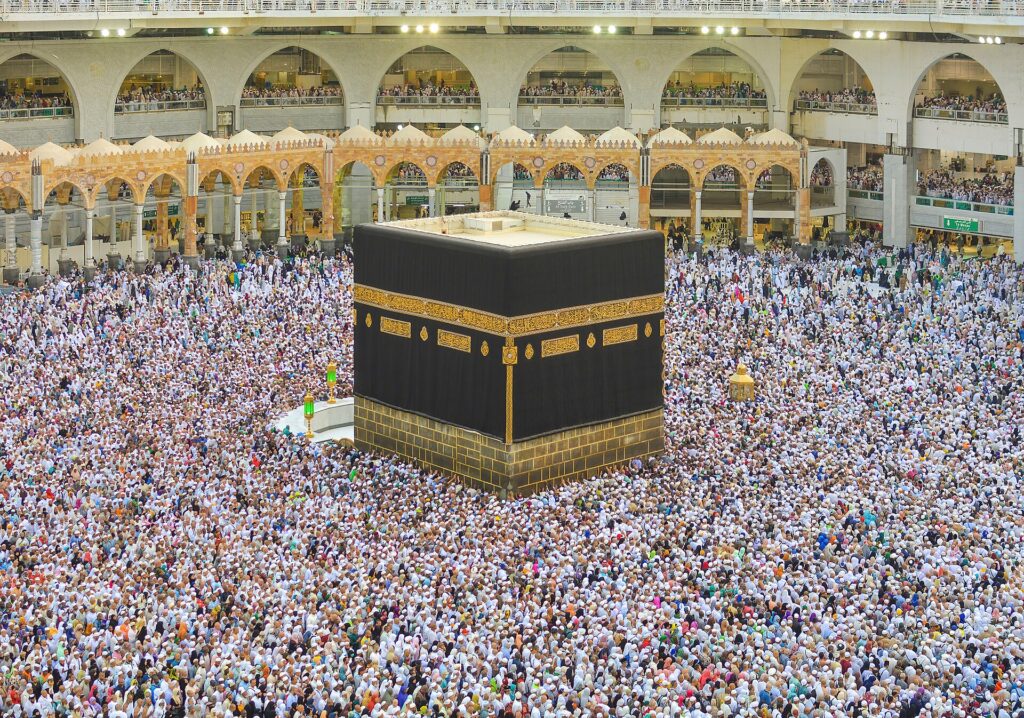
During tawaf, it is more comfortable for women, in terms of both safety and privacy, to choose the somewhat outer circles rather than the most crowded circles close to the Kaaba. Choosing the hours when the crowds thin out also makes it easier to perform tawaf in peace. For the practical details of tawaf, you can read our article on how to perform tawaf.
Women at Masjid al-Haram and the Prophet’s Mosque
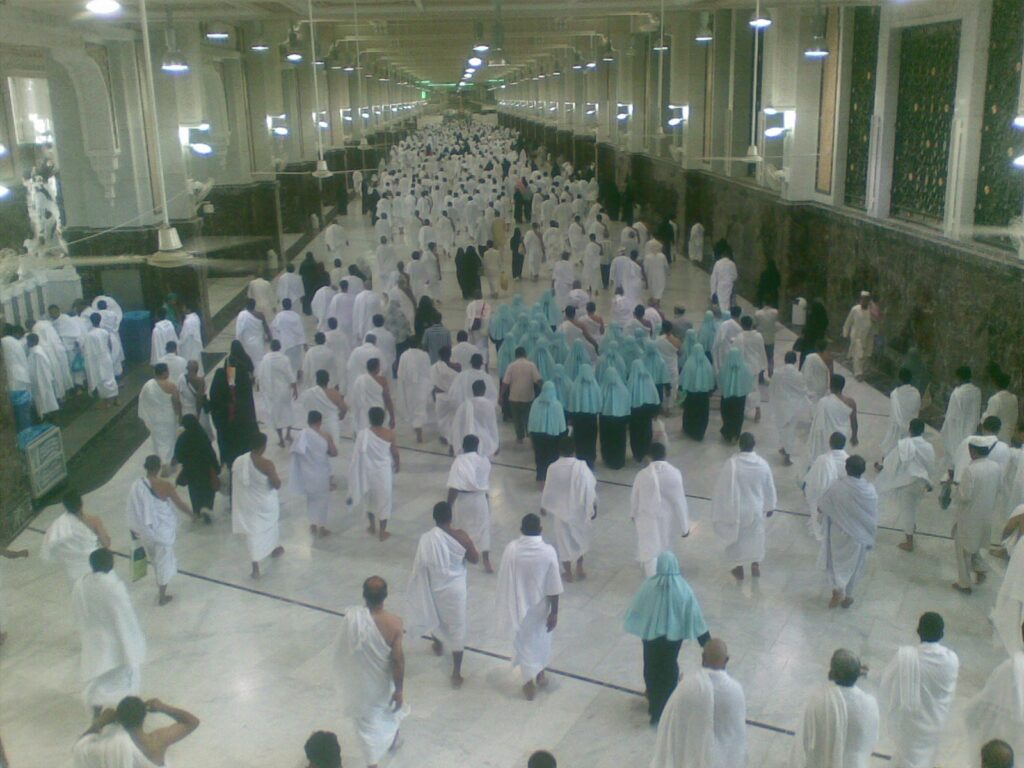
At Masjid al-Haram and at the Prophet’s Mosque (Masjid an-Nabawi), there are prayer areas set aside for women, and these areas are entered through specific gates. Keeping in mind that the women’s sections can fill up early at busy times, it is a good habit to go to the mosque before the prayer time. Female staff on duty give directions at the gates and in the prayer areas.
At the Prophet’s Mosque, the visit to the Rawdah is usually arranged in separate time slots for women and requires a permit obtained through the Nusuk app. Since visiting hours and permit rules can change, we recommend that you find out the current arrangements before arriving in Madinah.
On Fridays and on the nights of Ramadan, both mosques become exceptionally crowded. On these days, it helps both safety and comfort for women travellers to go to the mosque early, to carry a small prayer mat and some water with them, and to wait for the crowd to disperse before leaving after the prayer.
What should women do to avoid getting lost?
Since the mosques have a great many gates, noting the number of the gate you entered through, agreeing on a specific meeting point with the group and keeping your guide’s number saved on your phone greatly reduce the risk of getting lost. Do not forget to carry your hotel card with you as well.
Tips for a Safe and Comfortable Journey
A few practical precautions make a big difference in helping women travellers complete their Umrah in peace:
- Choose an organisation that has a female guide or a staff member responsible for women travellers.
- Clarify room sharing and the accompaniment arrangements before setting off.
- Keep your valuables to a minimum and store your passport in a secure inside pocket.
- Do not leave your group at busy times, and if possible perform tawaf and sa’i together with a friend.
- In hot weather, pay attention to how much water you drink and how long you rest.
- Leave a few days of flexibility in your programme in case your period starts.
Important: The age, accompaniment and document rules concerning women’s travel are updated from time to time by Saudi Arabia; from a religious point of view, too, different assessments may be made depending on the person’s situation. Before making a decision, confirm the current conditions with official sources and your travel agency, and the religious ruling with Diyanet’s current fatwas.
With the right preparation and a trustworthy organisation, Umrah is a journey women can experience with peace of mind. At RotaNur, we pay particular attention to the needs of our women travellers on our Umrah tours and stand by them at every step, from room arrangements to the plan of worship. To decide together on the programme that suits you, you can reach us via our contact page.
Frequently Asked Questions
Can women wear gloves in ihram?
According to the Hanafi school, it is not forbidden for a woman in ihram to wear gloves, because according to this school the part that a woman in ihram must leave uncovered is her face. The Shafi’i, Maliki and Hanbali schools, however, hold that a woman in ihram should not wear gloves. Because of this difference of opinion, leaving the hands uncovered is the more cautious choice. If you have a particular need, decide after consulting Diyanet’s current fatwas or your group guide.
Can women use scented cosmetics in ihram?
No, after making the intention and reciting the talbiyah, products such as perfume, scented creams, shampoo, soap and wet wipes are not used. According to the Hanafi school, henna is also regarded as a fragrance, so henna is not applied to the hands or hair while in ihram. For personal care needs, the most practical solution is to prepare unscented products before setting off. We have explained the other restrictions besides fragrance in detail in our article on ihram restrictions.
Can a woman whose period starts after tawaf perform sa’i?
Yes. According to the Hanafi school, being in a state of wudu is not a condition for sa’i; a woman whose period starts after she has completed the tawaf of Umrah in a state of purity can perform her sa’i. After sa’i, she leaves ihram by cutting the ends of her hair, and her Umrah is complete. If the period started before tawaf was performed, however, she needs to wait until she is pure to perform tawaf. For your own situation, consult your guide and Diyanet’s current explanations.
How do women book an appointment to visit the Rawdah?
The visit to the Rawdah (ar-Rawdah al-Mutahharah) is made, for both women and men, with an appointment booked through the Nusuk app; separate time slots are usually set aside for women. Since limits may be placed on how often appointments can be booked and the rules can change, it is useful to install the app on your phone before arriving in Madinah and to get support from your guide. For the greeting to be offered and the etiquette to be observed during the visit, you can take a look at our article on the Rawdah supplication.
Can elderly or sick women perform tawaf in a wheelchair?
Yes. According to the Hanafi school, it is necessary (wajib) for those who are able to perform tawaf on foot; however, a person with a valid excuse such as old age, illness or being unable to walk may perform tawaf in a wheelchair or by being carried, and in this case no penalty is required. At Masjid al-Haram, there are routes arranged for wheelchair users. You are advised to find out the current conditions for using these routes from your guide and to move around with a companion.

Cihat Murat Yüksel is the editor of the RotaNur blog and the founder of Markention. Drawing on the sources of Türkiye's Presidency of Religious Affairs (Diyanet), he turns the questions travellers ask most about preparing for Umrah, Hajj and halal travel into clear, practical guides.
Questions answered in this article
Can Women Go on Umrah Alone?
The answer to this question should be considered in two separate dimensions: the religious ruling and Saudi Arabia’s entry rules. From a religious point of view, the classical books of Islamic jurisprudence take as their basis that a woman sets out on a long journey with her husband or a mahram, and this approach is based on hadiths that restrict a woman’s long journeys without a mahram (al-Bukhari, Muslim). While the Hanafi school takes a stricter position on this matter, the Shafi’i and Maliki schools allow a woman to travel for the obligatory Hajj and Umrah with a group made up of trustworthy women.
According to Diyanet, can women go on Umrah without a mahram?
The explanations of Diyanet show an approach according to which women may go on Hajj and Umrah without a mahram on journeys where the safety of the route is ensured and which are made with a trustworthy group. However, since the details may vary according to the person’s situation, we recommend that you consult Diyanet’s current fatwas or the Diyanet Alo 190 Communication Centre before making a decision.
Who can women go on Umrah with?
Women can go on Umrah with their husbands, with their mahrams or within a group run by a trustworthy organisation. On journeys made with family members, it is important to have the documents showing the family relationship ready; on journeys made with a tour group, it is important to clarify room sharing and the arrangements for accompaniment in advance.
Who Is a Mahram and Why Does It Matter?
A mahram is a man whom a woman is permanently forbidden to marry because of a tie of blood, milk kinship or marriage. Having a mahram on the journey is an arrangement intended to ensure the woman’s safety and that she is supported when needed. A woman’s husband is not a mahram, but he has the same ruling in terms of accompanying her. The main mahrams are as follows:
Can a married woman go on Umrah without her husband’s permission?
Since in the Hanafi school Umrah is an act of worship that is Sunnah to perform once in a lifetime, a married woman is advised to plan this journey with her husband’s consent. The husband’s approval is important both for peace in the family and for support during the journey. For the differences in ruling between the obligatory Hajj and voluntary acts of worship, you can consult Diyanet’s current fatwas.
From what age can women go on Umrah without a mahram?
The age limit at which Saudi Arabia allows Umrah without a mahram has changed several times over the years and may change again in the future. For this reason, rather than treating any age figure as a fixed rule, the best course is to find out from your agency the requirement that applies at the time of your application and to prepare your documents accordingly.