











Contents 22 sections
- What Is Tawaf and What Types of Tawaf Are There?
- Preparing Before Starting Tawaf
- How do you make the intention for tawaf?
- Can tawaf be performed without wudu?
- Where Does Tawaf Start? The Black Stone Line
- Do you need to touch the Black Stone in the crowd?
- What should I do if I realise I have already passed the Black Stone line?
- How Are Idtiba and Raml Performed in Practice?
- Is tawaf valid if raml cannot be performed?
- Counting the Circuits Correctly
- What do you do if you are unsure how many circuits you have done?
- Do you need to touch the Yemeni Corner?
- Tawaf in Crowds and Choosing a Floor
- What do you do if a prayer time begins during tawaf?
- What happens if wudu is broken during tawaf?
- Tawaf for Women, Older Pilgrims and Wheelchair Users
- Can tawaf be performed in a wheelchair?
- Does the tawaf of the person pushing the wheelchair count?
- The Tawaf Prayer and What Comes After
- Can you begin sa’i before performing the tawaf prayer?
- Supplications to Recite During Tawaf
- Frequently Asked Questions
The short answer to how to perform tawaf is clear: you start in line with the Black Stone, walk seven circuits with the Kaaba on your left, and perform two rak’ahs of tawaf prayer. For someone going to Masjid al-Haram for the first time, however, the real questions arise on the ground: How do you find the starting line? How are idtiba and raml performed? How do you count the circuits in a crowd? Which floor should you choose? Is tawaf possible in a wheelchair? In this article, we focus on these practical details of tawaf. If you would like to see all the steps of Umrah in order, take a look at our guide on how to perform Umrah.
What Is Tawaf and What Types of Tawaf Are There?
Tawaf means walking around the Kaaba seven times in a set manner; each circuit is called a shawt. According to the Hanafi school, the first four circuits of tawaf are a pillar (rukn), while the remaining three circuits are necessary (wajib). Tawaf is one of the core acts of worship of Hajj and Umrah, and it is also a voluntary act of worship that anyone in Makkah can perform whenever they wish. The rulings on the different types of tawaf can be summarised as follows:
| Type of tawaf | When is it performed? | Ruling according to the Hanafi school |
|---|---|---|
| Tawaf of Umrah | After entering ihram, before sa’i | Pillar of Umrah (fard) |
| Tawaf al-Qudum (arrival tawaf) | On arrival in Makkah, for those performing Hajj al-Ifrad or Hajj al-Qiran | Sunnah |
| Tawaf al-Ziyarah (Ifadah) | During the days of Eid al-Adha | Pillar of Hajj (fard) |
| Farewell tawaf (Tawaf al-Wada) | When leaving Makkah after Hajj | Necessary (wajib) for pilgrims coming from outside Makkah |
| Voluntary tawaf | At any time while in Makkah | Voluntary (nafl) |
Whichever tawaf is performed, the basic method is the same; the differences lie in details such as idtiba, raml and whether or not sa’i follows. For the timing of the Hajj tawafs, you can read our article how to perform Hajj.
Preparing Before Starting Tawaf
A few minutes of preparation before starting tawaf allow you to perform all seven circuits with peace of mind. Renew your wudu before entering Masjid al-Haram, either at the hotel or in the mosque’s ablution facilities. Rather than leaving your slippers on the racks by the doors, putting them in a small cloth bag and carrying it with you removes the risk of losing them on the way out. If you are going as a group, agree in advance on where you will meet after tawaf; the mosque’s gate numbers are the best landmarks for this.
- Be in a state of wudu and make sure that your awrah is fully covered.
- Have a shoe bag, a small bottle of water and a circuit counter with you.
- Carry your bag at the front and keep your valuables in your ihram belt.
- Put your phone on silent; do not interrupt tawaf to take photos.
- If you have an elderly or slow-walking relative with you, choose your floor in advance.
How do you make the intention for tawaf?
The intention is made in the heart, and it is good to say it with the tongue as well. In your own language, you can say something like: “O Allah, I intend to perform the tawaf of Umrah for Your sake; make it easy for me and accept it from me.” For a voluntary tawaf, the type of tawaf is expressed accordingly. The intention for tawaf is made shortly before reaching the line of the Black Stone.
Can tawaf be performed without wudu?
No. According to the Hanafi school, performing tawaf in a state of wudu is necessary (wajib). A tawaf performed without wudu requires a penalty depending on its type, and it is recommended that it be performed again with wudu. For this reason, it is important to check your wudu before starting tawaf and to be careful that your wudu is not broken in the crowd.
Where Does Tawaf Start? The Black Stone Line
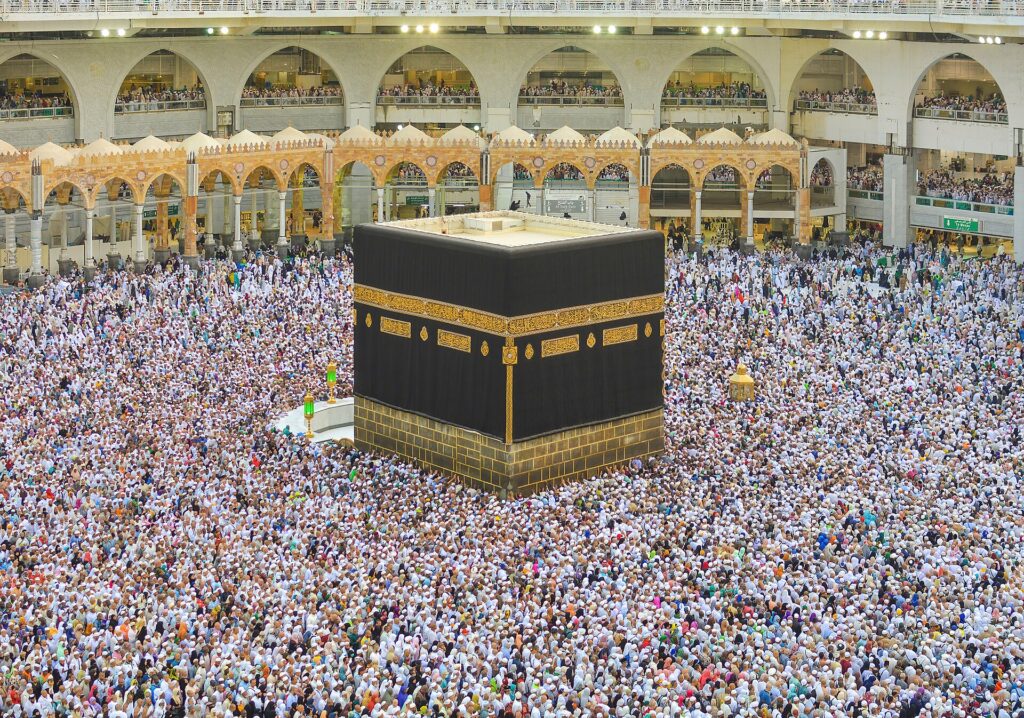
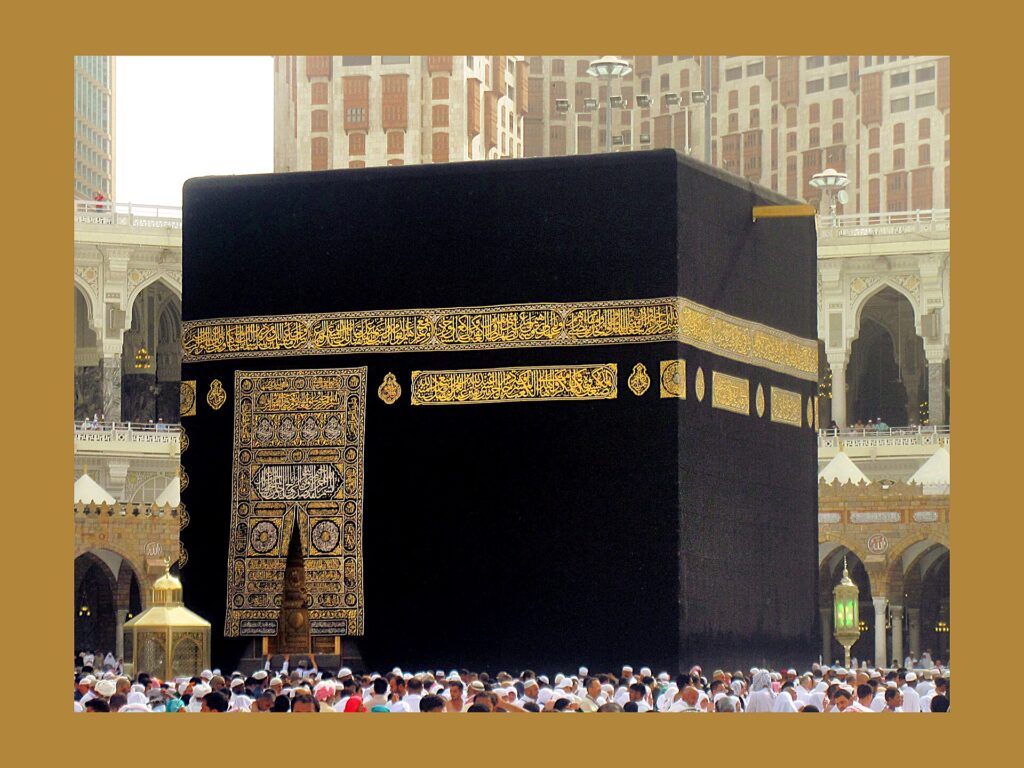
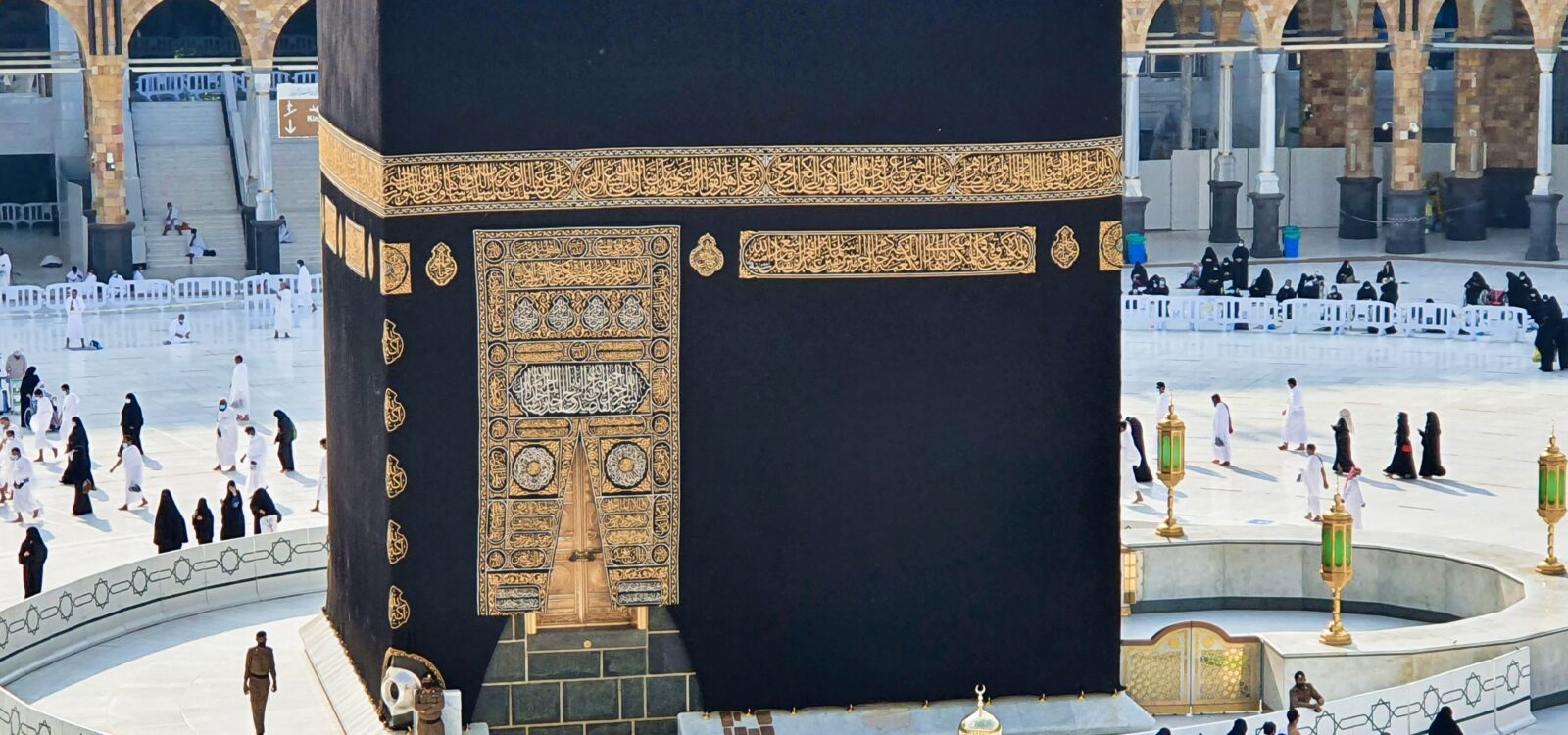
Tawaf begins in line with the corner of the Kaaba where the Black Stone is located, and each circuit is completed at this same line. The Black Stone is located in the corner to the left of the Kaaba’s door. To find the starting point in the crowd, you can use the green-lit marker on the mosque wall that faces this line; similar directions are also provided on the upper floors. As arrangements may change over time, if you cannot see the marker on the floor you are on, ask the staff or your guide. To get to know the corners and parts of the Kaaba more closely, take a look at our article on the parts of the Kaaba.
On reaching the line, you turn your face towards the Black Stone, raise your hands to ear level with the palms facing the stone and recite the takbir; then you kiss your hand. This is called istilam and is repeated at the start of each circuit. You then turn to the right and begin walking with the Kaaba on your left.
Do you need to touch the Black Stone in the crowd?
No, touching and kissing the Black Stone is not a requirement; in a crowd, it is sufficient to greet it by gesturing with your hand from a distance. Pushing to reach the stone, hurting others and disrupting the flow of tawaf can mean falling into a forbidden (haram) act for the sake of an act that is Sunnah.
What should I do if I realise I have already passed the Black Stone line?
If you realise that you have passed the starting line, do not try to walk against the flow of the crowd. The safest course is to carry on with tawaf and start counting your circuits from the Black Stone line the next time you reach it. This way, there is no chance of performing an incomplete circuit.
How Are Idtiba and Raml Performed in Practice?
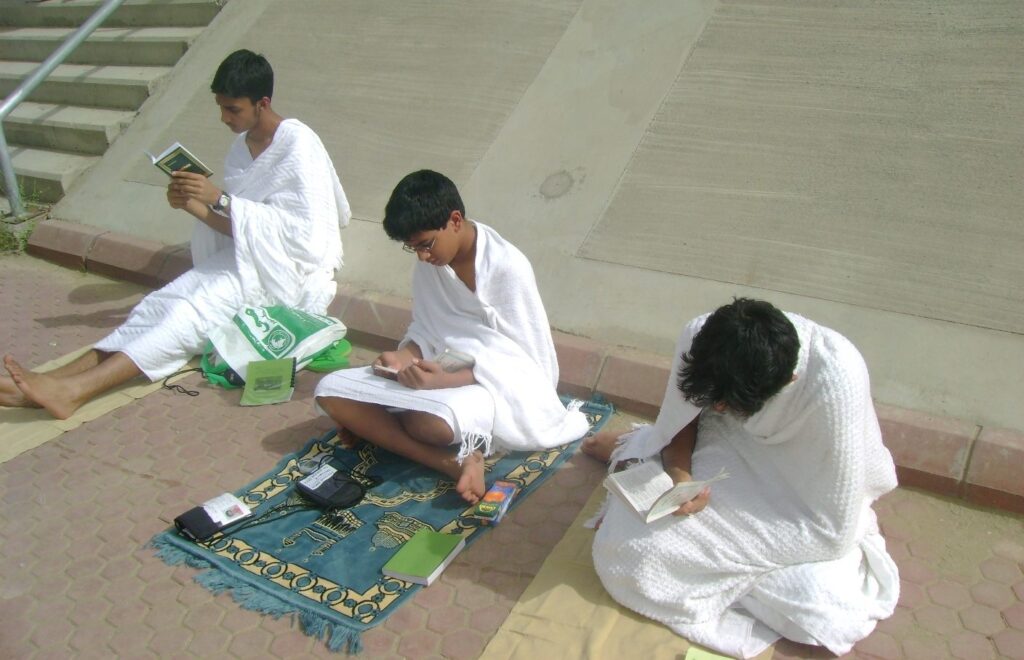
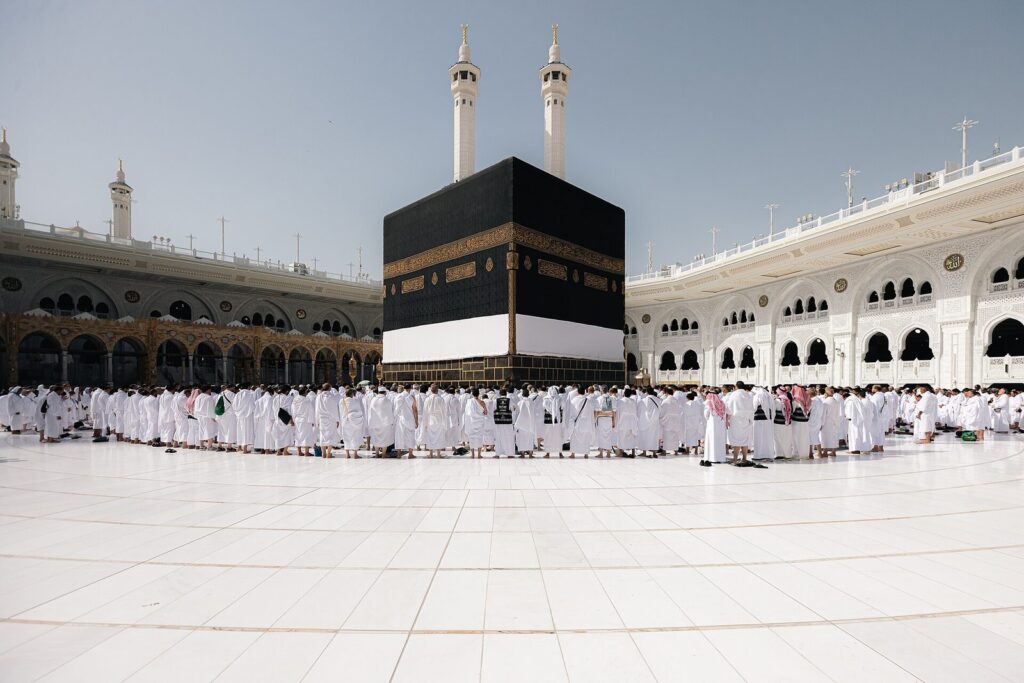
In tawafs that will be followed by sa’i, such as the tawaf of Umrah, there are two Sunnah practices for men. Idtiba means passing the middle of the rida under the right armpit and throwing both ends over the left shoulder, leaving the right shoulder bare. Idtiba is maintained from the beginning to the end of tawaf, and before the tawaf prayer, the rida is adjusted again to cover both shoulders. For the general arrangement of the ihram garments, you can read our article how to wear ihram.
Raml, meanwhile, means walking briskly with short steps in the first three circuits, with the shoulders moving slightly. Running or jumping is not raml; the aim is a strong, lively walk. The last four circuits are completed at a normal walking pace. When performing raml in a crowd, take care not to bump into the people around you.
Is tawaf valid if raml cannot be performed?
Yes. According to the Hanafi school, raml and idtiba are Sunnah; not being able to perform them because of crowds, old age or illness does not affect the validity of tawaf and does not require a penalty. If raml cannot be performed close to the Kaaba because of the crowds, performing raml in a circle a little further out may be preferred; if this is not possible either, one continues at a normal walking pace.
Counting the Circuits Correctly
One of the most common problems in tawaf is losing count of the circuits. It is very easy to lose count while you are busy with supplication and dhikr, trying to find your way in the crowd or following your group companions. A few simple methods greatly reduce this risk:
- Use a string of seven prayer beads or a digital counter worn on the finger.
- Count each circuit only when you reach the Black Stone line, and do not keep count in between.
- If you are in a group, give the counting task to one person and confirm at the end of each circuit with a gesture rather than out loud.
- Use the Yemeni Corner (ar-Rukn al-Yamani) as an intermediate marker; when you pass this corner, you know that you are nearing the end of the circuit.
- Walk around the outside of the semicircular area known as the Hijr Ismail (Hatim); a circuit in which you pass through the Hatim is counted as incomplete.
What do you do if you are unsure how many circuits you have done?
In an obligatory or necessary tawaf, a person who is not sure of the number of circuits is advised to complete the tawaf on the basis of the lower number that they know for certain. For example, a person who is unsure whether it is the fifth or the sixth circuit accepts that they have done the fifth circuit and does two more. If the doubt recurs frequently, using a counter is the most practical solution.
Do you need to touch the Yemeni Corner?
The Yemeni Corner is the corner that comes before the Black Stone. If possible, it is Sunnah to touch this corner with the hand; if it cannot be touched because of the crowds, there is no need to gesture towards it from a distance, and one simply keeps walking.
Tawaf in Crowds and Choosing a Floor
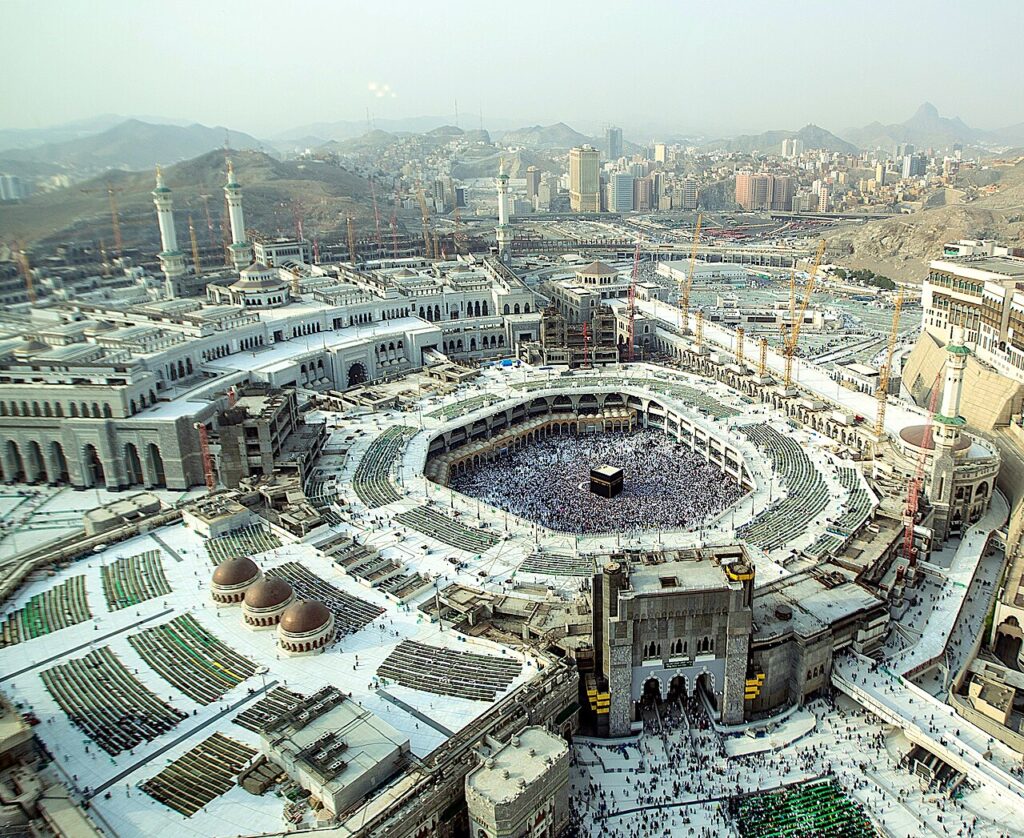
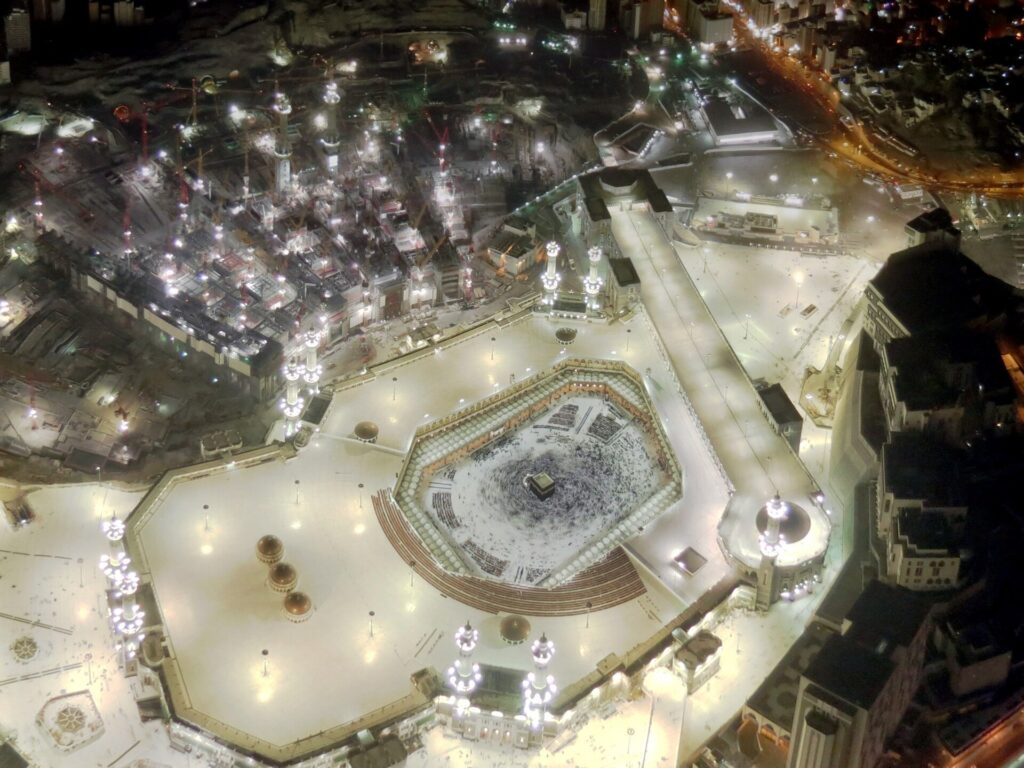
At Masjid al-Haram, tawaf can be performed on the ground level of the mataf, the open area around the Kaaba, as well as on the upper floors and on the roof level. On the ground level, the circle is tighter, so a circuit takes less time, but the crowds and the crush increase. On the upper floors, walking is more comfortable, but because the circle is wider, the distance becomes noticeably longer. As access to the ground level of the mataf may be restricted for those not in ihram during busy periods, you need to find out the current arrangements from the staff.
The least crowded times are generally between mid-morning (duha) and noon, and after midnight; Fridays, Ramadan nights and the time just before the prayer times are the busiest. In the crowds, not walking against the flow, not stopping suddenly and not cutting diagonally across the circle to get closer to the Kaaba are important both for your own safety and for the peace of others.
What do you do if a prayer time begins during tawaf?
If the iqamah is called for an obligatory prayer during tawaf, tawaf is paused and the prayer is performed in congregation wherever you are. After the prayer, tawaf is resumed from the point where you left off; there is no need to start tawaf again from the beginning. In this situation, remember to check your counter so that you can recall the circuit you were on and the place where you stopped.
What happens if wudu is broken during tawaf?
A person whose wudu is broken during tawaf leaves the tawaf, performs wudu and, on returning, may continue from where they left off; if they wish, they may also start the tawaf again from the beginning. Continuing tawaf without wudu, however, is not correct. Finding out in advance where the ablution facilities are located inside the mosque saves time in this situation.
Important: Arrangements at Masjid al-Haram such as the use of the floors, access to the mataf, wheelchair routes and permits obtained through Nusuk change from time to time. Before going for tawaf, find out the current practice from your guide and the mosque staff; for questions of Islamic jurisprudence, consult the current fatwas of Diyanet (Türkiye’s Presidency of Religious Affairs).
Tawaf for Women, Older Pilgrims and Wheelchair Users
Women perform tawaf in the same way as men; however, they do not perform idtiba or raml. To preserve privacy in the crowds, choosing circles a little further out rather than those closest to the Kaaba, and choosing the times when the crowds are thinner, makes for a more comfortable tawaf. According to the Hanafi school, a woman who is menstruating or experiencing postnatal bleeding (nifas) does not perform tawaf until she has become pure. We cover other details relating to women travellers in our Umrah guide for women.
For elderly travellers, the most important thing is to set the right pace. Taking short breaks between circuits, drinking water and choosing a circle away from the crowds make it easier to complete tawaf without strain. Sitting down to rest in the middle of tawaf does not invalidate it; after resting, one continues from the point where one left off.
Can tawaf be performed in a wheelchair?
Yes. A person who cannot walk because of illness, old age or disability may perform tawaf in a wheelchair or other vehicle, and their tawaf is valid. According to the Hanafi school, however, if someone who is able to walk is carried around in tawaf without a valid excuse, this requires a penalty. There are designated floors and routes for wheelchairs at Masjid al-Haram; as these arrangements may change, you need to get up-to-date information from the staff.
Does the tawaf of the person pushing the wheelchair count?
If the person pushing the wheelchair has also made the intention for tawaf, they have both performed their own tawaf and helped their relative perform theirs. For this, it is enough for each of the two people to make the intention separately and for the circuits to be counted correctly.
The Tawaf Prayer and What Comes After
After the seven circuits have been completed, two rak’ahs of tawaf prayer are performed; according to the Hanafi school, this prayer is necessary (wajib). Performing the prayer behind the Station of Ibrahim (Maqam Ibrahim) is virtuous; however, as trying to pray there in a crowd would block the path of those performing tawaf, it is sufficient to perform it at any suitable place in Masjid al-Haram. It is Sunnah to recite Surah al-Kafirun in the first rak’ah and Surah al-Ikhlas in the second.
If tawaf ends during a disliked (makruh) prayer time, the tawaf prayer is performed after that time has passed. After the prayer, one drinks Zamzam and, if possible, makes supplication at the Multazam, between the Black Stone and the door of the Kaaba. If the tawaf of Umrah has been performed, one then heads to the hill of Safa for sa’i.
Can you begin sa’i before performing the tawaf prayer?
What is in line with the Sunnah is to perform the tawaf prayer right after tawaf and then move on to sa’i. If the prayer has been postponed for a reason such as a disliked (makruh) prayer time, sa’i can be performed and the prayer offered once its time has come. A forgotten tawaf prayer is performed whenever it is remembered; for details on this matter, you can consult Diyanet’s current fatwas.
Supplications to Recite During Tawaf
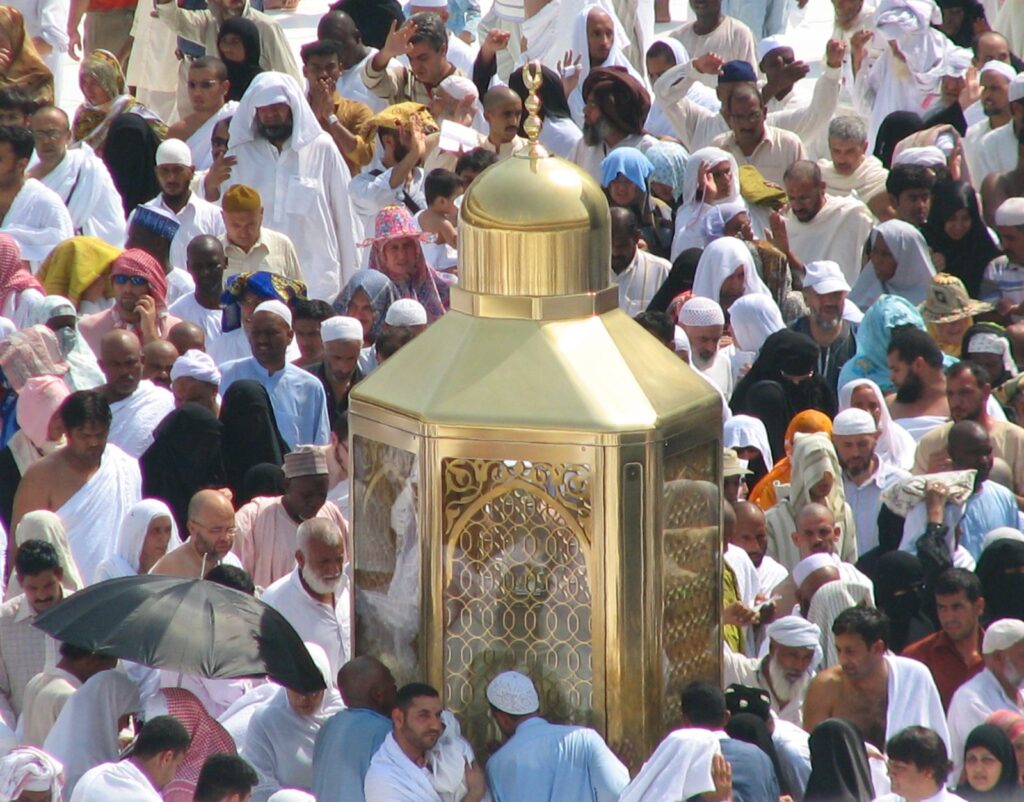
There is no specific supplication that must be recited for each circuit of tawaf. The person performing tawaf may recite the supplications they know, as well as tasbih, takbir, salawat and verses of the Qur’an; supplicating sincerely in their own language is also entirely appropriate. Between the Yemeni Corner and the Black Stone, the following supplication from the Qur’an is often recited (Surah al-Baqarah, verse 201):
Transliteration: Rabbana atina fid-dunya hasanatan wa fil-akhirati hasanatan wa qina ‘adhaban-nar.
Meaning: Our Lord! Give us good in this world and good in the Hereafter, and protect us from the punishment of the Fire.
We have brought together other texts, such as the talbiyah, the words said when greeting the Black Stone and the supplications of sa’i, with their transliterations and meanings in our article on supplications to recite during Umrah.
Tawaf is a unique experience of joining the same rhythm as the millions of believers circling the Kaaba; with correct knowledge and a little preparation, it is possible to live this experience in peace. At RotaNur, on our Umrah tours we perform the first tawaf together with our travellers and provide guidance at every step, from choosing a floor to counting the circuits. For any questions, you can reach us through our contact page.
Frequently Asked Questions
How long does a tawaf take?
The time a tawaf takes varies according to the crowds and the floor on which you perform it. At less crowded times, seven circuits on the ground level of the mataf are often completed in under an hour; on the upper floors and the roof level, however, because the circle is wider, both the distance and the time increase noticeably. Set aside extra time for the tawaf prayer, Zamzam and, if you are performing Umrah, sa’i; if you are with elderly relatives, allow for breaks as well.
Is it permissible to talk during tawaf?
There is no harm in necessary or beneficial conversation during tawaf; however, idle worldly talk has been regarded as disliked (makruh). As tawaf is an act of worship, it is recommended to spend this time in dhikr, supplication and salawat. You may speak briefly and quietly with your group companions to find your way or to confirm the circuit count and, by postponing phone calls until tawaf is over, you can preserve both your own peace of mind and that of the people around you.
How many times can voluntary tawaf be performed?
There is no set limit on the number of voluntary tawafs; as long as you are in Makkah, you may perform tawaf as much as you are able. According to the Hanafi school, it is necessary (wajib) to perform two rak’ahs of tawaf prayer after each tawaf; for this reason, the disliked (makruh) prayer times also need to be taken into account. Staying within walking distance of Masjid al-Haram and choosing the times when the crowds are thinner make it easier to perform voluntary tawafs without tiring yourself out.
What happens if you leave Makkah without performing the farewell tawaf?
According to the Hanafi school, the farewell tawaf is necessary (wajib) for pilgrims coming from outside Makkah, and leaving it out without a valid excuse requires a penalty sacrifice (dam). If the person who has left returns and performs the tawaf before crossing the miqat, no penalty is required. Women who are menstruating or experiencing postnatal bleeding are exempt from this tawaf; and it is not necessary for those who are performing only Umrah. We explain its place among the rites of Hajj in our article how to perform Hajj.
Do you have to be in ihram to perform tawaf?
No, you do not need to be in ihram for every tawaf. The tawaf of Umrah is performed in ihram; voluntary tawaf, and the Tawaf al-Ziyarah and farewell tawaf performed after leaving ihram, can be done in normal clothes. In every case, you must be in a state of wudu and your awrah must be covered. As the ground level of the mataf may be reserved for those in ihram during busy periods, those performing tawaf without ihram may be directed to the upper floors; find out the current arrangements from the staff.

Cihat Murat Yüksel is the editor of the RotaNur blog and the founder of Markention. Drawing on the sources of Türkiye's Presidency of Religious Affairs (Diyanet), he turns the questions travellers ask most about preparing for Umrah, Hajj and halal travel into clear, practical guides.
Questions answered in this article
What Is Tawaf and What Types of Tawaf Are There?
Tawaf means walking around the Kaaba seven times in a set manner; each circuit is called a shawt. According to the Hanafi school, the first four circuits of tawaf are a pillar (rukn), while the remaining three circuits are necessary (wajib). Tawaf is one of the core acts of worship of Hajj and Umrah, and it is also a voluntary act of worship that anyone in Makkah can perform whenever they wish. The rulings on the different types of tawaf can be summarised as follows:
How do you make the intention for tawaf?
The intention is made in the heart, and it is good to say it with the tongue as well. In your own language, you can say something like: “O Allah, I intend to perform the tawaf of Umrah for Your sake; make it easy for me and accept it from me.” For a voluntary tawaf, the type of tawaf is expressed accordingly. The intention for tawaf is made shortly before reaching the line of the Black Stone.
Can tawaf be performed without wudu?
No. According to the Hanafi school, performing tawaf in a state of wudu is necessary (wajib). A tawaf performed without wudu requires a penalty depending on its type, and it is recommended that it be performed again with wudu. For this reason, it is important to check your wudu before starting tawaf and to be careful that your wudu is not broken in the crowd.
Do you need to touch the Black Stone in the crowd?
No, touching and kissing the Black Stone is not a requirement; in a crowd, it is sufficient to greet it by gesturing with your hand from a distance. Pushing to reach the stone, hurting others and disrupting the flow of tawaf can mean falling into a forbidden (haram) act for the sake of an act that is Sunnah.
What should I do if I realise I have already passed the Black Stone line?
If you realise that you have passed the starting line, do not try to walk against the flow of the crowd. The safest course is to carry on with tawaf and start counting your circuits from the Black Stone line the next time you reach it. This way, there is no chance of performing an incomplete circuit.
How Are Idtiba and Raml Performed in Practice?
In tawafs that will be followed by sa’i, such as the tawaf of Umrah, there are two Sunnah practices for men. Idtiba means passing the middle of the rida under the right armpit and throwing both ends over the left shoulder, leaving the right shoulder bare. Idtiba is maintained from the beginning to the end of tawaf, and before the tawaf prayer, the rida is adjusted again to cover both shoulders. For the general arrangement of the ihram garments, you can read our article how to wear ihram.