


Contents 13 sections
- Where Are the Hills of Safa and Marwa?
- What do the names Safa and Marwa mean?
- How Many Metres Is It from Safa to Marwa?
- The Story of Safa and Marwa: Hajar and Ismail
- Safa and Marwa in the Quran and the Hadith
- What Is Sa’y, and What Is Its Ruling?
- Is ablution required for sa’y?
- How Is Sa’y Performed?
- Why do people walk briskly between the green lights?
- The Mas’a Today: Floors, Wheelchairs and Its Old State
- Supplications to Recite During Sa’y
- Tips for Visiting Safa and Marwa
- Frequently Asked Questions
The two small hills that come to mind at the words Safa and Marwa lie on the eastern side of Masjid al-Haram, a few hundred metres from the Kaaba, and the sa’y, one of the necessary rites of Umrah and Hajj, is performed between these two hills. These hills, between which Hajar ran seven times in search of water for her son Ismail, were counted among “the symbols of Allah” in the Quran and became part of worship through the sa’y of the Prophet. In this article we explain where the hills of Safa and Marwa are, how many metres apart they are, the story of Hajar, Safa and Marwa in the Quran and the hadiths, the ruling on sa’y and how it is performed, the meaning of the green lights, today’s sa’y area (the mas’a) and its old state, and practical tips for sa’y in crowds and in a wheelchair.
In Short
On the eastern side of Masjid al-Haram in Makkah, near the Kaaba. Safa is the southern hill and Marwa the northern one; the way between them (the mas’a) is today under the roof of the mosque.
Where Are the Hills of Safa and Marwa?
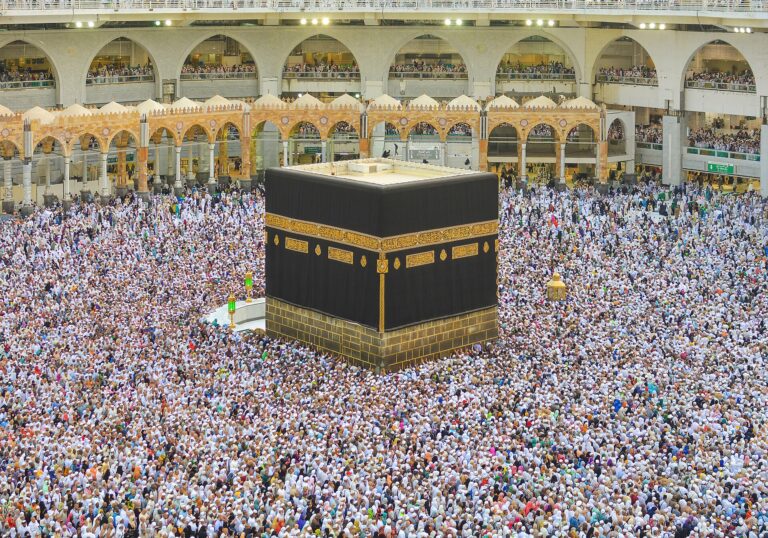
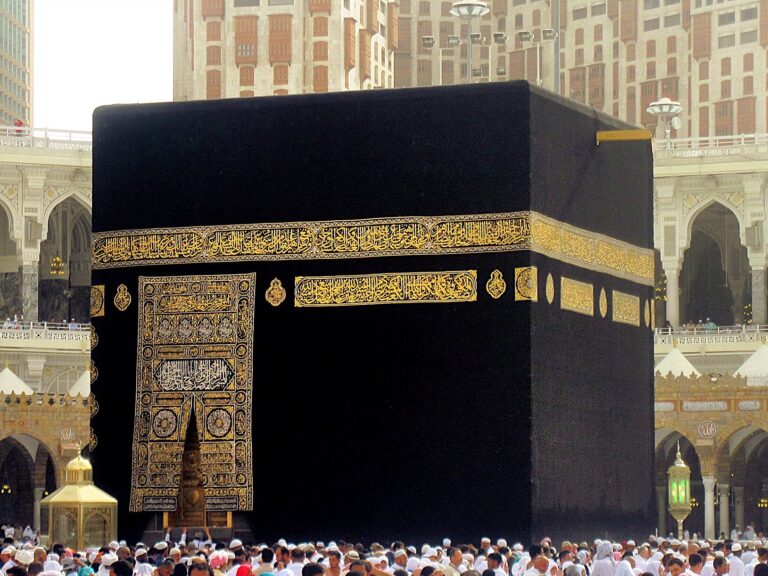
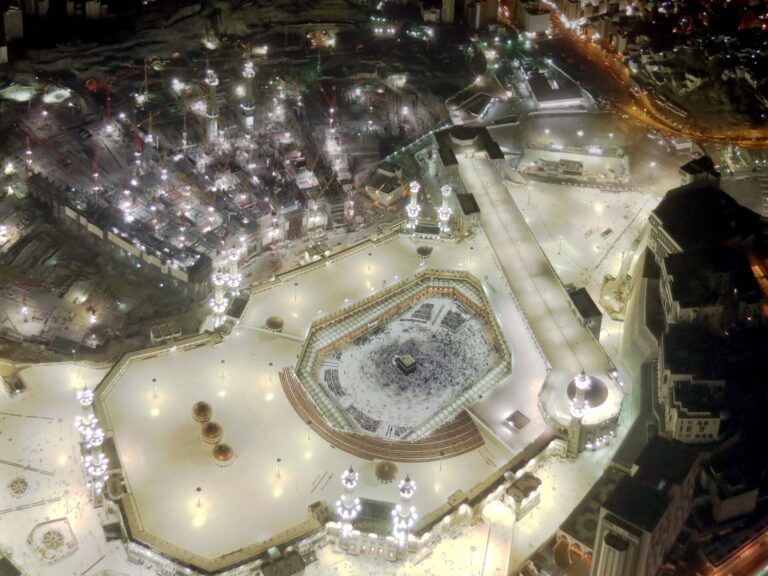
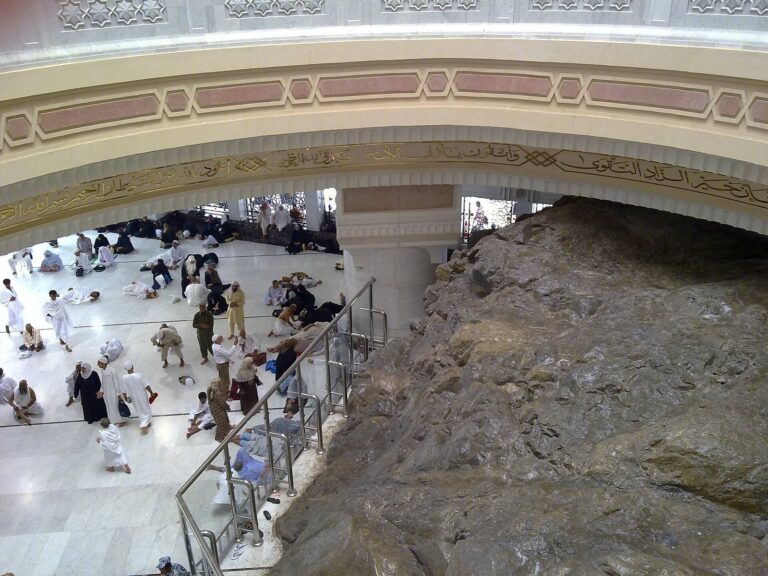
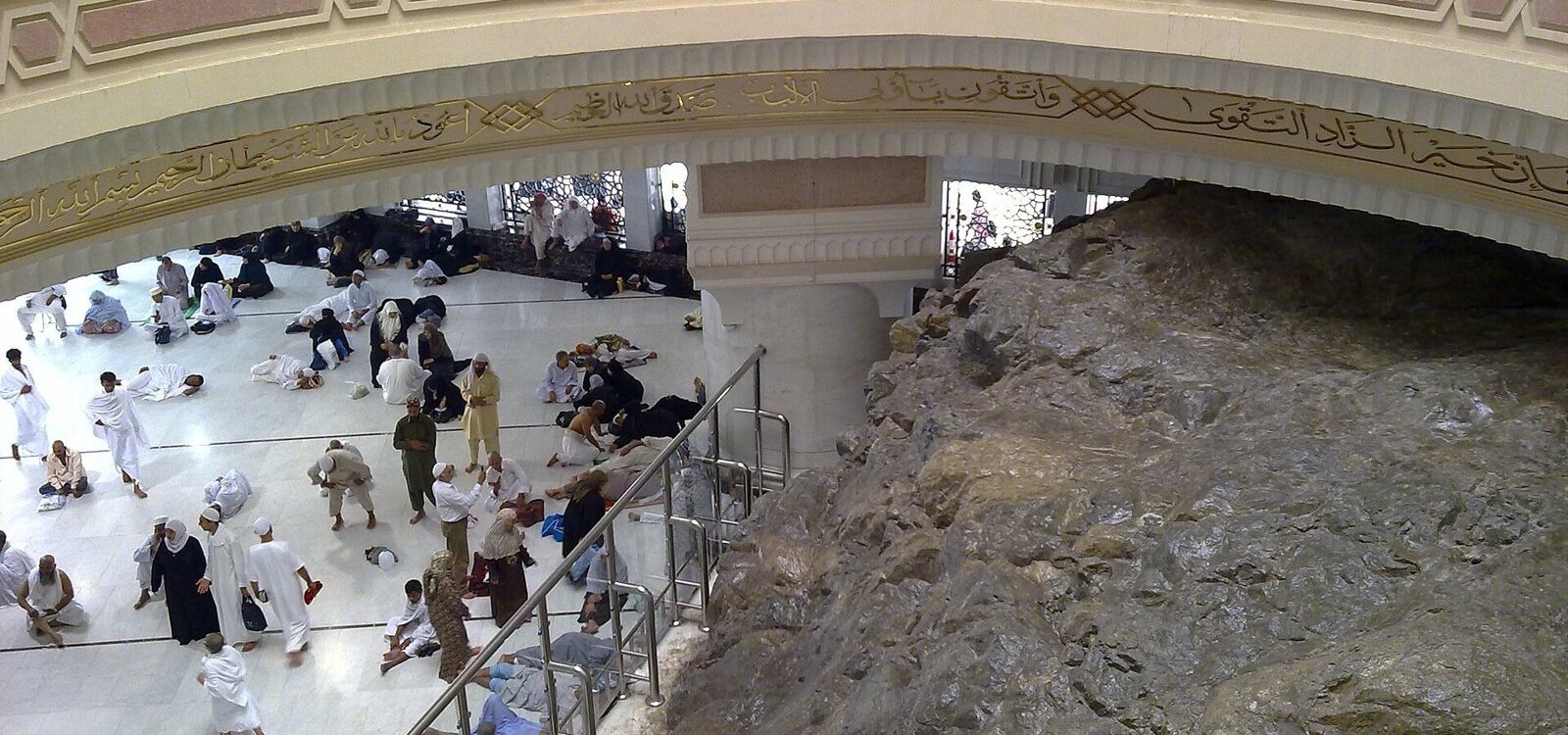
Safa and Marwa are two hills inside Masjid al-Haram in Makkah, to the east of the Kaaba; Safa is the southern hill, closer to the Kaaba, and Marwa the northern one. Once outside the mosque at the foot of the mountains of Abu Qubays and Qu’ayqi’an, these two hills were brought under the roof of Masjid al-Haram by the 20th-century expansions, and the way between them became part of the mosque under the name “mas’a” (the place of sa’y). Today the rocky ground of Safa can be seen at the southern end of the mas’a behind glass railings; the rock of Marwa stands at the northern end, embedded in the wall. An Umrah pilgrim who has circled the Kaaba reaches Safa in a few minutes by walking from the line of the Black Stone towards the mas’a. The gates, floors and sections of Masjid al-Haram are described in our article on Masjid al-Haram, and the location of the Kaaba in our article on where the Kaaba is.
What do the names Safa and Marwa mean?
In Arabic “safa” means hard, smooth rock and “marwa” means white, shining stone; the two hills took their names from the type of rock at their base. The dark hard rock of Safa can be seen exposed today at the southern end of the mas’a; the whitish stone of Marwa stands embedded in the wall at the northern end. Both are mentioned by these names in the Quran (al-Baqarah, 2/158).
How Many Metres Is It from Safa to Marwa?
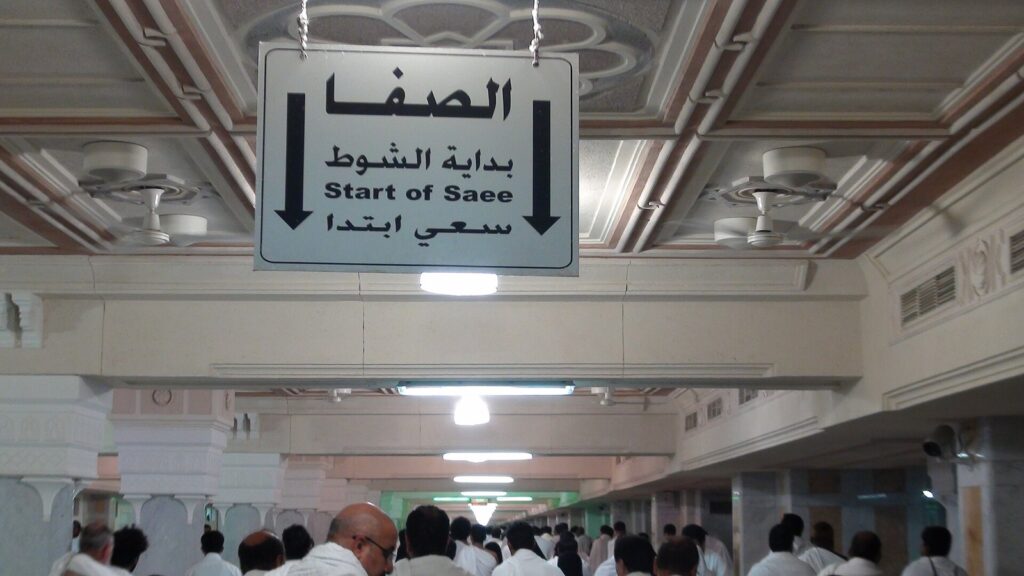
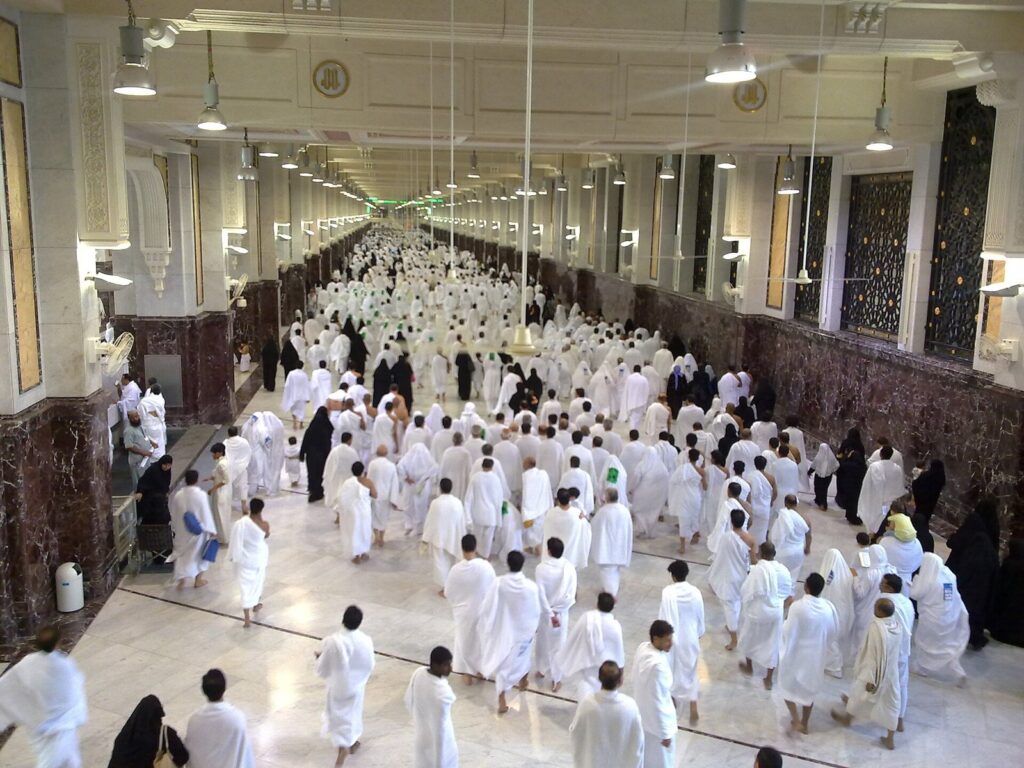
The distance between Safa and Marwa is about 400–450 metres; the sources give measurements varying between 394 and 450 metres, because the measurement changes according to which point of each hill is taken as the basis. Since one passage from Safa to Marwa counts as one lap (shawt) and the sa’y consists of seven laps, the total walking distance is about three kilometres; at an average pace the sa’y takes forty to fifty minutes, and up to an hour in crowds. The mas’a today is a hall about forty metres wide and several storeys high; the outward and return directions are separated, and lanes for wheelchairs have been made in the middle.
| Topic | Information |
|---|---|
| Location | The eastern side of Masjid al-Haram, near the Kaaba; Safa to the south, Marwa to the north |
| Distance between them | About 400–450 metres (394–450 m according to the sources) |
| Sa’y distance | 7 laps, about 3 km in total; 40–60 minutes |
| Green lights | The old valley floor between the two hills; men walk briskly here (harwala) |
| Mas’a | About 40 m wide, several storeys, air-conditioned; wheelchair lanes |
| Ruling | Wajib in the Hanafi school; a pillar (rukn) in the Shafi’i, Maliki and Hanbali schools |
The Story of Safa and Marwa: Hajar and Ismail
According to the long narration from Ibn Abbas (may Allah be pleased with him) in the Book of the Prophets in Bukhari, the Prophet Ibrahim, by the command of Allah, left his wife Hajar and his still suckling son Ismail in the valley of Makkah, at the place where the Kaaba stands; they had with them a bag of dates and a skin of water. When the water ran out Hajar, so as not to see her crying child, climbed the nearby hill of Safa, looked around, and when she saw no one she went down into the valley and, running along the low part of the valley, climbed Marwa; she repeated this seven times. On the seventh ascent she heard a voice and saw Zamzam springing up at Ismail’s feet. At the end of this narration the Prophet said, “That is why people perform sa’y between the two hills” (Bukhari, Anbiya 9). The sa’y is a mother’s search for water for her child kept alive as an act of worship by the whole community; every Muslim who circles the Kaaba then follows in Hajar’s footsteps. The same narration also tells how the tribe of Jurhum settled by Zamzam and how Makkah grew into a town. The story of Zamzam and its state today are told in our article on the well of Zamzam.
Safa and Marwa in the Quran and the Hadith
Hajar’s story was turned into worship by revelation. Safa and Marwa are mentioned by name in the Quran: “Indeed, Safa and Marwa are among the symbols of Allah. So whoever makes Hajj to the House or performs Umrah, there is no blame upon him for walking between them” (al-Baqarah, 2/158). According to the explanation of Aisha (may Allah be pleased with her), this verse was revealed to remove the hesitation of the Muslims who, because of the idols on these hills in the pre-Islamic period, were reluctant to perform sa’y (Bukhari, Hajj 79). At the Farewell Hajj the Prophet climbed Safa, and when he saw the Kaaba he pronounced the takbir and the tahlil, said “La ilaha illallahu wahdahu la sharika lah, lahu’l-mulku wa lahu’l-hamdu wa huwa ala kulli shay’in qadir”, made a long supplication, then walked to Marwa, quickened his pace on the floor of the valley and made the same supplication at Marwa (Muslim, Hajj 147). His beginning from Safa, saying “We begin with what Allah began with”, is the basis for the sa’y beginning at Safa and ending at Marwa.
What Is Sa’y, and What Is Its Ruling?
The place of Safa and Marwa in worship is understood through the sa’y. Sa’y literally means to run and to strive; in the language of worship it means going back and forth seven times between Safa and Marwa. According to the Hanafi school sa’y is one of the necessary (wajib) rites of Hajj and Umrah; if it is omitted, a penalty sacrifice (dam) is required. According to the Shafi’i, Maliki and Hanbali schools, sa’y is a pillar (rukn); Hajj and Umrah are not complete without it. In Umrah the sa’y is performed once, after the tawaf of Umrah; in Hajj it is performed after the tawaf of arrival or the tawaf of visitation according to the type of Hajj, and one sa’y is enough for one Hajj. Those performing Hajj al-Tamattu perform two sa’ys, one for Umrah and one for Hajj; in Hajj al-Ifrad there is a single sa’y, and if the pilgrim performs it after the tawaf of arrival on reaching Makkah, it is not repeated after the tawaf of visitation on the days of Eid. The sa’y must come after a tawaf and be tied to a tawaf performed in ihram; a person performing Umrah does not shave before finishing the sa’y. We described the steps of Umrah in our article on how Umrah is performed and the steps of Hajj in our article on how Hajj is performed.
Is ablution required for sa’y?
No; ablution is not a condition for sa’y, but performing it in a state of ablution is recommended. The reason ablution is required for tawaf but not for sa’y is that sa’y, although it takes place inside the mosque, is not counted as an act of worship with the status of prayer. This is why women in their monthly period cannot perform tawaf, but if they have already performed their tawaf they may continue with the sa’y; if ablution is broken during the sa’y, the sa’y is not invalidated. Being in ihram is not a condition for sa’y either; but since in Umrah one does not leave ihram before the sa’y is finished, the sa’y of Umrah is in practice performed in ihram. In Hajj, the sa’y performed after the tawaf of visitation is without ihram.
How Is Sa’y Performed?
Sa’y begins, after the tawaf and the tawaf prayer, by greeting the Black Stone from a distance and moving into the mas’a. One climbs Safa, turns towards the Kaaba, pronounces the takbir and the tahlil and makes supplication; then one walks towards Marwa, men passing briskly through the section marked with green lights, and on reaching Marwa one turns towards the Kaaba again and makes supplication. Reaching Marwa is the first lap; returning from Marwa to Safa is the second lap, and the seventh lap ends at Marwa. The steps of sa’y are as follows:
- Intention after the tawaf and the tawaf prayer: “O Allah, I intend to perform the sa’y of Umrah (of Hajj) for Your sake; make it easy for me and accept it.”
- Climbing Safa: facing the Kaaba, hands raised, the takbir, the tahlil and the salawat are pronounced and supplication is made.
- Walking to Marwa: between the green lights men perform harwala and women walk normally; supplication and remembrance along the way.
- Standing at Marwa: one turns towards the Kaaba and makes supplication as at Safa; this is the first lap.
- Seven laps are completed in the same manner; the seventh lap ends at Marwa and supplication is made.
- In Umrah, after the sa’y one shaves or trims the hair and leaves ihram; in Hajj the following steps continue according to the type of Hajj.
Why do people walk briskly between the green lights?
The section marked with green lights corresponds to the old valley floor along which Hajar ran because she could not see Ismail; the Prophet, too, quickened his pace in this section during the sa’y. The brisk and lively walk of men here is called “harwala” and is Sunnah; women do not quicken their pace. Harwala is not running; it is enough to walk with quicker steps without pushing anyone in the crowd. The elderly and the sick may pass without harwala.
Important: Sa’y begins at Safa; the first passage of a person who begins at Marwa does not count, and one more lap must be performed. A person in doubt about the number of laps takes the number known for certain as the basis. Sa’y may be performed on a day other than the tawaf, but never before the tawaf; in Umrah, shaving before the sa’y is finished means violating a prohibition of ihram.
The Mas’a Today: Floors, Wheelchairs and Its Old State
The place where sa’y is performed today looks very different from the open valley along which Hajar ran, but the two hills and the distance between them are the same. Until the 1950s the way between Safa and Marwa was a market street outside Masjid al-Haram, lined on both sides with shops; pilgrims performed the sa’y in this street, in the open. In the photographs of the late 19th century the mas’a can be seen in this state, with its arched gateways at Safa and Marwa. With the Saudi expansions the mas’a was first turned into a covered hall, and with the expansion begun in 2008 its width, previously about twenty metres, was increased to forty metres and floors were added. Today the sa’y can be performed on the ground floor, on the first and second floors and on the roof; the floors are air-conditioned, and the outward and return lanes are separated. For sa’y in a wheelchair the middle lanes and the upper floors are set aside; the mosque’s wheelchair service and electric carts may be used. The sa’y of elderly and sick pilgrims performed on an upper floor or in a wheelchair is valid. In busy hours the upper floors are more comfortable; the hours after the dawn prayer and around midnight are the quietest times. In the Hajj season and in the last ten days of Ramadan all the floors of the mas’a fill up; in those periods the sa’y may take more than an hour, and group leaders shift the sa’y to the night hours. For those curious about the old state of the mas’a, the photographs of Makkah from the late 19th century show the three-arched gateway at Safa and the street lined with shops; these photographs are found today in the museums of Makkah and in the Ottoman archives.
Supplications to Recite During Sa’y
No particular text of supplication is required for sa’y; it is enough to turn towards the Kaaba at Safa and Marwa, to say the takbir and the tahlil which the Prophet recited, and to make whatever supplication one wishes along the way. Reciting between the green lights the supplication “Rabbiğfir verham ve tecâvez ammâ ta’lem, inneke ente’l-eazzü’l-ekrem” (Rabbighfir warham wa tajawaz amma ta’lam, innaka anta’l-a’azzu’l-akram: My Lord, forgive, have mercy and overlook what You know of my faults; indeed You are the Most Mighty, the Most Generous) is a practice narrated from the Companions. The long texts divided lap by lap in dua books are not binding; a supplication made in one’s own language is also accepted. To pronounce the takbir and the tahlil three times at each ascent of Safa and Marwa and to make supplication between them is the practice of the Prophet; in crowds one should make a short, sincere supplication and give way rather than standing for a long time. The words and meaning of the sa’y supplications are explained in our article on duas to recite during Umrah, and those of tawaf in our article on how tawaf is performed.
Tips for Visiting Safa and Marwa
After the knowledge, the practice: for most Umrah pilgrims the first sa’y between Safa and Marwa is more tiring and more emotional than the tawaf. Because the sa’y comes after the tawaf, it is the most tiring part of Umrah; together with the tawaf, close to five kilometres are walked. Slippers are not taken off at the entrance to the mas’a, and the sa’y may be performed in slippers; but since it is inside Masjid al-Haram, clean slippers are needed. For water, one may drink from the Zamzam taps on either side of the mas’a. For the elderly and children, the sa’y may also be performed in a separate session after a short rest following the tawaf; a long gap between the tawaf and the sa’y does not invalidate the worship. To avoid losing the group in the crowd, it is a practical solution to fix a meeting point at Safa or Marwa, and if women and men perform the sa’y separately, to meet at Marwa when the sa’y ends. The particular situations of women regarding the sa’y are explained in our article on how women go to Umrah. Keeping away from worldly talk during the sa’y, not blocking others’ way by taking photographs on the phone, and keeping count of the laps with prayer beads or on the fingers make the worship easier.
- Beginning the sa’y with a short breather and a Zamzam break rather than immediately after the tawaf prayer reduces fatigue.
- In busy hours prefer the upper floors; the sa’y is valid even though the distance is longer.
- Increase the lap count at every arrival at Marwa: laps 1, 3, 5 and 7 end at Marwa; 2, 4 and 6 at Safa.
- Quickening the pace between the green lights is Sunnah for men; women and the elderly walk normally.
Frequently Asked Questions
Where are the hills of Safa and Marwa?
On the eastern side of Masjid al-Haram in Makkah, near the Kaaba. Safa is the southern hill and Marwa the northern one; the way between them (the mas’a) is today under the roof of the mosque.
How many metres is it from Safa to Marwa?
About 400–450 metres. In the seven-lap sa’y about three kilometres are walked in total, and the sa’y usually takes forty to sixty minutes.
Why do people run between Safa and Marwa?
Hajar ran seven times between the two hills in search of water for her son Ismail; the Prophet, too, quickened his pace on the floor of the valley during the sa’y. Today men walk briskly (harwala) in the section marked with green lights, while women walk normally.
How many laps is sa’y and where does it end?
It is seven laps; one passage from Safa to Marwa counts as one lap. Sa’y begins at Safa and the seventh lap ends at Marwa.
Is ablution needed for sa’y?
It is not a condition; being in a state of ablution is recommended. If ablution is broken during the sa’y, the sa’y is not invalidated; women in their monthly period may perform the sa’y if they have already performed their tawaf.
Can sa’y be performed in a wheelchair?
Yes; wheelchair lanes and the upper floors of the mas’a are set aside for this. A sa’y performed in a wheelchair or an electric cart is valid.
Cihat Murat Yüksel is the editor of the RotaNur blog and the founder of Markention. Drawing on the sources of Türkiye's Presidency of Religious Affairs (Diyanet), he turns the questions travellers ask most about preparing for Umrah, Hajj and halal travel into clear, practical guides.
Questions answered in this article
Where Are the Hills of Safa and Marwa?
Safa and Marwa are two hills inside Masjid al-Haram in Makkah, to the east of the Kaaba; Safa is the southern hill, closer to the Kaaba, and Marwa the northern one. Once outside the mosque at the foot of the mountains of Abu Qubays and Qu’ayqi’an, these two hills were brought under the roof of Masjid al-Haram by the 20th-century expansions, and the way between them became part of the mosque under the name “mas’a” (the place of sa’y). Today the rocky ground of Safa can be seen at the southern end of the mas’a behind glass railings; the rock of Marwa stands at the northern end, embedded in the wall. An Umrah pilgrim who has circled the Kaaba reaches Safa in a few minutes by walking from the line of the Black Stone towards the mas’a. The gates, floors and sections of Masjid al-Haram are described in our article on Masjid al-Haram, and the location of the Kaaba in our article on where the Kaaba is.
What do the names Safa and Marwa mean?
In Arabic “safa” means hard, smooth rock and “marwa” means white, shining stone; the two hills took their names from the type of rock at their base. The dark hard rock of Safa can be seen exposed today at the southern end of the mas’a; the whitish stone of Marwa stands embedded in the wall at the northern end. Both are mentioned by these names in the Quran (al-Baqarah, 2/158).
How Many Metres Is It from Safa to Marwa?
The distance between Safa and Marwa is about 400–450 metres; the sources give measurements varying between 394 and 450 metres, because the measurement changes according to which point of each hill is taken as the basis. Since one passage from Safa to Marwa counts as one lap (shawt) and the sa’y consists of seven laps, the total walking distance is about three kilometres; at an average pace the sa’y takes forty to fifty minutes, and up to an hour in crowds. The mas’a today is a hall about forty metres wide and several storeys high; the outward and return directions are separated, and lanes for wheelchairs have been made in the middle.
What Is Sa’y, and What Is Its Ruling?
The place of Safa and Marwa in worship is understood through the sa’y. Sa’y literally means to run and to strive; in the language of worship it means going back and forth seven times between Safa and Marwa. According to the Hanafi school sa’y is one of the necessary (wajib) rites of Hajj and Umrah; if it is omitted, a penalty sacrifice (dam) is required. According to the Shafi’i, Maliki and Hanbali schools, sa’y is a pillar (rukn); Hajj and Umrah are not complete without it. In Umrah the sa’y is performed once, after the tawaf of Umrah; in Hajj it is performed after the tawaf of arrival or the tawaf of visitation according to the type of Hajj, and one sa’y is enough for one Hajj. Those performing Hajj al-Tamattu perform two sa’ys, one for Umrah and one for Hajj; in Hajj al-Ifrad there is a single sa’y, and if the pilgrim performs it after the tawaf of arrival on reaching Makkah, it is not repeated after the tawaf of visitation on the days of Eid. The sa’y must come after a tawaf and be tied to a tawaf performed in ihram; a person performing Umrah does not shave before finishing the sa’y. We described the steps of Umrah in our article on how Umrah is performed and the steps of Hajj in our article on how Hajj is performed.
Is ablution required for sa’y?
No; ablution is not a condition for sa’y, but performing it in a state of ablution is recommended. The reason ablution is required for tawaf but not for sa’y is that sa’y, although it takes place inside the mosque, is not counted as an act of worship with the status of prayer. This is why women in their monthly period cannot perform tawaf, but if they have already performed their tawaf they may continue with the sa’y; if ablution is broken during the sa’y, the sa’y is not invalidated. Being in ihram is not a condition for sa’y either; but since in Umrah one does not leave ihram before the sa’y is finished, the sa’y of Umrah is in practice performed in ihram. In Hajj, the sa’y performed after the tawaf of visitation is without ihram.
How Is Sa’y Performed?
Sa’y begins, after the tawaf and the tawaf prayer, by greeting the Black Stone from a distance and moving into the mas’a. One climbs Safa, turns towards the Kaaba, pronounces the takbir and the tahlil and makes supplication; then one walks towards Marwa, men passing briskly through the section marked with green lights, and on reaching Marwa one turns towards the Kaaba again and makes supplication. Reaching Marwa is the first lap; returning from Marwa to Safa is the second lap, and the seventh lap ends at Marwa. The steps of sa’y are as follows:
Why do people walk briskly between the green lights?
The section marked with green lights corresponds to the old valley floor along which Hajar ran because she could not see Ismail; the Prophet, too, quickened his pace in this section during the sa’y. The brisk and lively walk of men here is called “harwala” and is Sunnah; women do not quicken their pace. Harwala is not running; it is enough to walk with quicker steps without pushing anyone in the crowd. The elderly and the sick may pass without harwala.