










Contents 18 sections
- What Is the Talbiyah and What Does It Mean?
- What does talbiyah mean?
- The Words and Meaning of the Talbiyah
- The History of the Talbiyah: Answering the Call of Ibrahim
- Does the talbiyah appear in the Qur’an?
- The Source and Ruling of the Talbiyah
- Can another remembrance be recited in place of the talbiyah?
- When Does the Talbiyah Begin?
- When is the talbiyah recited?
- When Does the Talbiyah End in Umrah and in Hajj?
- When does the talbiyah end?
- How Is the Talbiyah Recited? Voice, Frequency and Etiquette
- Do women recite the talbiyah aloud?
- Duas to Recite After the Talbiyah
- Common Mistakes Concerning the Talbiyah
- What does someone who forgets or delays the talbiyah do?
- A Short Reflection on the Meaning of the Talbiyah
- Frequently Asked Questions
The talbiyah is the answer to the call that begins with the words “Labbayk Allahumma labbayk”, which every Umrah and Hajj pilgrim who enters ihram keeps on their tongue. It is recited together with the intention at the miqat, repeated throughout the journey, and ends with tawaf on reaching the Kaaba. In this article we explain the words and meaning of the talbiyah, its source and ruling, when it begins and ends in Umrah and Hajj, how it is recited and the duas that may be recited after it, following the explanations of Diyanet (Türkiye’s Presidency of Religious Affairs). The talbiyah is a short text; but saying it with an understanding of its meaning changes the spirit of the journey from the first moment of ihram.
What Is the Talbiyah and What Does It Mean?
In the dictionary, talbiyah means “to answer a call, to obey a command”. As a term it refers to the words of remembrance beginning “Labbayk Allahumma labbayk”, which a person who has made the intention for Hajj or Umrah recites when entering ihram and for as long as they remain in ihram. The word “labbayk” is translated as “here I am, at Your service, I have answered Your call”. The person reciting the talbiyah declares that they are answering the call to Hajj that Allah made to humankind through the Prophet Ibrahim; this call is mentioned in verse 27 of Surah al-Hajj.
What does talbiyah mean?
The talbiyah is answering Allah’s invitation with “here I am, at Your service” through the words “Labbayk Allahumma labbayk”. The word comes from the Arabic root “labbayk” and is the name of the remembrance that Hajj and Umrah pilgrims recite throughout the time they are in ihram. The talbiyah is both the sign of entering ihram and an audible reminder of servitude throughout the journey.
The Words and Meaning of the Talbiyah
The text of the talbiyah is fixed as narrated from the Prophet (peace be upon him) by Bukhari and Muslim, and it is recited in the same words all over the world. Its words and meaning are as follows:
Words: Lebbeyk Allâhümme lebbeyk. Lebbeyke lâ şerîke leke lebbeyk. İnne’l-hamde ve’n-ni’mete leke ve’l-mülk. Lâ şerîke lek. (Labbayk Allahumma labbayk, labbayka la sharika laka labbayk, inna l-hamda wa n-ni’mata laka wa l-mulk, la sharika lak.)
Meaning: Here I am, O Allah, here I am! At Your service, here I am! You have no partner; at Your service, here I am! Truly all praise is Yours; the blessing and the sovereignty are Yours. You have no partner.
Reciting the talbiyah in its Arabic original is in keeping with the Sunnah; but a person who knows no Arabic at all also recites the talbiyah by saying its meaning in their own language. According to Diyanet’s rulings, what matters is the awareness of answering the call. Learning the words piece by piece makes memorisation easier: the sentence “Labbayk Allahumma labbayk” twice, then “la sharika laka labbayk”, then the sentence of praise and sovereignty, and again “la sharika lak”. We collected the other duas to be recited for Umrah in our article on the duas of Umrah.
The History of the Talbiyah: Answering the Call of Ibrahim
The origin of the talbiyah lies in the call to Hajj described in the Qur’an. In verse 27 of Surah al-Hajj, Allah commands the Prophet Ibrahim to call people to Hajj; the commentaries relate that the souls answered this call with “labbayk”. The talbiyah is therefore the moment when the Hajj and Umrah pilgrim joins, in their own words, an invitation thousands of years old. The Arabs of the pre-Islamic period also recited a talbiyah; but they added words to the text that mentioned their idols. The Prophet (peace be upon him) re-established the talbiyah in the form we know today, with words that mention Allah alone and reject associating partners with Him.
The Companions attached great importance to the talbiyah. According to the narrations, the Prophet’s travelling companions repeated the talbiyah from Madinah to Makkah until their voices grew hoarse, and Umar said that reciting the talbiyah aloud was among the adornments of Hajj. This tradition lives on today as groups in ihram on the roads to Makkah say “Labbayk” with one voice.
Does the talbiyah appear in the Qur’an?
The text of the talbiyah is found not in the Qur’an but in the Sunnah of the Prophet (peace be upon him); it is narrated in the same words in the hadith sources, above all Bukhari and Muslim. What appears in the Qur’an is the call to which the talbiyah responds: verse 27 of Surah al-Hajj commands the Prophet Ibrahim to invite people to Hajj. The talbiyah is the servant’s answer to this invitation.
The Source and Ruling of the Talbiyah
The talbiyah is a remembrance that the Prophet (peace be upon him) recited during the Farewell Hajj and taught to the Companions; its text appears in the hadith sources in the same words. Its ruling differs between the schools of law. According to the Hanafi school, reciting the talbiyah together with the intention when entering ihram is a condition of ihram; one does not enter ihram merely by making the intention without reciting the talbiyah or a remembrance that takes its place. According to the Shafi’i, Maliki and Hanbali schools, ihram is established by the intention and the talbiyah is Sunnah.
Repeating the talbiyah frequently for as long as one remains in ihram is Sunnah according to all the schools. The Prophet’s encouragement to the effect that the best deeds of the pilgrim are the talbiyah and the sacrifice, and the narrations that the Companions recited the talbiyah until their voices were hoarse, show the place of this remembrance in the journey. Reciting the talbiyah aloud is also Sunnah; but the voice should not be loud enough to disturb those around you.
Can another remembrance be recited in place of the talbiyah?
According to the Hanafi school, if a remembrance of Allah such as tasbih, tahlil or takbir is recited in place of the talbiyah when entering ihram, the ihram is established, because what is required is to remember Allah together with the intention. Even so, the best course is to recite the talbiyah in its own text in order to follow the Sunnah of the Prophet (peace be upon him). After entering ihram, remembrances and duas other than the talbiyah may also be recited freely.
When Does the Talbiyah Begin?
The talbiyah begins the moment it is recited together with the intention for ihram. In practice the order is as follows:
- The nails are cut, the necessary cleaning is done and, if possible, a full ablution (ghusl) is taken; men wrap themselves in the unstitched ihram garments and women wear their normal clothes.
- If it is not a disliked time, two rak’ahs of ihram prayer are performed; it is Sunnah to recite Surah al-Kafirun in the first rak’ah and Surah al-Ikhlas in the second.
- The intention for Umrah or Hajj is made with the heart and the tongue; for the words of the intention, see our article on the intention for ihram.
- Immediately after the intention the talbiyah is recited. From this moment the person is in ihram and the ihram restrictions begin.
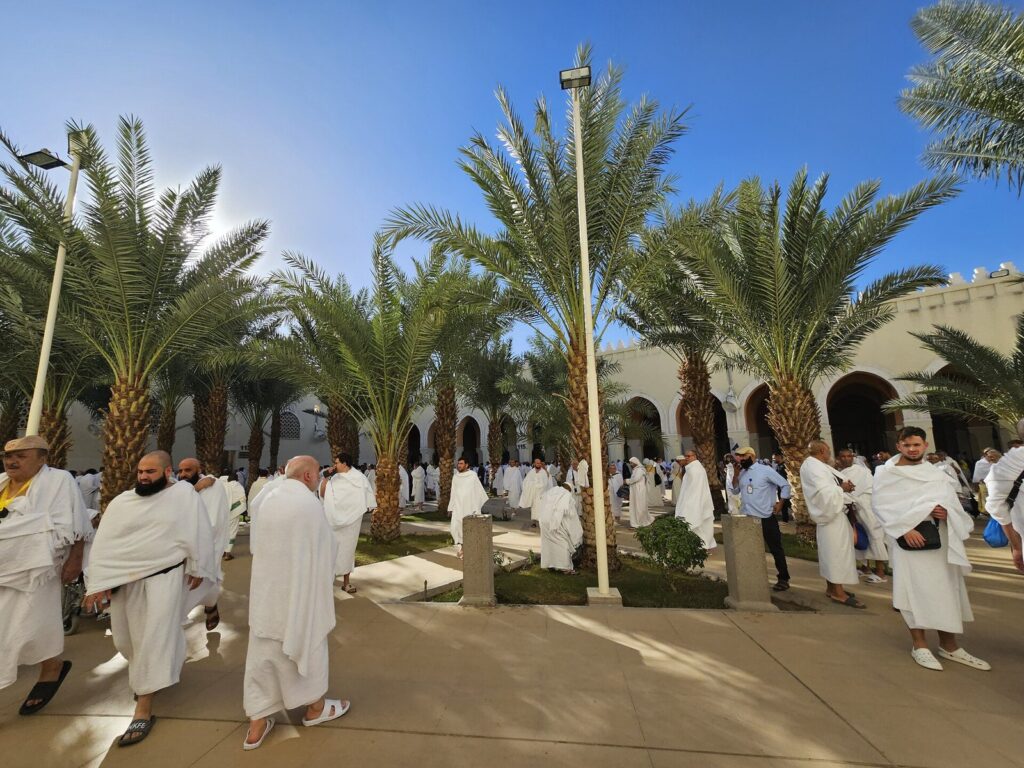
Where ihram is entered determines where the talbiyah begins. Those flying directly from Türkiye to Jeddah make their ihram preparations at the airport and recite the intention and talbiyah on the plane before reaching the miqat line; the guide or the cabin crew announces the moment. Groups that go to Madinah first make the intention and begin the talbiyah at the miqat of Dhul Hulaifah (Abyar Ali) when moving on to Makkah. Those who wish to perform a second Umrah in Makkah go to the Aisha Mosque in Tan’im and enter ihram in the same way, with the intention and talbiyah.
When is the talbiyah recited?
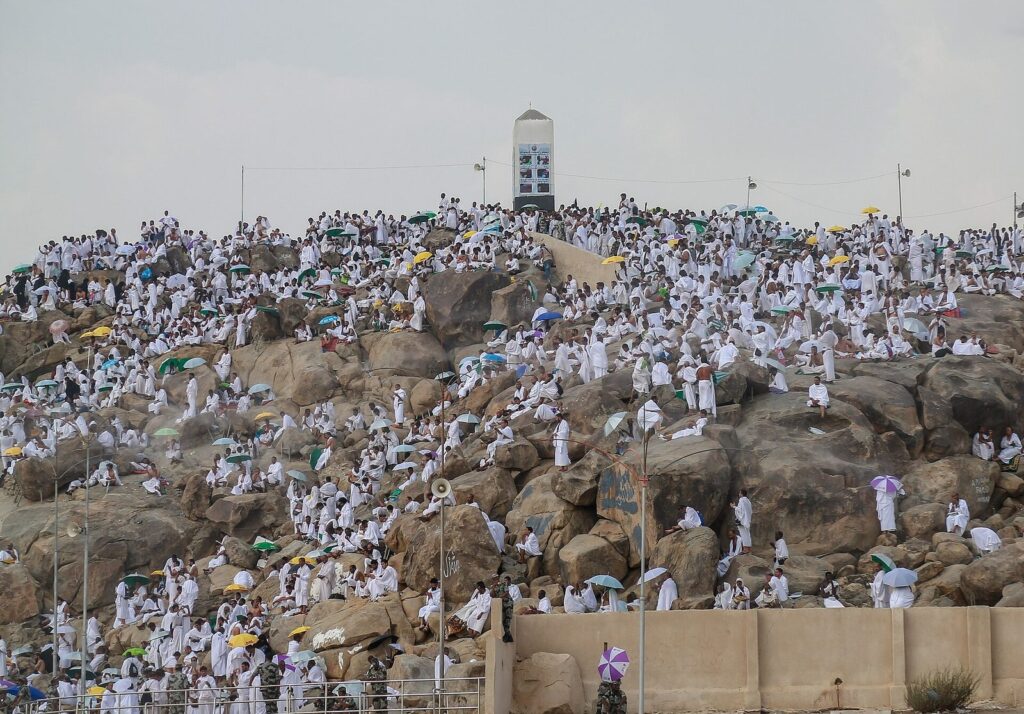
The talbiyah begins the moment the intention for ihram is made and is repeated throughout the time in ihram, especially at these moments: after the prayers, when going up or down a slope, when meeting another group, at dawn, when boarding or leaving a vehicle, and when entering Makkah. In Umrah the talbiyah stops when one enters Masjid al-Haram and begins tawaf; in Hajj it ends when the first stone is thrown at the Jamrat al-Aqabah on the morning of Eid.
When Does the Talbiyah End in Umrah and in Hajj?
The point at which the talbiyah ends is different in Umrah and Hajj. In Umrah the talbiyah stops the moment one enters Masjid al-Haram and begins the tawaf of Umrah; during tawaf, the duas and remembrances of tawaf are recited, not the talbiyah. In Hajj, the talbiyah continues throughout Arafat and Muzdalifah and ends with the throwing of the first stone at the Jamrat al-Aqabah on the first day of Eid. The table below summarises the beginning and end of the talbiyah in both acts of worship.
| Worship | Talbiyah begins | Talbiyah ends | Notes |
|---|---|---|---|
| Umrah | At the miqat, with the intention | When the tawaf of Umrah begins | No talbiyah during sa’i and shaving |
| Hajj (Ifrad) | At the miqat, with the intention for Hajj | With the first stone at the Jamrat al-Aqabah on Eid | The talbiyah stops during the arrival tawaf and resumes afterwards |
| Hajj (Tamattu’) | At the miqat for Umrah; again when entering ihram in Makkah for Hajj | With tawaf in Umrah, with the first stone at Aqabah in Hajj | No talbiyah between the two ihrams |
| Hajj (Qiran) | At the miqat, with the intention for Hajj and Umrah | With the first stone at the Jamrat al-Aqabah | The talbiyah stops during the tawaf of Umrah and then continues |
When does the talbiyah end?
In Umrah the talbiyah ends the moment one enters Masjid al-Haram and begins tawaf; in Hajj it ends when the first stone is thrown at the Jamrat al-Aqabah on the first day of Eid al-Adha. After these moments, takbir, tahlil and dua replace the talbiyah. For the details according to the types of Hajj, see our article on the types of Hajj, and for what to recite during tawaf, our guide on how to perform tawaf.
How Is the Talbiyah Recited? Voice, Frequency and Etiquette
The talbiyah is recited, if possible, three times in succession and with its meaning in mind; leaving a short pause after each repetition helps the words settle in the mind. When it is recited together on the bus or the plane, following the rhythm set by the guide strengthens the sense of unity in the group. In the practice of the Prophet, the talbiyah was recited aloud; for this reason men are advised to recite it audibly, and women in a low voice that only they and those next to them can hear. It is not necessary to recite it like a choir; everyone may recite it at their own pace. Not hurrying, pronouncing the words correctly and keeping the meaning in mind are part of the etiquette.
- Recite the talbiyah after each of the daily prayers; saying it three times after the prayer is common practice.
- Renew the talbiyah when boarding and leaving a vehicle, when going up and down slopes and when meeting another group.
- Recite the talbiyah more often when approaching and entering Makkah; say it for the last time before beginning tawaf on entering the Haram.
- Do not recite the talbiyah during tawaf and sa’i; in these parts the duas of tawaf and sa’i are recited.
- Make it a habit to send blessings on the Prophet and to make dua in your own language after the talbiyah.
Do women recite the talbiyah aloud?
Women recite the talbiyah in a low voice, so that only they and those immediately next to them can hear; according to the Hanafi school women do not need to raise their voices. This does not mean the talbiyah is less important for women; women also recite the talbiyah just as often for as long as they are in ihram. Women who are menstruating may also enter ihram and recite the talbiyah; they only postpone tawaf until they are clean.
Duas to Recite After the Talbiyah
It is Sunnah to send blessings on the Prophet (peace be upon him) and to make dua after the talbiyah. After the talbiyah the Companions would ask Allah for His pleasure and Paradise and seek refuge in Him from the Fire. A short dua narrated in the dua books for after the talbiyah is as follows:
Words: Allâhümme innî es’elüke rıdâke ve’l-cennete ve eûzü bike min sahatike ve’n-nâr. (Allahumma inni as’aluka ridaka wa l-jannata wa a’udhu bika min sakhatika wa n-nar.)
Meaning: O Allah, I ask You for Your pleasure and for Paradise; I seek refuge in You from Your anger and from the Fire.
Besides this dua, the dua from the Qur’an “Rabbenâ âtinâ fi’d-dünyâ haseneten ve fi’l-âhireti haseneten ve kınâ azâbe’n-nâr” (al-Baqarah, 2:201) is also often recited between the talbiyahs. It is not obligatory to recite a particular dua; a person may pray in their own language for their own needs. We explained the duas recited for the journey itself in our article on the travel dua.
Common Mistakes Concerning the Talbiyah
Although the talbiyah is a short text, some mistakes are repeated in practice. The most frequent mistake of those entering ihram for the first time is to think they have entered ihram by putting on the ihram garments; whereas ihram begins with the intention and the talbiyah. Making the intention after the miqat line has been passed on the plane is also a common error and requires a penalty. Continuing the talbiyah during tawaf, turning the talbiyah into a fast and meaningless repetition, and shouting it loudly enough to disturb others are other common mistakes.
Important: According to the Hanafi school, ihram is established by the talbiyah, or a remembrance that takes its place, recited together with the intention. Those travelling to Jeddah by plane must recite the intention and talbiyah before passing the miqat line; wait for your guide’s reminder and put on the ihram garments at the airport.
What does someone who forgets or delays the talbiyah do?
A person who has put on the ihram garments and made the intention but forgotten the talbiyah recites it as soon as they remember; according to the Hanafi school, if neither the talbiyah nor a remembrance was recited with the intention, ihram has not been entered, so if the miqat line has been passed the matter should be referred to the group’s religious guide. A person who passes the miqat without ihram returns to the miqat and enters ihram if possible; if they do not return, they must offer a sacrifice as a penalty.
A Short Reflection on the Meaning of the Talbiyah
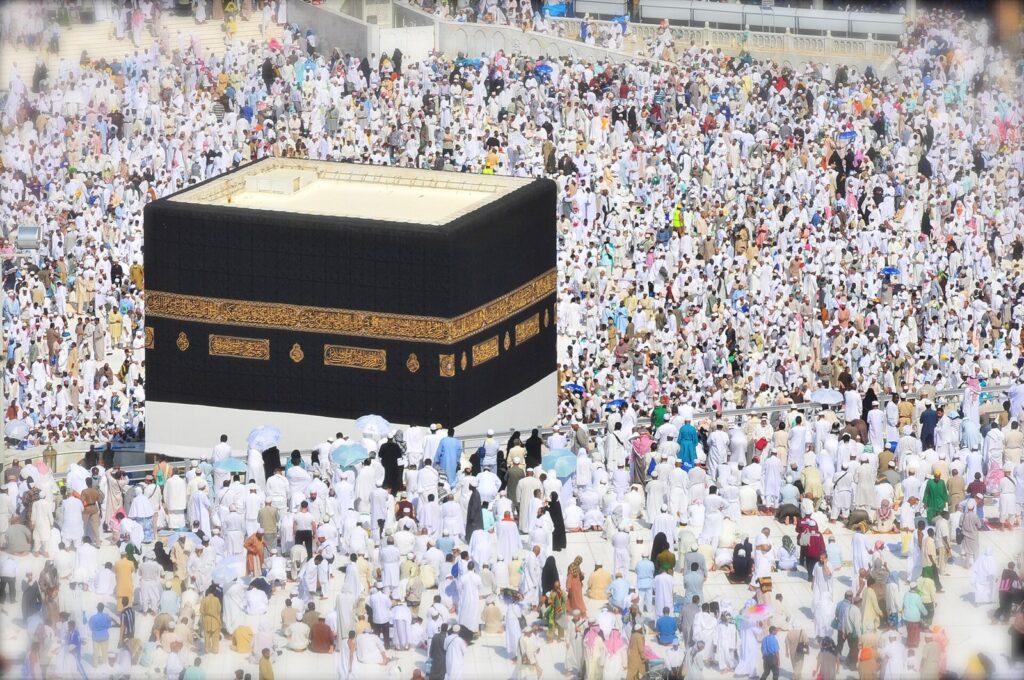
The talbiyah is a covenant that the person in ihram renews at every step. Saying “Here I am, O Allah, at Your service”, the servant reminds themselves of the reason for the journey; saying “You have no partner”, they declare the oneness of Allah; saying “Praise, blessing and sovereignty are Yours”, they remember the owner of everything in their hands. For this reason the talbiyah is not just a text to be memorised, but a consciousness that carries the meaning of ihram. That these words give way to takbir and dua when you first see the Kaaba shows the course the journey takes; we explained what to recite at that moment in our article on the dua on seeing the Kaaba.
At RotaNur we explain the moment of entering ihram, the talbiyah and the steps that follow in practice, with a guide, in our Umrah and Hajj programmes. You can see the programme options on our Umrah tours page, and for your questions about ihram and the talbiyah you can write to us 24/7 from our contact page or the WhatsApp button on this page.
Frequently Asked Questions
How many times is the talbiyah recited?
There is no set number; it is Sunnah to recite it three times when entering ihram and to repeat it frequently for as long as one is in ihram. Renewing the talbiyah after the prayers, when moving from place to place on the journey and when entering Makkah is common practice. More than the number, what matters is that the talbiyah is recited regularly and with its meaning in mind.
Can the talbiyah be recited in Turkish or English?
A person who cannot recite Arabic also enters ihram by saying the meaning of the talbiyah in their own language; according to Diyanet, what matters is the intention of answering the call. Even so, because it is short, learning the Arabic text is not difficult, and that is what conforms to the Sunnah. Repeating it for a few days before the journey is enough for most people.
Do children recite the talbiyah?
Children who have not reached puberty may perform Umrah with their guardian; if the child can recite the talbiyah when entering ihram they do so, and if not, the guardian makes the intention and recites the talbiyah on their behalf. The guardian sees to it that children observe the ihram restrictions; for situations requiring a penalty, the group’s religious guide is consulted.
Can the talbiyah be recited without performing the ihram prayer?
Yes, the two rak’ahs of ihram prayer are Sunnah, and if they cannot be performed because of a disliked time or impossibility, this does not prevent entering ihram with the intention and talbiyah. Those who enter ihram on the plane may perform the prayer at the airport; if they cannot, they make the intention and recite the talbiyah directly. Not performing the prayer does not leave the ihram incomplete.
What is the difference between the talbiyah and the takbir?
The talbiyah is the remembrance beginning “Labbayk Allahumma labbayk” recited while in ihram; the takbir is the phrase “Allahu akbar”. In Hajj, the takbir is added to the talbiyah from Muzdalifah onwards; with the first stone at the Jamrat al-Aqabah the talbiyah ends and gives way to the takbir. In Umrah the talbiyah stops when tawaf begins; on seeing the Kaaba, takbir and tahlil are recited.

Cihat Murat Yüksel is the editor of the RotaNur blog and the founder of Markention. Drawing on the sources of Türkiye's Presidency of Religious Affairs (Diyanet), he turns the questions travellers ask most about preparing for Umrah, Hajj and halal travel into clear, practical guides.
Questions answered in this article
What Is the Talbiyah and What Does It Mean?
In the dictionary, talbiyah means “to answer a call, to obey a command”. As a term it refers to the words of remembrance beginning “Labbayk Allahumma labbayk”, which a person who has made the intention for Hajj or Umrah recites when entering ihram and for as long as they remain in ihram. The word “labbayk” is translated as “here I am, at Your service, I have answered Your call”. The person reciting the talbiyah declares that they are answering the call to Hajj that Allah made to humankind through the Prophet Ibrahim; this call is mentioned in verse 27 of Surah al-Hajj.
What does talbiyah mean?
The talbiyah is answering Allah’s invitation with “here I am, at Your service” through the words “Labbayk Allahumma labbayk”. The word comes from the Arabic root “labbayk” and is the name of the remembrance that Hajj and Umrah pilgrims recite throughout the time they are in ihram. The talbiyah is both the sign of entering ihram and an audible reminder of servitude throughout the journey.
Does the talbiyah appear in the Qur’an?
The text of the talbiyah is found not in the Qur’an but in the Sunnah of the Prophet (peace be upon him); it is narrated in the same words in the hadith sources, above all Bukhari and Muslim. What appears in the Qur’an is the call to which the talbiyah responds: verse 27 of Surah al-Hajj commands the Prophet Ibrahim to invite people to Hajj. The talbiyah is the servant’s answer to this invitation.
Can another remembrance be recited in place of the talbiyah?
According to the Hanafi school, if a remembrance of Allah such as tasbih, tahlil or takbir is recited in place of the talbiyah when entering ihram, the ihram is established, because what is required is to remember Allah together with the intention. Even so, the best course is to recite the talbiyah in its own text in order to follow the Sunnah of the Prophet (peace be upon him). After entering ihram, remembrances and duas other than the talbiyah may also be recited freely.
When Does the Talbiyah Begin?
The talbiyah begins the moment it is recited together with the intention for ihram. In practice the order is as follows:
When is the talbiyah recited?
The talbiyah begins the moment the intention for ihram is made and is repeated throughout the time in ihram, especially at these moments: after the prayers, when going up or down a slope, when meeting another group, at dawn, when boarding or leaving a vehicle, and when entering Makkah. In Umrah the talbiyah stops when one enters Masjid al-Haram and begins tawaf; in Hajj it ends when the first stone is thrown at the Jamrat al-Aqabah on the morning of Eid.