


Contents 25 sections
- Sarajevo: Where the Ottomans, Austria and Yugoslavia Meet
- How many days should you set aside for Sarajevo?
- Mostar and the Old Bridge
- The Herzegovina Region: Blagaj, Počitelj and Neum
- The Blagaj Tekke and the source of the Buna
- Počitelj
- Neum
- Can you swim in the sea in Bosnia and Herzegovina?
- Central Bosnia: Travnik, Jajce and Konjic
- Travnik: The city of viziers and the Coloured Mosque
- Is halal food available in Travnik?
- Jajce: The waterfall in the middle of the town
- Konjic: The stone bridge and Tito’s bunker
- Srebrenica and the Potočari Memorial Cemetery
- Eastern and Northern Bosnia: Višegrad, Bihać, Banja Luka and Tuzla
- Višegrad: The Mehmed Paša Sokolović Bridge
- Bihać and the Una National Park
- Banja Luka and the Ferhadija Mosque
- Tuzla and Prusac
- Halal Travel Notes: Food, Prayer and Dress
- Do you need a visa for Bosnia and Herzegovina?
- Sample Route: Bosnia and Herzegovina in Six Days
- When is the best time to visit Bosnia and Herzegovina?
- How do you get from Sarajevo to Mostar?
- Frequently Asked Questions
For anyone who wants to discover the country in the heart of the Balkans where the Ottoman heritage is most intensely alive, the list of places to visit in Bosnia and Herzegovina holds far more than Sarajevo. The stone bridge of Mostar, the Buna River gushing from beneath the rock at Blagaj, the viziers’ houses of Travnik, the waterfall in the middle of the town at Jajce and the bridge of Mimar Sinan at Višegrad are all connected by journeys of a few hours. In this guide, we at RotaNur have gathered fifteen stops, what you need to know from the point of view of halal travel, and a sample route. Because opening hours and entrance fees can change, we recommend confirming these details from up-to-date sources before you travel.
Sarajevo: Where the Ottomans, Austria and Yugoslavia Meet
A journey through Bosnia and Herzegovina almost always begins in Sarajevo. Built on both banks of the Miljacka River, the city lets you pass in a few steps from the Ottoman fabric of Baščaršija to the boulevards of the Austro-Hungarian period. The Tunnel of Hope and the Kovači Cemetery, which tell the story of the war years, should be visited to understand Sarajevo’s recent history. See our article on places to visit in Sarajevo for a detailed plan; the main points to see in the city are these:
- Baščaršija, with the Sebilj fountain and the coppersmiths’ bazaar around it
- The Gazi Husrev-beg Mosque, its madrasa, bezistan and clock tower
- The Latin Bridge and the Vijećnica (the old city hall) on the banks of the Miljacka
- The Yellow Bastion overlooking the city, and the Kovači Cemetery
- The Tunnel of Hope, Vrelo Bosne and Mount Trebević, reached by cable car
How many days should you set aside for Sarajevo?
A full day is enough for Baščaršija, the Gazi Husrev-beg Mosque, the Yellow Bastion and the Tunnel of Hope; a second day covers the stops outside the city such as Vrelo Bosne, Trebević and Srebrenica. If you are also going to see Mostar and the Herzegovina region, the most efficient plan is to spend two nights in Sarajevo and then head south.
Mostar and the Old Bridge
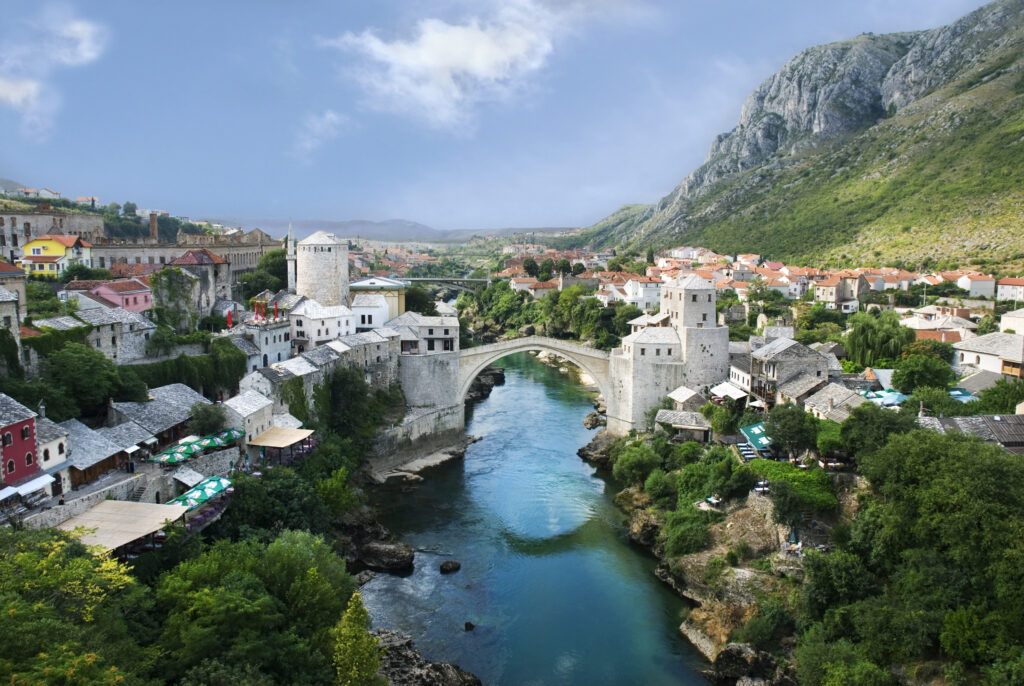
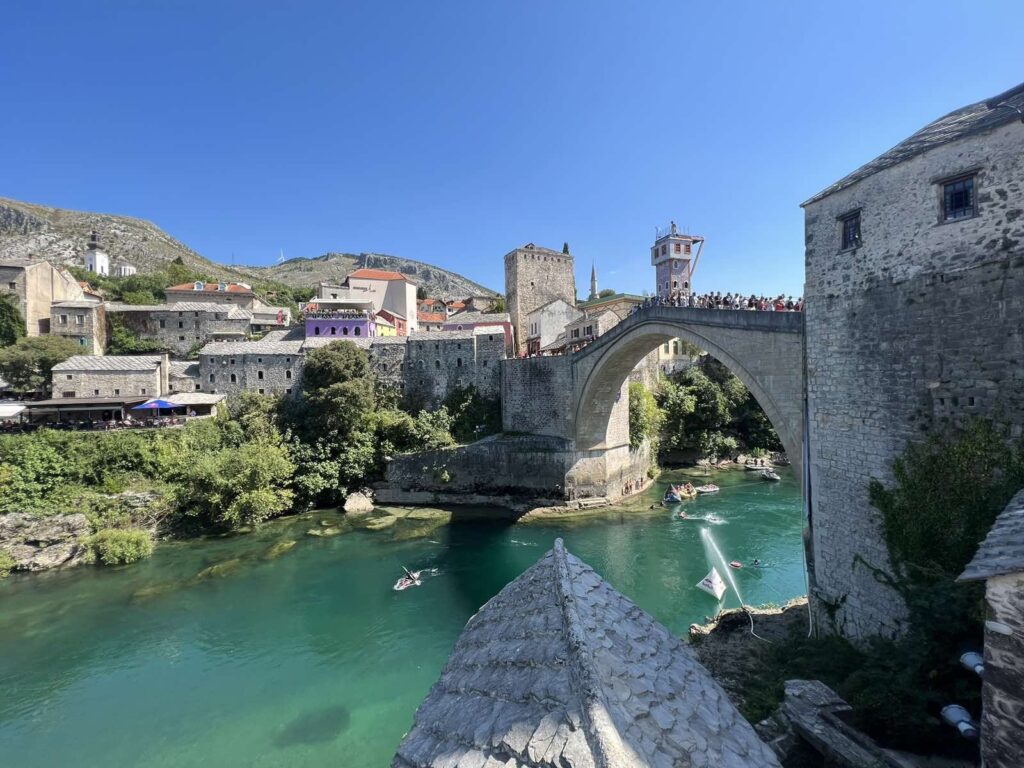
The Stari Most, the Old Bridge over the Neretva River, is the symbol of Bosnia and Herzegovina. Built in the 16th century by Mimar Hayreddin, a student of Mimar Sinan, the bridge was destroyed in 1993 and rebuilt faithfully, reopening in 2004. The Kujundžiluk bazaar at the two ends of the bridge, the view of the bridge from the minaret of the Koski Mehmed Pasha Mosque, the Karađoz-beg Mosque and the old houses along the Neretva fill half a day in Mostar. The young men who dive from the bridge into the river are the city’s best-known sight in summer; the workshops on both banks of the bridge sell copperwork and handmade souvenirs. The call to prayer rising from the minarets at dusk and the lighting of the bridge are the best reasons to spend a night in Mostar. We described all the stops in Mostar in our article on places to visit in Mostar.
The Herzegovina Region: Blagaj, Počitelj and Neum
The Herzegovina region, centred on Mostar, lets you combine the three most photographed stops of a Bosnian trip in a single day. The three places below are each about half an hour from Mostar.
The Blagaj Tekke and the source of the Buna
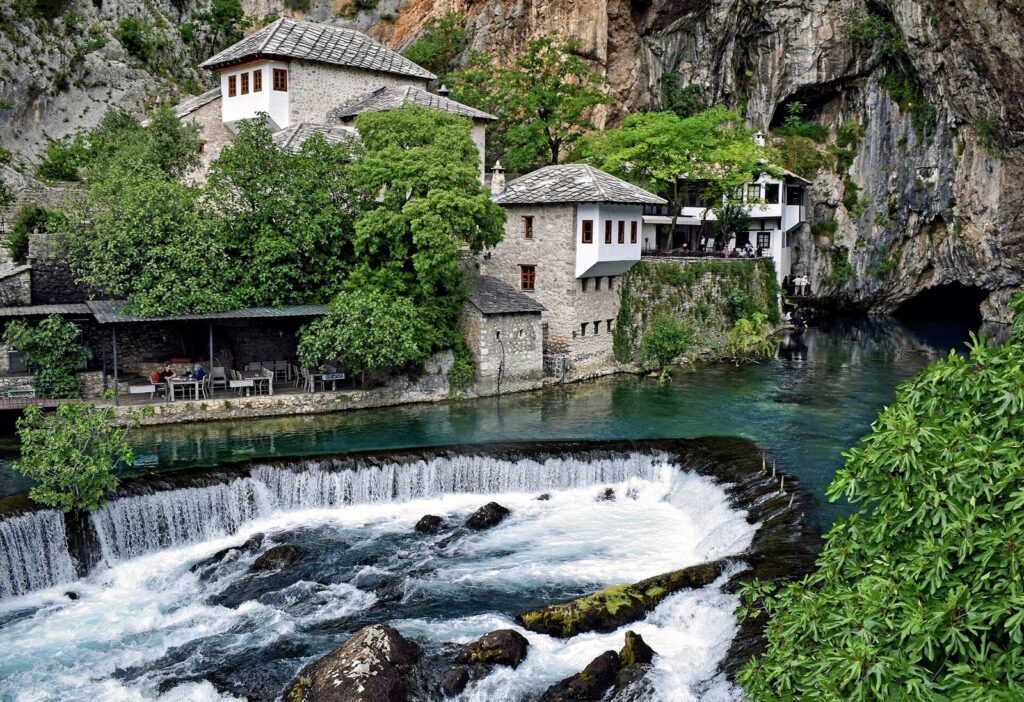
The Buna River rises from a cave at the foot of a giant rock; the Blagaj Tekke, founded beside the rock in the 16th century, seems to hang over the water with its Ottoman timber architecture. Today the tekke is a museum and a place of prayer open to visitors; inside there is a tomb attributed to Sarı Saltuk, though historians do not regard this attribution as certain. Eating trout in the restaurants on the banks of the Buna and drinking tea in the coolness of the river are among the most peaceful moments of a trip through Herzegovina.
Počitelj
On the road between Mostar and the Adriatic, Počitelj, built on a rocky slope, is one of the best-preserved examples of an Ottoman-period town, with its stone houses, the Šišman Ibrahim Pasha Mosque, its clock tower and its fortress. The stone steps up to the fortress offer a view of the Neretva valley; a walk through the town’s streets among the pomegranate and fig trees takes less than half an hour.
Neum
Neum, the country’s only town on the Adriatic coast, is ideal for a seaside break between Mostar and Dubrovnik. Its coastline of around twenty kilometres is suitable for swimming in the summer months, and the road to the Croatian city of Dubrovnik also passes through here.
Can you swim in the sea in Bosnia and Herzegovina?
Yes, the country’s roughly twenty-kilometre stretch of Adriatic coast is at the town of Neum, and you can swim there in the summer months. As Neum is about an hour from Mostar, it can be added to a Herzegovina trip as a half-day break by the sea.
Central Bosnia: Travnik, Jajce and Konjic
These three towns on the roads between Sarajevo and Mostar or Bihać carry the liveliest traces of Ottoman-period Bosnia. Most tours include these stops with one overnight stay and two lunch breaks.
Travnik: The city of viziers and the Coloured Mosque
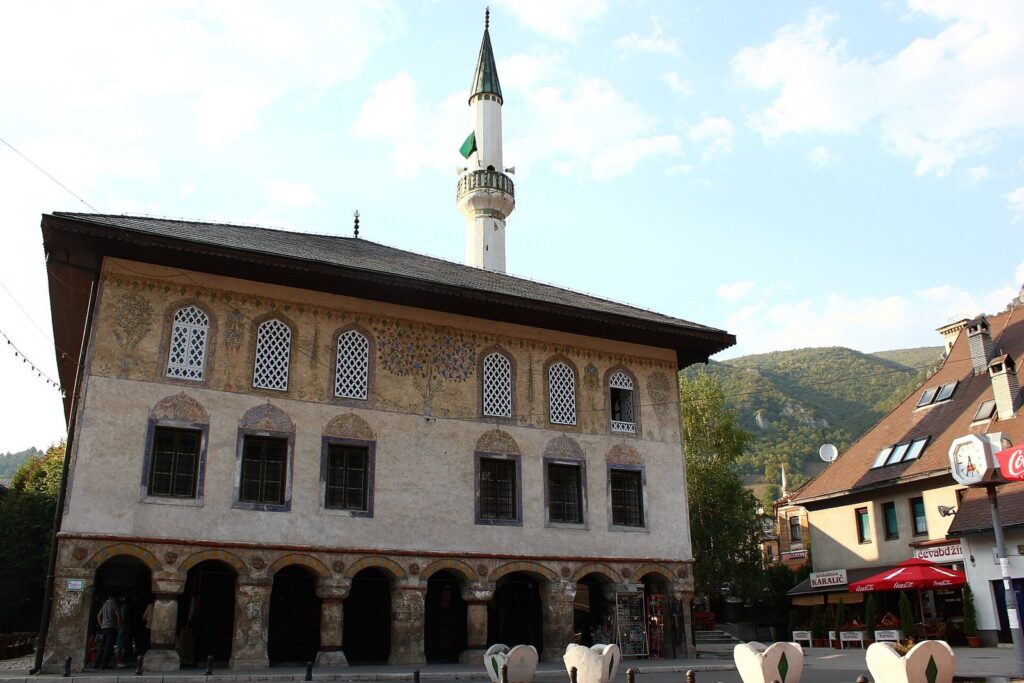
Travnik, to the north-west of Sarajevo, was the seat of the Ottoman province of Bosnia in the 18th and 19th centuries and is therefore known as the “city of viziers”. The symbol of the city is the Coloured Mosque (the Sulejmanija Mosque), whose facade is decorated with painted plant motifs; the shops beneath the mosque are a rare example of the Ottoman bazaar tradition. Travnik Castle, the Plava Voda spring and the birthplace of the Nobel laureate Ivo Andrić are the other stops.
Is halal food available in Travnik?
Yes, most of the restaurants in Travnik’s bazaar use halal meat, and the town is famous for Bosnia’s best-loved kebab, the “Travnik ćevap”. The bakeries in the bazaar sell burek and the coffee houses serve Bosnian coffee. Because the daytime routine of restaurants can change in Ramadan, ask your group’s guide.
Jajce: The waterfall in the middle of the town
Jajce, where the Pliva River flows into the Vrbas, is a town with few equals in Europe, with a waterfall flowing right in the middle of the town centre. In this last capital of the Bosnian kings, a medieval fortress, a Roman temple of Mithras and catacombs stand side by side with Ottoman mosques. The wooden watermills on the Pliva Lakes, a few kilometres above the town, offer one of the most peaceful views of rural Bosnia. Jajce is also a convenient overnight stop between Sarajevo and Bihać.
Konjic: The stone bridge and Tito’s bunker
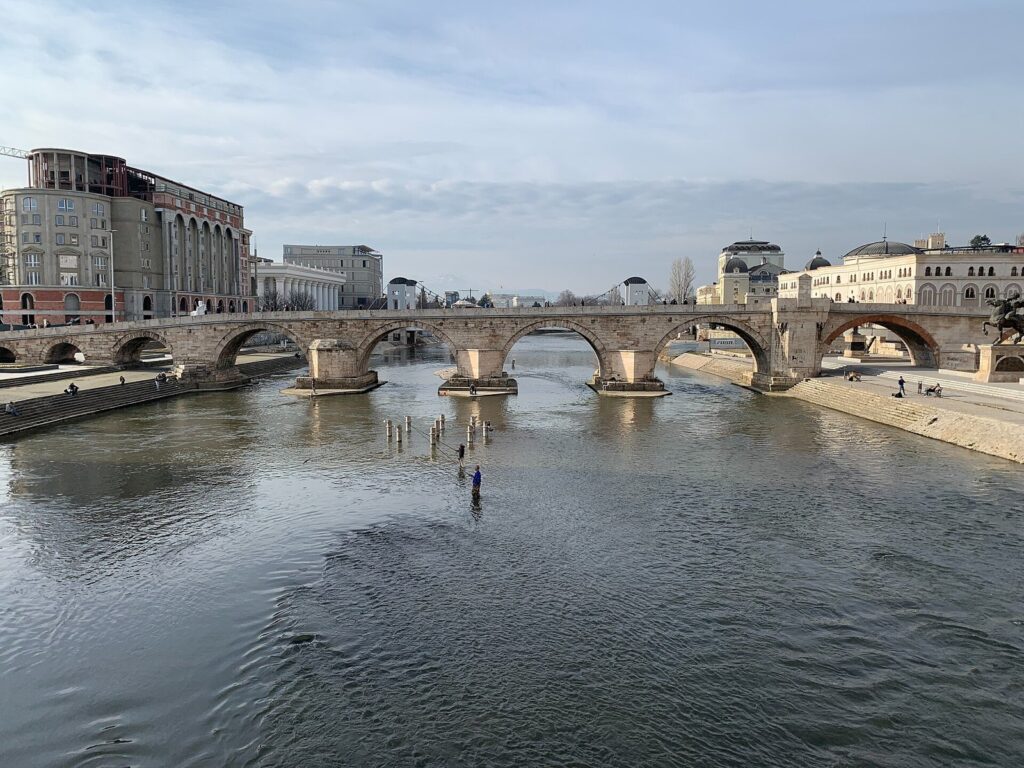
On the road down from Sarajevo to Mostar, Konjic on the banks of the Neretva is known for its 17th-century stone bridge and its woodcarving. Tito’s nuclear bunker, dug into the mountain near the town, is one of the largest secret structures of the Cold War period and is visited on guided tours. Konjic is the starting point for those who want to go rafting on the Neretva; it is also possible to see the bridge and the bazaar with a short stop.
Srebrenica and the Potočari Memorial Cemetery
Srebrenica, to the east of Sarajevo, is a stop visited as quietly as a place of pilgrimage, with the Potočari Memorial Cemetery commemorating the genocide of 1995. The memorial area, the cemetery and the museum set up in the old battery factory document the most painful page of recent history. The visit is the heaviest but most instructive part of a trip through Bosnia; most halal culture tours include it in the programme.
Important: The Potočari Memorial Cemetery is a place of mourning. Be silent during the visit, do not step on the gravestones, take photographs only of the memorial area, and if you happen to be there for the commemoration held on 11 July every year, follow the instructions of the organisers.
Eastern and Northern Bosnia: Višegrad, Bihać, Banja Luka and Tuzla
These cities, two to four hours from Sarajevo, are usually included in programmes of more than a week or in Balkan tours connected with Serbia and Croatia. On a short programme only Višegrad can be visited on a day trip.
Višegrad: The Mehmed Paša Sokolović Bridge
The Mehmed Paša Sokolović Bridge over the Drina River is an eleven-arched masterpiece completed by Mimar Sinan in 1577 and is on the UNESCO World Heritage List. Known worldwide through Ivo Andrić’s novel “The Bridge on the Drina”, the bridge can be visited on a day trip from Sarajevo. The stone town of Andrićgrad built beside the bridge and a boat trip on the Drina complete the visit.
Bihać and the Una National Park
Bihać, in the north-west of the country, is surrounded by the emerald-green waters of the Una River. The Štrbački Buk waterfalls and the terraced falls of Martin Brod in the Una National Park are the centre of Bosnia’s nature tourism. In Bihać, the Fethija Mosque is a rare building converted into a mosque from a Gothic church.
Banja Luka and the Ferhadija Mosque
Banja Luka, the country’s second-largest city, is known for the Kastel fortress on the banks of the Vrbas River and the 16th-century Ferhadija Mosque. Destroyed in 1993, the mosque was rebuilt using some of its original stones and reopened for worship in 2016. The city is a preferred overnight stop on the Jajce and Una route.
Tuzla and Prusac
Tuzla, in the north-east, offers a different kind of stop with the artificial salt lakes in its city centre and the historic Kapija square. The village of Prusac in central Bosnia is known for the Ajvatovica commemoration held on the last Sunday of June every year; the rock believed to have split at the prayer of Ajvaz Dede is the centre of the largest Muslim pilgrimage tradition outside Türkiye.
Halal Travel Notes: Food, Prayer and Dress
Bosnia and Herzegovina is a country with a large Muslim population where halal food is easy to find. Ćevapi, burek, begova čorba, klepe and Bosnian coffee are the basis of the menus; most restaurants in Baščaršija and Mostar use halal meat, but do not hesitate to ask where you are in doubt. Mosques are in the centre of every town; praying the Friday prayer in the Gazi Husrev-beg Mosque is a fixed part of the tours. You can dress comfortably; visitors in hijab are an ordinary part of daily life. We explained the concept of halal travel and the points to watch in our article on what halal tourism is.
For prayer times you can use apps based on the calendar of the Islamic Community of Bosnia and Herzegovina; the call to prayer can be heard from all the mosques in Sarajevo’s old town. In Ramadan Baščaršija comes alive with iftar tables, and on the morning of Eid the courtyard of the Gazi Husrev-beg Mosque fills with worshippers; accommodation and flights should be booked early in these periods. There are separate sections for women in the mosques, and in the tekkes and tombs covering the head is enough.
- The currency is the convertible mark; cards are accepted in city centres, keep cash for towns and villages.
- The number of shopkeepers and guides who speak Turkish, especially in Sarajevo, is surprisingly large.
- Turkish citizens can enter without a visa for short visits; confirm the current conditions with the Turkish Ministry of Foreign Affairs before you travel.
- In the summer months Herzegovina is hot and Sarajevo is cool; in winter, snowfall lengthens journey times.
- Bargaining is part of the bazaar culture when shopping for souvenirs in Bosnia; do not insist in shops with fixed prices.
Do you need a visa for Bosnia and Herzegovina?
Turkish citizens can enter Bosnia and Herzegovina without a visa for short tourist visits; a valid passport is required for entry. Because the visa-free period and the document requirements can change under agreements between countries, consult the current announcement of the Turkish Ministry of Foreign Affairs and your agency before travelling.
Sample Route: Bosnia and Herzegovina in Six Days
The plan below shows a pattern often used in halal culture tours; the number of days and the order vary from programme to programme.
| Day | Region | Stops |
|---|---|---|
| 1 | Sarajevo | Arrival, Baščaršija, the Sebilj, the Gazi Husrev-beg Mosque, the Yellow Bastion in the evening |
| 2 | Around Sarajevo | The Tunnel of Hope, Vrelo Bosne, Trebević; optional day trip to Srebrenica |
| 3 | Central Bosnia | Travnik (the Coloured Mosque, the castle), Jajce (the waterfall, the Pliva Lakes), overnight in Jajce |
| 4 | Herzegovina | The Konjic bridge, the Old Bridge and bazaar of Mostar, overnight in Mostar |
| 5 | Herzegovina | The Blagaj Tekke, Počitelj, optional seaside break in Neum, return to Mostar |
| 6 | Return | Return to Sarajevo, last shopping, flight |
When is the best time to visit Bosnia and Herzegovina?
May to October is the most suitable period for both Sarajevo and Herzegovina; in spring the waters of the Una and the Pliva are at their strongest, and in autumn Baščaršija is quieter. In July and August Mostar is hot and crowded, and the area around the bridge is busy. In the winter months Sarajevo under snow offers a beauty of its own; the Jahorina and Bjelašnica ski resorts are half an hour from the city.
How do you get from Sarajevo to Mostar?
The road from Sarajevo to Mostar follows the Neretva valley and takes about two and a half hours; the train runs through the same valley and is very popular for its scenery. In tour programmes this journey is combined with a stop in Konjic. For independent travellers there are regular buses throughout the day; train times change with the season and should be checked in advance.
Because it combines the Ottoman heritage, halal cuisine and Balkan nature in a single country, Bosnia and Herzegovina is the best-loved route of halal culture tours. At RotaNur we organise our Bosnia programmes with an expert guide, with attention to the Friday prayer and the etiquette of visits; you can compare the options on our Bosnia and Balkans tours page, look at other routes on our culture tours page, and for your questions write to us 24/7 from our contact page or the WhatsApp button on this page.
Frequently Asked Questions
What currency is used in Bosnia and Herzegovina?
The currency of Bosnia and Herzegovina is the convertible mark (KM). Although the euro is accepted in some tourist businesses, change is given in marks; the most convenient way is to exchange money at the airport or at the exchange offices in the city centre. Credit and debit cards are widely accepted in the big cities, while cash is needed in villages and small towns.
How many days are enough for a trip to Bosnia and Herzegovina?
Four days are ideal for Sarajevo and Mostar, and six days for a tour that also covers Travnik, Jajce and Blagaj. Those who also want to see distant stops such as the Una National Park, Višegrad and Srebrenica should choose programmes of more than a week. For a weekend getaway, a three-day plan combining Sarajevo and Mostar is also satisfying.
Is Turkish spoken in Bosnia and Herzegovina?
The official language is Bosnian; but thanks to Turkish television series, young people who have studied in Türkiye and trade ties, it is normal to meet shopkeepers and guides who speak Turkish in Sarajevo and Mostar. Because Bosnian contains thousands of words borrowed from Turkish, words such as the names of dishes, bazaar and mosque sound familiar. English is also sufficient at tourist sites.
Where is the Friday prayer performed in Bosnia and Herzegovina?
The Gazi Husrev-beg Mosque in Sarajevo and the Koski Mehmed Pasha and Karađoz-beg mosques in Mostar are the most popular places for the Friday prayer; in Travnik the Coloured Mosque and in Banja Luka the Ferhadija Mosque fill with the Friday congregation. Tour programmes are usually arranged so that Friday is spent in Sarajevo or Mostar; your guide will tell you the prayer time in advance.
What should you buy in Bosnia and Herzegovina?
The copperwork of Baščaršija, Bosnian coffee sets, handmade coffee pots, woodcarvings, the pomegranate and fig jams of Mostar and Travnik cheese are the best-loved souvenirs. Pomegranate juice is found in Blagaj and Počitelj, and local honey in Jajce. Remember that you will have to put liquids in your checked luggage, and do not leave shopping to the last day.

Cihat Murat Yüksel is the editor of the RotaNur blog and the founder of Markention. Drawing on the sources of Türkiye's Presidency of Religious Affairs (Diyanet), he turns the questions travellers ask most about preparing for Umrah, Hajj and halal travel into clear, practical guides.
Questions answered in this article
How many days should you set aside for Sarajevo?
A full day is enough for Baščaršija, the Gazi Husrev-beg Mosque, the Yellow Bastion and the Tunnel of Hope; a second day covers the stops outside the city such as Vrelo Bosne, Trebević and Srebrenica. If you are also going to see Mostar and the Herzegovina region, the most efficient plan is to spend two nights in Sarajevo and then head south.
Can you swim in the sea in Bosnia and Herzegovina?
Yes, the country’s roughly twenty-kilometre stretch of Adriatic coast is at the town of Neum, and you can swim there in the summer months. As Neum is about an hour from Mostar, it can be added to a Herzegovina trip as a half-day break by the sea.
Is halal food available in Travnik?
Yes, most of the restaurants in Travnik’s bazaar use halal meat, and the town is famous for Bosnia’s best-loved kebab, the “Travnik ćevap”. The bakeries in the bazaar sell burek and the coffee houses serve Bosnian coffee. Because the daytime routine of restaurants can change in Ramadan, ask your group’s guide.
Do you need a visa for Bosnia and Herzegovina?
Turkish citizens can enter Bosnia and Herzegovina without a visa for short tourist visits; a valid passport is required for entry. Because the visa-free period and the document requirements can change under agreements between countries, consult the current announcement of the Turkish Ministry of Foreign Affairs and your agency before travelling.
When is the best time to visit Bosnia and Herzegovina?
May to October is the most suitable period for both Sarajevo and Herzegovina; in spring the waters of the Una and the Pliva are at their strongest, and in autumn Baščaršija is quieter. In July and August Mostar is hot and crowded, and the area around the bridge is busy. In the winter months Sarajevo under snow offers a beauty of its own; the Jahorina and Bjelašnica ski resorts are half an hour from the city.
How do you get from Sarajevo to Mostar?
The road from Sarajevo to Mostar follows the Neretva valley and takes about two and a half hours; the train runs through the same valley and is very popular for its scenery. In tour programmes this journey is combined with a stop in Konjic. For independent travellers there are regular buses throughout the day; train times change with the season and should be checked in advance.