










Contents 13 sections
- What Is the Traveller’s Prayer?
- Who Counts as a Traveller? Distance and Duration
- How Is the Traveller’s Prayer Performed?
- How is the intention made for the traveller’s prayer?
- Are the Sunnah Prayers and Witr Performed on a Journey?
- Traveller and Resident in Congregational Prayer
- How many rak’ahs does an Umrah pilgrim pray when following the imam in Masjid al-Haram?
- Are You a Traveller on Umrah? The Length of Stay in Makkah and Madinah
- The Traveller’s Prayer on Hajj: Arafat, Muzdalifah and Mina
- Prayer on the Plane, on the Bus and at Rest Stops
- Making Up a Prayer Missed on a Journey
- What differs between the schools in the traveller’s prayer?
- Frequently Asked Questions
Prayer while travelling (in Turkish, seferi namaz) is the practice by which a Muslim on a journey (a musafir) performs the four-rak’ah obligatory prayers as two rak’ahs; it rests on the verse of the Quran that permits shortening the prayer on a journey (an-Nisa, 4/101) and on the Prophet’s performing the four-rak’ah obligatory prayers as two on all his journeys. For Umrah and Hajj travellers this is not an abstract point of jurisprudence but a question met at every prayer time in Makkah and Madinah: “Do I pray two rak’ahs at the hotel, and four when I follow the imam in Masjid al-Haram?” In this article we explain what the traveller’s prayer is, who counts as a traveller (how many kilometres, how many days), how the traveller’s prayer is performed and its intention, the position of the Sunnah prayers and witr, the relation between resident and traveller in congregational prayer, being a traveller in Makkah and Madinah on Umrah, combining prayers at Arafat and Muzdalifah on Hajj, prayer on the plane and the bus, and making up prayers missed on a journey, on the basis of the Hanafi school and the explanations of the Presidency of Religious Affairs (Diyanet), touching also on the differences of the other schools.
In Short
The obligatory prayers of noon, afternoon and night are performed as two rak’ahs; dawn remains two and sunset three rak’ahs, and the witr is performed too. The Sunnah prayers are performed with their own numbers of rak’ahs.
What Is the Traveller’s Prayer?
“Safar” means journey and “musafir” means traveller. The traveller’s performing the four-rak’ah obligatory prayers (noon, afternoon and night) as two rak’ahs is called “qasr” (shortening); the two-rak’ah obligatory prayer of dawn, the three-rak’ah obligatory prayer of sunset and the witr prayer do not change. The Quran says, “And when you travel throughout the land, there is no blame upon you for shortening the prayer” (an-Nisa, 4/101); in the hadith narrated by Umar, the Prophet said that shortening the prayer on a journey is a gift (a charity) from Allah to His servants and that this gift should be accepted (Muslim, Musafirin 4). According to the Hanafi school, the traveller’s performing the four-rak’ah obligatory prayers as two is not a concession but the binding rule (azimah); that is, if a traveller prays four he has acted contrary to the Sunnah, and if he misses the first sitting of the prayer, his prayer is invalid. In the Shafi’i and Hanbali schools shortening is a concession; the traveller may pray the full prayer if he wishes, but shortening is more meritorious.
Who Counts as a Traveller? Distance and Duration
According to the Hanafi school and the practice of Diyanet, a person becomes a traveller the moment he intends to go to a place at least ninety kilometres from the settlement where he is and passes the boundaries of that settlement; his status as a traveller continues as long as he intends to stay less than fifteen days at the place he reaches. The moment he intends to stay fifteen days or more he becomes a resident and performs his prayers in full. In counting the period the days of arrival and departure are also counted; a person who decides to leave before completing fifteen days remains a traveller. The purpose of the journey (worship, trade, a visit, a holiday) does not change the ruling; what matters is the distance and the intended length of stay. A person returning to his home town (his original homeland) ceases to be a traveller on entering the boundaries of his home town. In the Shafi’i school the travel distance is about eighty kilometres, and the period that ends the status of traveller is four days, excluding the days of arrival and departure. The status of traveller also applies to a place more than ninety kilometres away visited on a day trip; what matters is the distance of the road, not how many hours the journey takes.
| Topic | Hanafi (Diyanet practice) | Shafi’i |
|---|---|---|
| Travel distance | About 90 km | About 80 km |
| Intended stay that ends traveller status | 15 days and over | 4 full days and over |
| Four-rak’ah obligatory prayers | Performed as two rak’ahs (binding rule) | Praying two rak’ahs is a concession; shortening is more meritorious |
| Combining (joining two prayers) | Only on Hajj, at Arafat and Muzdalifah | Noon–afternoon and sunset–night may be combined on a journey |
| Sunnah prayers | Performed if there is safety and opportunity; the dawn Sunnah is not omitted | Performing them is recommended |
| Traveller following a resident imam | Prays four rak’ahs | Prays four rak’ahs |
How Is the Traveller’s Prayer Performed?
The traveller performs the obligatory prayers of noon, afternoon and night as two rak’ahs; at the end of the two rak’ahs he sits, recites the Tahiyyat, the salli and barik and the supplication, and gives the salam. The performance of these prayers is no different from the obligatory prayer of dawn; only the intention is made for the obligatory prayer of noon, afternoon or night. The dawn prayer is performed as two and the sunset prayer as three rak’ahs, exactly as usual; the witr prayer is not omitted either. A traveller praying alone performs noon as two and adds nothing else until night; the Sunnah prayers are performed according to circumstances, as explained below. If a person who forgets that he is a traveller prays four, his prayer is valid if he sat in the second rak’ah, the last two rak’ahs becoming voluntary; if he stood up without sitting in the second rak’ah, according to the Hanafis the obligatory prayer is invalid and is performed again.
- The noon prayer: the obligatory part two rak’ahs; the Sunnah prayers (four and two) are performed if there is opportunity.
- The afternoon prayer: the obligatory part two rak’ahs; since its Sunnah is non-emphasised, it is mostly not performed on a journey.
- The sunset prayer: the obligatory part three rak’ahs, unchanged; its Sunnah may be performed.
- The night prayer: the obligatory part two rak’ahs; the final Sunnah and the witr are performed, and the witr is not omitted.
- The dawn prayer: the obligatory part two rak’ahs, unchanged; its Sunnah is performed on a journey too.
How is the intention made for the traveller’s prayer?
It is enough to say, “I intend to perform today’s obligatory noon prayer for the sake of Allah”; the words “as a traveller” or “two rak’ahs” are not required in the intention, though there is no harm in saying them. The intention is made in the heart; saying it aloud is Sunnah. If the prayer is performed in congregation, the words “I follow the imam” are added.
Are the Sunnah Prayers and Witr Performed on a Journey?
According to the Hanafi school, the traveller performs the Sunnah prayers if he is in safety and has time; in situations such as danger on the road, the vehicle about to move or the group waiting, he may omit the Sunnah prayers. The Sunnah of the dawn prayer, the final Sunnah of the night prayer and the witr should be performed on a journey too; it is narrated that the Prophet did not omit the dawn Sunnah and the witr on his journeys. Diyanet’s widely known explanation is as follows: the traveller may perform the Sunnah prayers; he does not sin if he does not; but in places such as Masjid al-Haram and the Prophet’s Mosque it is not fitting to omit the Sunnah prayers when there is opportunity. The Sunnah prayers are performed not as two rak’ahs but with their own numbers of rak’ahs (the first Sunnah of noon four, the final Sunnah two, and so on); shortening applies only to the obligatory prayers.
Traveller and Resident in Congregational Prayer
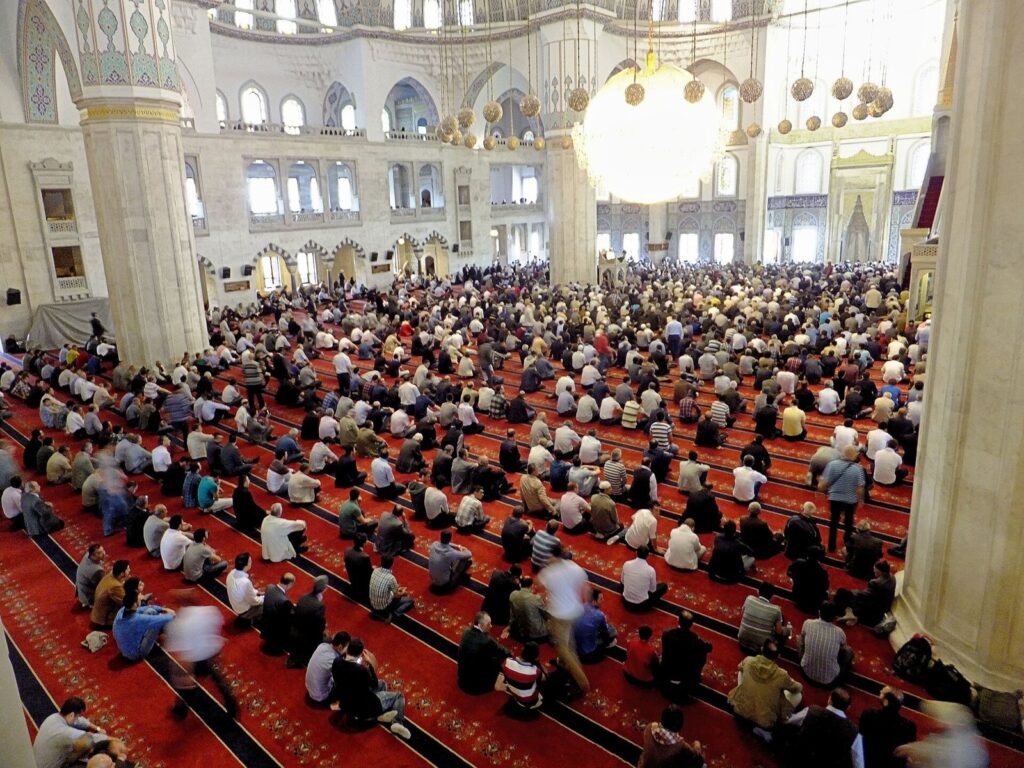
If a traveller follows a resident imam, he completes the prayer as four rak’ahs together with the imam; this applies to all congregational prayers in Masjid al-Haram and the Prophet’s Mosque, because the imams of these mosques are residents. If a traveller leads the prayer and there are residents behind him, he gives the salam at two rak’ahs and the resident congregation rise and pray two more rak’ahs to complete their prayer; it is in keeping with the Sunnah for the traveller imam to announce before the prayer or after the salam, “I am a traveller; complete your prayer.” In the congregational prayer that Umrah groups perform among themselves at the hotel or on the bus, if the imam and the congregation are travellers, the prayer is performed as two rak’ahs. A traveller who joins a resident imam late (masbuq) also completes the remaining rak’ahs on the basis of four. For the etiquette of entering the mosque and the tahiyyat al-masjid, see our article on the dua for entering the mosque.
How many rak’ahs does an Umrah pilgrim pray when following the imam in Masjid al-Haram?
Four rak’ahs; because the imam is a resident, and a traveller who follows a resident imam prays the full prayer. The same pilgrim, when praying alone at the hotel or with fellow travellers, performs noon, afternoon and night as two rak’ahs. An Umrah pilgrim who intends to stay fifteen days or more in Makkah is a resident and prays four everywhere.
Are You a Traveller on Umrah? The Length of Stay in Makkah and Madinah
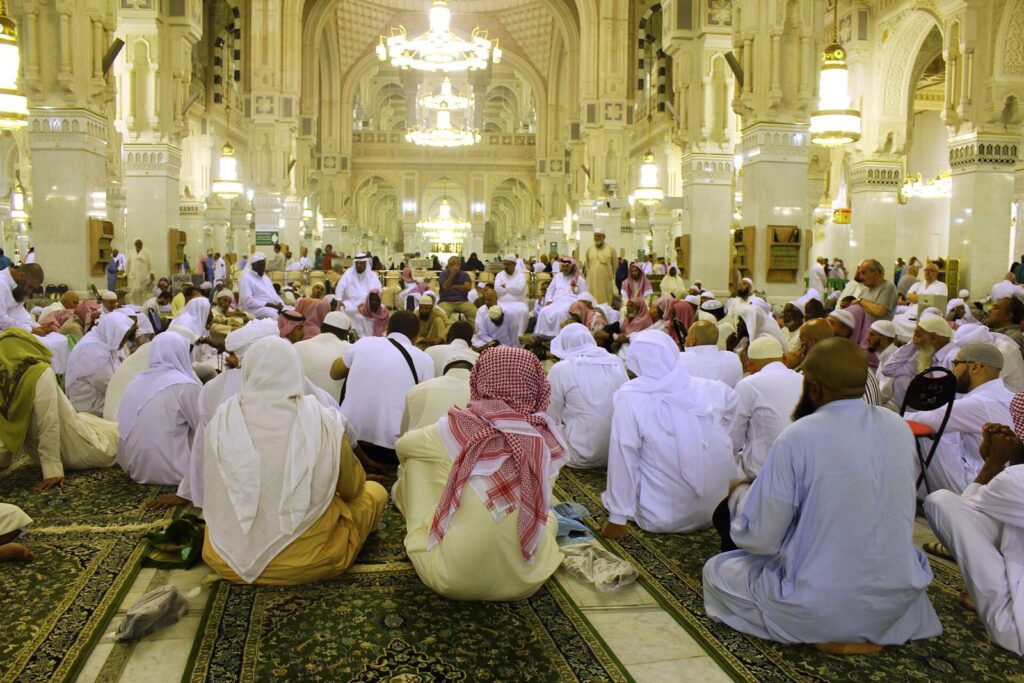
The Umrah traveller is a traveller from the moment he sets out from Türkiye. Whether he is a traveller in Makkah and in Madinah depends on how many days he intends to stay in each city, and the two cities are assessed separately: an Umrah pilgrim staying ten days in Makkah and eight days in Madinah is a traveller in both cities; the fact that the total exceeds fifteen days does not change the ruling, because the intention must be fifteen days for a single place. An Umrah pilgrim who intends to stay fifteen days or more in Makkah becomes a resident in Makkah; when he moves to Madinah he counts as a traveller again. Since programmes mostly stay less than fifteen days in one city, the great majority of Umrah pilgrims pray two rak’ahs at the hotel and four when they join the congregation in the mosque. The lengths of Umrah programmes are explained in our article on how many days Umrah takes, and the prayer arrangements in Masjid al-Haram in our articles on Masjid al-Haram and the Prophet’s Mosque. The rulings for travellers also apply on the journey between Makkah and Madinah, and the obligatory prayers performed at a bus stop are two rak’ahs. In brief, the Umrah pilgrim’s traveller status is as follows:
- Departure from Türkiye: a traveller on passing the boundary of the settlement; on the plane and at the airport the four-rak’ah obligatory prayers are performed as two.
- A stay of less than fifteen days in Makkah: a traveller; two rak’ahs at the hotel, four when following the resident imam in the mosque.
- An intended stay of fifteen days or more in Makkah: a resident; four rak’ahs everywhere.
- Madinah: assessed independently of Makkah; a stay of less than fifteen days means a traveller.
- Return: traveller status ends on entering the boundary of the home town.
Important: On Umrah, traveller status depends on the intention to stay less than fifteen days per city. At the hotel and within the group the four-rak’ah obligatory prayers are performed as two; in Masjid al-Haram and the Prophet’s Mosque, when following the resident imam, they are performed as four. On long-stay Umrah programmes those staying fifteen days or more in Makkah count as residents; in case of doubt, the group’s religious guide or Diyanet’s fatwa line should be asked.
The Traveller’s Prayer on Hajj: Arafat, Muzdalifah and Mina
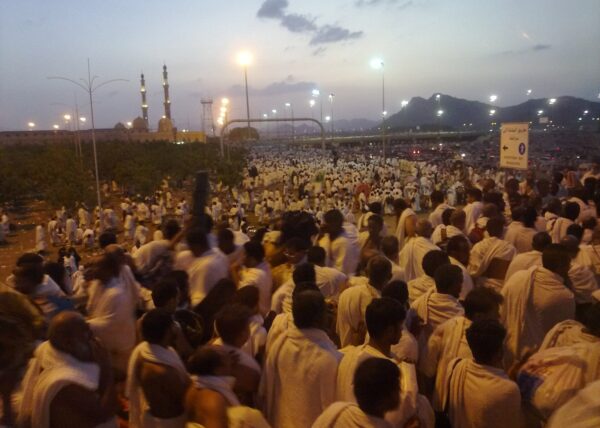
The position of the Hajj pilgrim in Makkah is the same as that of the Umrah pilgrim; but on Hajj there are two special situations. First, at Arafat the noon and afternoon prayers are combined and performed at the time of noon (jam’ al-taqdim), and at Muzdalifah the sunset and night prayers are combined and performed at the time of night (jam’ al-ta’khir); the Hanafi school accepts combining only in these two places and because of Hajj, and prayers are not combined elsewhere on a journey. Second, since Arafat, Muzdalifah and Mina are closer to Makkah than the travel distance, a pilgrim who is a resident in Makkah is a resident in these places too, and a pilgrim who is a traveller in Makkah is a traveller here too; the traveller pilgrim performs noon and afternoon at Arafat combined, as two rak’ahs each, and at Muzdalifah performs sunset as three and night as two. In these prayers performed in congregation, if the imam is a resident, the travellers behind him pray four. The arrangement of the standing at Arafat is explained in our article on the standing at Arafat, the days of Hajj in our article on how Hajj is performed, and the supplications recited on the days of Hajj in our article on Hajj duas.
Prayer on the Plane, on the Bus and at Rest Stops
If a prayer time comes in during the journey, a place is first sought where it can be performed before the time runs out: the airport prayer rooms, the bus stops and the prayer rooms at rest areas are for this. On the plane, if it is possible to stand and to face the qibla, the prayer is performed standing; if not, it is performed sitting in the seat, by gesture (ima). According to Hanafi jurisprudence, it is in keeping with caution to repeat an obligatory prayer performed sitting by gesture once on the ground; Diyanet also recommends that an obligatory prayer performed sitting on the plane be performed again if one lands before its time runs out. The obligatory prayer is not performed while the bus is moving; one waits for the stop, and if the time is about to run out, a short stop is requested from the driver. Since Umrah buses make their stops according to the prayer times, this problem is rarely met on group journeys. At the rest stops there is water for ablution and a prayer room; if there is none, dry ablution (tayammum) is performed and the prayer is performed within its time. The travel dua is recited at the start of the journey; on long flights, since the direction of the qibla changes with the route of the aircraft, the qibla compass in prayer apps is used.
Making Up a Prayer Missed on a Journey
On a journey a prayer is sometimes missed despite every effort; in that case how it is made up also depends on the traveller status. A four-rak’ah obligatory prayer missed on a journey is performed as two rak’ahs even if it is made up after the person has become a resident; because the make-up prayer is performed according to the ruling at the moment the prayer was missed. The reverse also applies: a noon prayer missed while a resident is performed as four rak’ahs when made up on a journey. This is why, on returning from Umrah, one must remember in which state the prayers to be made up were missed. For prayers that fall into arrears on a journey, the Sunnah prayers other than the witr and the dawn Sunnah are not made up. Rather than leaving a prayer to be made up on a journey, it is best to follow the prayer times, to plan the flight time according to the prayer times and, on reaching Makkah, to perform any prayer in arrears before beginning Umrah.
What differs between the schools in the traveller’s prayer?
For the Hanafis, shortening is the binding rule, the travel distance is about ninety kilometres, traveller status ends with the intention of a fifteen-day stay, and combining is done only at Arafat and Muzdalifah. For the Shafi’is, shortening is a concession, the distance is about eighty kilometres, traveller status ends with the intention of a four-day stay, and noon–afternoon and sunset–night may be combined on a journey. The views of the Malikis and the Hanbalis are largely close to those of the Shafi’is. When travellers of different schools are together in Umrah groups, everyone prays according to his own school; the school of the imam in the congregation does not affect the validity of the prayer.
Frequently Asked Questions
How many rak’ahs is the traveller’s prayer?
The obligatory prayers of noon, afternoon and night are performed as two rak’ahs; dawn remains two and sunset three rak’ahs, and the witr is performed too. The Sunnah prayers are performed with their own numbers of rak’ahs.
How many kilometres are needed to be a traveller?
About ninety kilometres according to the Hanafi school and the practice of Diyanet; about eighty kilometres according to the Shafi’is. The distance is counted from the boundary of the settlement.
For how many days is the traveller’s prayer performed?
For as long as one intends to stay less than fifteen days at the place one goes to; a person who intends to stay fifteen days or more becomes a resident and performs the prayers in full (four days for the Shafi’is).
Are prayers shortened on Umrah?
An Umrah pilgrim staying less than fifteen days in Makkah and Madinah is a traveller; at the hotel he performs the four-rak’ah obligatory prayers as two, and in Masjid al-Haram and the Prophet’s Mosque he prays four when following the resident imam. An Umrah pilgrim staying fifteen days or more in one city is a resident in that city.
Are the Sunnah prayers performed while a traveller?
They are performed if there is safety and time; there is no sin if they are not. The Sunnah of the dawn prayer and the witr are not omitted on a journey either.
How is a prayer missed on a journey made up?
A four-rak’ah obligatory prayer missed on a journey is performed as two rak’ahs even if made up later as a resident; a prayer missed as a resident is performed as four rak’ahs when made up on a journey.

Cihat Murat Yüksel is the editor of the RotaNur blog and the founder of Markention. Drawing on the sources of Türkiye's Presidency of Religious Affairs (Diyanet), he turns the questions travellers ask most about preparing for Umrah, Hajj and halal travel into clear, practical guides.
Questions answered in this article
What Is the Traveller’s Prayer?
“Safar” means journey and “musafir” means traveller. The traveller’s performing the four-rak’ah obligatory prayers (noon, afternoon and night) as two rak’ahs is called “qasr” (shortening); the two-rak’ah obligatory prayer of dawn, the three-rak’ah obligatory prayer of sunset and the witr prayer do not change. The Quran says, “And when you travel throughout the land, there is no blame upon you for shortening the prayer” (an-Nisa, 4/101); in the hadith narrated by Umar, the Prophet said that shortening the prayer on a journey is a gift (a charity) from Allah to His servants and that this gift should be accepted (Muslim, Musafirin 4). According to the Hanafi school, the traveller’s performing the four-rak’ah obligatory prayers as two is not a concession but the binding rule (azimah); that is, if a traveller prays four he has acted contrary to the Sunnah, and if he misses the first sitting of the prayer, his prayer is invalid. In the Shafi’i and Hanbali schools shortening is a concession; the traveller may pray the full prayer if he wishes, but shortening is more meritorious.
How Is the Traveller’s Prayer Performed?
The traveller performs the obligatory prayers of noon, afternoon and night as two rak’ahs; at the end of the two rak’ahs he sits, recites the Tahiyyat, the salli and barik and the supplication, and gives the salam. The performance of these prayers is no different from the obligatory prayer of dawn; only the intention is made for the obligatory prayer of noon, afternoon or night. The dawn prayer is performed as two and the sunset prayer as three rak’ahs, exactly as usual; the witr prayer is not omitted either. A traveller praying alone performs noon as two and adds nothing else until night; the Sunnah prayers are performed according to circumstances, as explained below. If a person who forgets that he is a traveller prays four, his prayer is valid if he sat in the second rak’ah, the last two rak’ahs becoming voluntary; if he stood up without sitting in the second rak’ah, according to the Hanafis the obligatory prayer is invalid and is performed again.
How is the intention made for the traveller’s prayer?
It is enough to say, “I intend to perform today’s obligatory noon prayer for the sake of Allah”; the words “as a traveller” or “two rak’ahs” are not required in the intention, though there is no harm in saying them. The intention is made in the heart; saying it aloud is Sunnah. If the prayer is performed in congregation, the words “I follow the imam” are added.
Are the Sunnah Prayers and Witr Performed on a Journey?
According to the Hanafi school, the traveller performs the Sunnah prayers if he is in safety and has time; in situations such as danger on the road, the vehicle about to move or the group waiting, he may omit the Sunnah prayers. The Sunnah of the dawn prayer, the final Sunnah of the night prayer and the witr should be performed on a journey too; it is narrated that the Prophet did not omit the dawn Sunnah and the witr on his journeys. Diyanet’s widely known explanation is as follows: the traveller may perform the Sunnah prayers; he does not sin if he does not; but in places such as Masjid al-Haram and the Prophet’s Mosque it is not fitting to omit the Sunnah prayers when there is opportunity. The Sunnah prayers are performed not as two rak’ahs but with their own numbers of rak’ahs (the first Sunnah of noon four, the final Sunnah two, and so on); shortening applies only to the obligatory prayers.
How many rak’ahs does an Umrah pilgrim pray when following the imam in Masjid al-Haram?
Four rak’ahs; because the imam is a resident, and a traveller who follows a resident imam prays the full prayer. The same pilgrim, when praying alone at the hotel or with fellow travellers, performs noon, afternoon and night as two rak’ahs. An Umrah pilgrim who intends to stay fifteen days or more in Makkah is a resident and prays four everywhere.
What differs between the schools in the traveller’s prayer?
For the Hanafis, shortening is the binding rule, the travel distance is about ninety kilometres, traveller status ends with the intention of a fifteen-day stay, and combining is done only at Arafat and Muzdalifah. For the Shafi’is, shortening is a concession, the distance is about eighty kilometres, traveller status ends with the intention of a four-day stay, and noon–afternoon and sunset–night may be combined on a journey. The views of the Malikis and the Hanbalis are largely close to those of the Shafi’is. When travellers of different schools are together in Umrah groups, everyone prays according to his own school; the school of the imam in the congregation does not affect the validity of the prayer.