








Contents 12 sections
- Where Is Masjid al-Qiblatayn?
- What does Qiblatayn mean?
- The Change of Qibla: The Event Behind the Name
- Why is the change of qibla important?
- The History of Masjid al-Qiblatayn
- Architecture
- Visiting Hours and Etiquette
- How to Get to Masjid al-Qiblatayn
- Masjid al-Qiblatayn in Umrah Programmes
- The Place Where a Direction Changed
- Frequently Asked Questions
- References
Masjid al-Qiblatayn means “the mosque of the two qiblas”. Located in the northwest of Madinah, it preserves the memory of the event in which the qibla, the direction of prayer, was changed from Masjid al-Aqsa in Jerusalem to the Kaaba in Makkah. In this guide, we look at where the mosque is, where its name comes from, how the change of qibla is described in the sources, its renovations from the Umayyads through the Ottomans to the present day, its architecture, the visiting arrangements and its place in Umrah programmes, together with our sources.
In Short
Masjid al-Qiblatayn stands in the northwest of Madinah, in the Wabrah lava field (harrah), about 5 kilometres from the Prophet’s Mosque. Its original name was the Mosque of Banu Salimah; it took its present name because verse 144 of Surah al-Baqarah was revealed and the qibla was turned towards the Kaaba while the Prophet (peace be upon him) was leading the prayer here. The present building was expanded by the Saudi government in 1987.
- Location: Northwest Madinah, about 5 km from the Prophet’s Mosque.
- Name: “The mosque of the two qiblas”; formerly the Mosque of Banu Salimah.
- Event: The qibla was turned to the Kaaba sixteen or seventeen months after the Hijrah.
- Present building: 1987 expansion; two domes and two minarets on the qibla side.
- Visiting: Kept open around the clock under a royal directive issued in October 2025.
Where Is Masjid al-Qiblatayn?
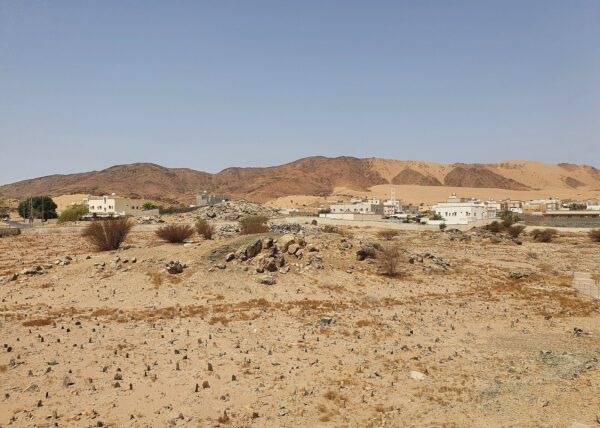
Masjid al-Qiblatayn is located in the northwest of Madinah, in Harrat al-Wabrah, one of the volcanic lava fields around the city, about 5 kilometres from the Prophet’s Mosque. In the time of the Prophet (peace be upon him), the place where the mosque stands was the home of the Banu Salimah, a clan of the Ansar; the mosque’s first name comes from them.
It is not within walking distance of the hotels around the Prophet’s Mosque; visitors usually stop here by vehicle, as part of a city tour planned together with the other sites of the Prophet’s life (sirah) in Madinah. We have gathered the city’s visiting circuit and the distances between the sites in a table in our guide to places to visit in Madinah.
Info Card: Masjid al-Qiblatayn
- Location
- Northwest Madinah, Harrat al-Wabrah
- Distance from the Prophet’s Mosque
- About 5 km
- Former name
- Mosque of Banu Salimah
- Change of qibla
- Sixteen or seventeen months after the Hijrah
- Related verse
- Surah al-Baqarah 2:144
- Last major renovation
- 1987, Saudi government; about 3,920 m²
- Opening hours
- Around the clock since October 2025
What does Qiblatayn mean?
“Qiblatayn” means “two qiblas” in Arabic, so Masjid al-Qiblatayn means “the mosque of the two qiblas”. The mosque received this name because it is remembered as the place where the Prophet (peace be upon him) turned his direction from Jerusalem to the Kaaba during a prayer. According to the TDV Encyclopaedia of Islam, after this event “imam al-qiblatayn”, meaning “the imam of the two qiblas”, was added to the Prophet’s titles.
The Change of Qibla: The Event Behind the Name
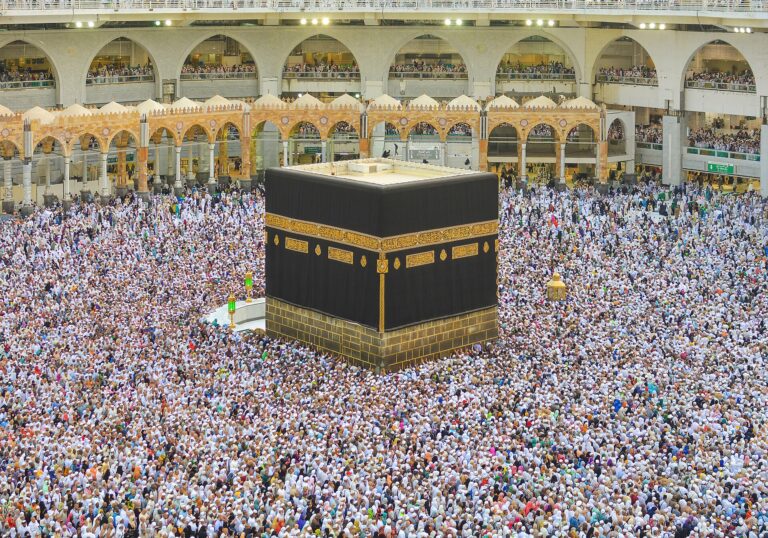
For a time after the Hijrah to Madinah, the Prophet (peace be upon him) and the Muslims prayed facing Masjid al-Aqsa in Jerusalem. According to the entry “Qibla” in the TDV Encyclopaedia of Islam, the qibla was turned to the Kaaba sixteen or seventeen months after the Hijrah. The verses about the event are verses 142 to 150 of Surah al-Baqarah; among them, verse 144 relates that the Prophet turned his face towards the sky in expectation and that he would be turned towards a qibla that would please him.
The sources contain different reports about which prayer it was and where the change took place. According to one report cited by the TDV Encyclopaedia of Islam, the verse was revealed while the Prophet was leading the noon (Zuhr) prayer at the Mosque of Banu Salimah during a visit to the mother of Bishr ibn al-Bara ibn Ma’rur, and the prayer was completed facing the Kaaba. The entry “Masjid al-Qiblatayn”, on the other hand, records that the prayer was either the noon or the afternoon (Asr) prayer.
The same entry notes that there are also reports about the news of the change of qibla reaching the congregations praying at the Prophet’s Mosque and at Quba. We have described how the news reached the congregation at Quba, and the history of the mosque there, separately in our article on Quba Mosque. This variety in the reports shows that the event was not confined to a single place, yet in memory it became most closely identified with the Mosque of Banu Salimah; the mosque’s name comes from this memory.
Why is the change of qibla important?
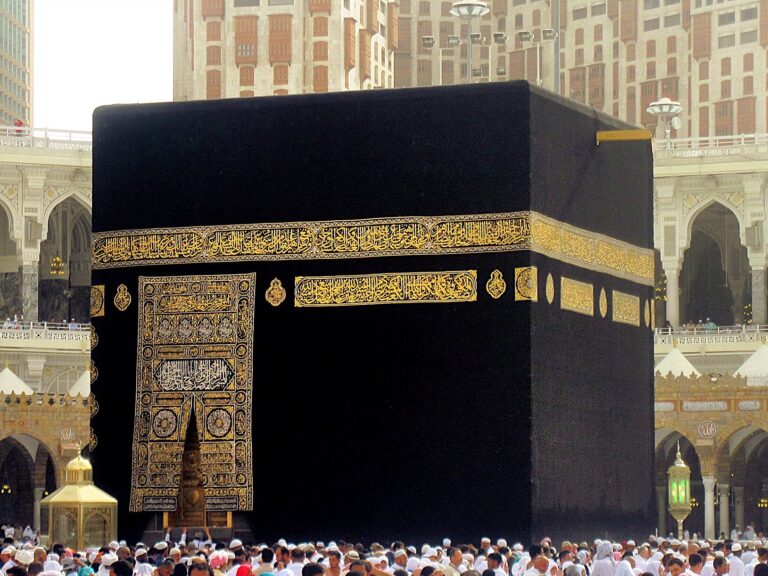
The qibla is the direction Muslims face in prayer, and it is regarded as one of the conditions of the prayer. The designation of the Kaaba as the qibla became a lasting turning point in the worship of the Muslim community; today, Muslims all over the world pray facing the Kaaba. For this reason, many people who visit Masjid al-Qiblatayn see it not merely as a building but as a living memory of the history of worship.
The History of Masjid al-Qiblatayn
The mosque has been repaired and expanded many times since the time of the Prophet (peace be upon him). The main periods recorded by the TDV Encyclopaedia of Islam are as follows:
| Period | Work carried out |
|---|---|
| Umayyads | During his governorship of Madinah, Umar ibn Abd al-Aziz had this mosque renewed together with the other mosques where the Prophet had prayed. |
| Mamluks, 893 AH (1488) | In the time of Sultan Qaitbay, Shahin al-Jamali had the ceiling renewed and the courtyard enclosed with a wall. |
| Ottomans, 950 AH (1543-44) | The first substantial reconstruction took place in the reign of Suleiman the Magnificent; with its porticoes, the mosque covered an area of 425 m² and was roofed with timber. |
| 1073 AH (1662) | The traveller al-Ayyashi described the mosque as a well-kept place of worship among vineyards and gardens, with no buildings around it. |
| 1901 | Ibrahim Rifat Pasha reported on his journey to the Hijaz that the mosque was in a ruined state. |
| 1987 | The Saudi government expanded and repaired the mosque; it became a large mosque covering an area of 3,920 m². |
During the 1987 renovation, a mihrab was placed facing the Kaaba, while a panel bearing the meaning of verse 144 of Surah al-Baqarah in five languages was placed facing Jerusalem; this panel was later removed. For this reason, you should not expect to see a second mihrab marking the old direction of the qibla in the mosque today; the “two mihrabs” that visitors talk about refer to arrangements of the past.
Architecture
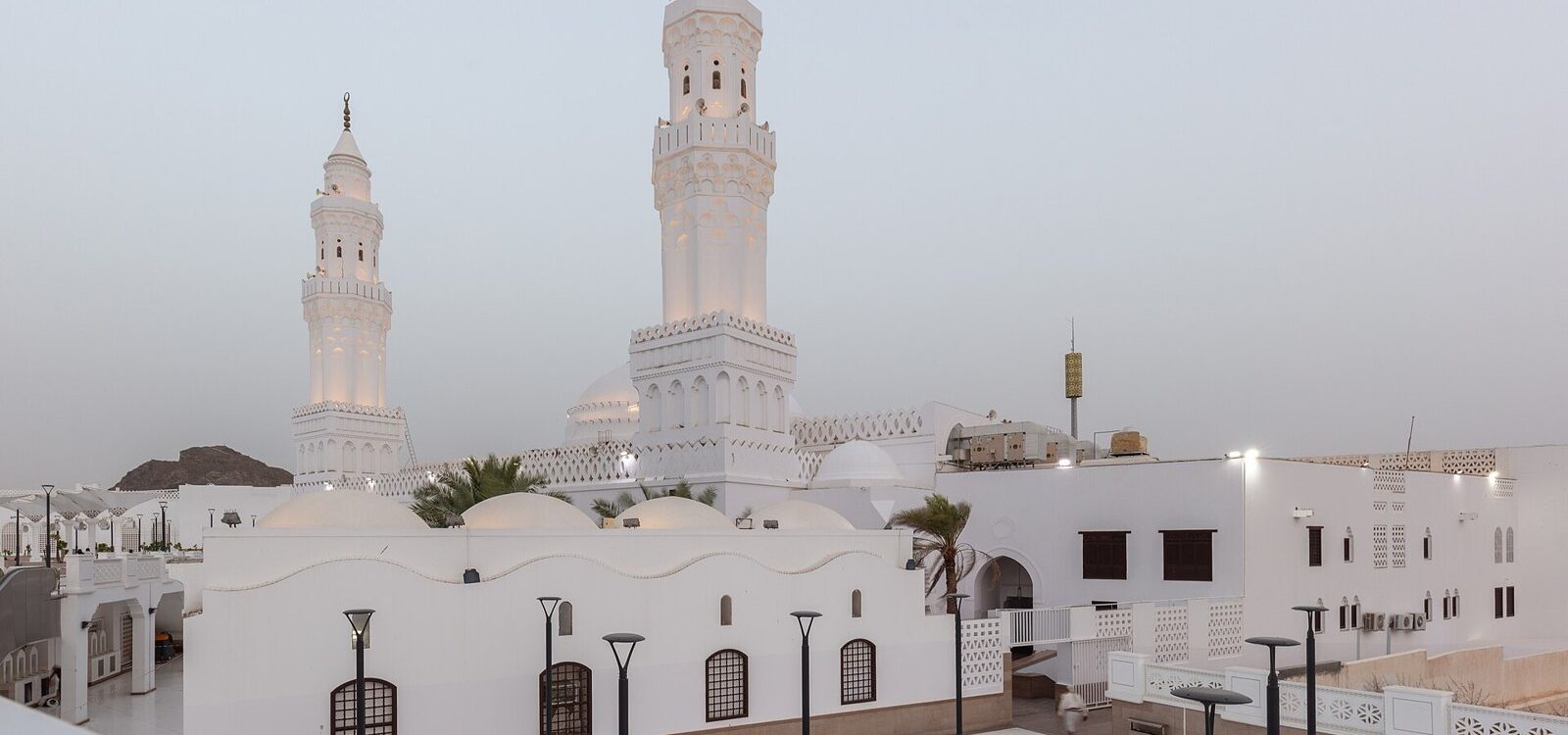
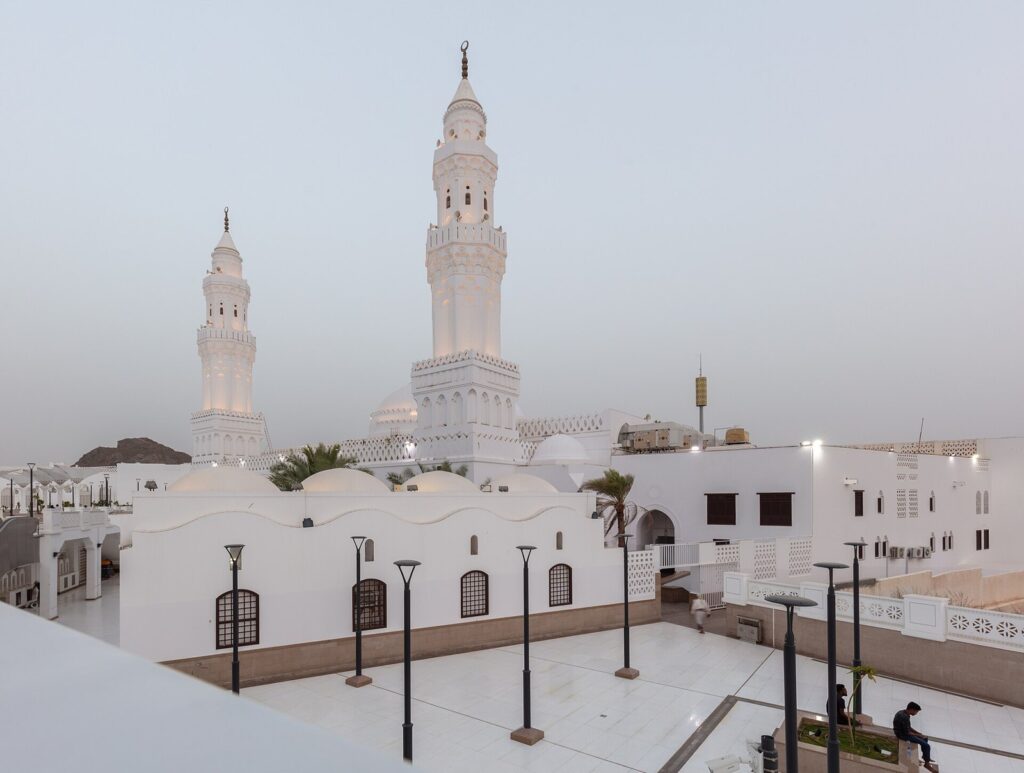
Today’s Masjid al-Qiblatayn is the product of the 1987 renovation. According to the TDV Encyclopaedia of Islam, the building is constructed of brick and clad in granite on the outside. A minaret rises at each of the two corners on the qibla side. The prayer hall (haram) is covered by two domes, each 8.7 metres in diameter and 8.18 metres high.
The interior is decorated with modern ornamental motifs and contains jali thuluth and Kufic calligraphy by the Turkish calligrapher Hasan Çelebi. With its white facade and two domes, the mosque carries the traditional architectural style of Madinah into a modern building. Visit Saudi, Saudi Arabia’s official tourism website, also presents Qiblatayn as one of the most important historic mosques in Madinah.
Visiting Hours and Etiquette
According to an announcement dated 6 October 2025 on the official website of Saudi Arabia’s authority for the Two Holy Mosques, the Custodian of the Two Holy Mosques, King Salman ibn Abd al-Aziz, directed that Qiblatayn Mosque be kept open around the clock for those who wish to pray. At the same time, the mosque is a place where the daily prayers are held; during prayer times you should follow the order of the congregation inside and avoid walking between the rows to take photographs. As the arrangements may change, we recommend confirming the current situation from official sources before you set out.
Some points to keep in mind during the visit:
- Enter the mosque in clean, modest clothing; women visitors should use the entrances and sections set aside for them.
- Leave your shoes on the shelves at the entrance and avoid speaking loudly.
- Pray with the change of qibla in mind, and spend your time in supplication and reflection.
- Remember that the mosque is a place of worship, not a museum; avoid taking photographs and videos, especially while the congregation is praying.
There is no special form of worship for visiting the mosque; the visit is made for supplication, reflection and taking a lesson, and it does not replace the acts of worship prescribed by the religion.
How to Get to Masjid al-Qiblatayn
The most practical way to reach the mosque, which is about 5 kilometres from the Prophet’s Mosque, is by vehicle. Visitors usually choose one of the following options:
- Guided city tour: The Madinah visiting tours in Umrah programmes go around sites such as Quba, Qiblatayn and Uhud by coach on the same day.
- Taxi or ride-hailing app: In your free time, you can go there and back by car from the area around the Prophet’s Mosque.
- Combining it with other visits: Planning Qiblatayn on the same route as the Uhud martyrs’ cemetery and Quba Mosque helps you use your time efficiently.
We have described the visit to the Uhud area and the etiquette of the cemetery in our article on the martyrs of Uhud. The main centre of worship in Madinah is, of course, the Prophet’s Mosque (Masjid an-Nabawi); the soundest approach is to plan the city tour so that you do not miss the daily prayers there.
Masjid al-Qiblatayn in Umrah Programmes
In Umrah programmes that include Madinah, Masjid al-Qiblatayn is one of the stops on the guided city tour, together with Quba Mosque and the Uhud martyrs’ cemetery. This visit is not part of the Umrah rites; the obligatory (fard) and necessary (wajib) acts of Umrah are performed in Makkah. The visit to Qiblatayn is a voluntary one, made to get to know the sirah on the spot and to recall the memory of the change of qibla.
The content and length of the tour vary from programme to programme; some tours set aside time for prayer at the mosque, while others make only a short stop. If you would like to pray at the mosque, it is a good idea to let your tour guide know in advance or to go separately on your free day.
The Place Where a Direction Changed
Masjid al-Qiblatayn is not a grand monument; even today it has the feel of a plain neighbourhood mosque where the five daily prayers are held. Yet it reminds every visitor that the direction Muslims face in prayer changed here, in the middle of a prayer. If you have a few days in Madinah, we suggest planning Qiblatayn not as a stop to be rushed through on the city tour, but as a pause in which you can read and reflect on the verses describing the change of qibla.
Frequently Asked Questions
Where is Masjid al-Qiblatayn?
What is the other name of Qiblatayn Mosque?
When was the qibla changed to the Kaaba?
During which prayer did the change of qibla take place?
Are there still two mihrabs at Masjid al-Qiblatayn?
What are the opening hours of Masjid al-Qiblatayn?
Can women visit Masjid al-Qiblatayn?
The mosque is a place where the daily prayers are held, and women visitors can visit it by using the sections set aside for them, as in other mosques in Madinah. You should follow the directions of the mosque staff regarding the entrance arrangements.
Is the visit to Qiblatayn part of Umrah?
No. The visit to Qiblatayn is not one of the essential rites of Umrah; it is a voluntary sirah visit made during the city tours in Madinah.
References
This article was prepared by the RotaNur editorial team on the basis of the sources below. On religious matters, the approach of the Presidency of Religious Affairs of Türkiye (Diyanet) and the TDV Encyclopaedia of Islam has been followed; as the visiting arrangements and hours in Madinah may change, please confirm the current situation from official sources before you set out.
- H. Ahmet Sezikli, “Mescid-i Kıbleteyn”, TDV İslâm Ansiklopedisi, vol. 29, 2004, pp. 278-279. islamansiklopedisi.org.tr. Accessed: 03.11.2026.
- Ahmet Özel, “Kıble”, TDV İslâm Ansiklopedisi, vol. 25, pp. 365-368. islamansiklopedisi.org.tr. Accessed: 03.11.2026.
- General Authority for the Affairs of the Two Holy Mosques (pep.gov.sa), “The Custodian of the Two Holy Mosques Directs 24-Hour Access to Qiblatain Mosque in Madinah”, 06.10.2025. pep.gov.sa. Accessed: 03.11.2026.
- Visit Saudi, “Qiblatain Mosque”. visitsaudi.com. Accessed: 03.11.2026.

Cihat Murat Yüksel is the editor of the RotaNur blog and the founder of Markention. Drawing on the sources of Türkiye's Presidency of Religious Affairs (Diyanet), he turns the questions travellers ask most about preparing for Umrah, Hajj and halal travel into clear, practical guides.
Questions answered in this article
Where Is Masjid al-Qiblatayn?
Masjid al-Qiblatayn is located in the northwest of Madinah, in Harrat al-Wabrah, one of the volcanic lava fields around the city, about 5 kilometres from the Prophet’s Mosque. In the time of the Prophet (peace be upon him), the place where the mosque stands was the home of the Banu Salimah, a clan of the Ansar; the mosque’s first name comes from them.
What does Qiblatayn mean?
“Qiblatayn” means “two qiblas” in Arabic, so Masjid al-Qiblatayn means “the mosque of the two qiblas”. The mosque received this name because it is remembered as the place where the Prophet (peace be upon him) turned his direction from Jerusalem to the Kaaba during a prayer. According to the TDV Encyclopaedia of Islam, after this event “imam al-qiblatayn”, meaning “the imam of the two qiblas”, was added to the Prophet’s titles.
Why is the change of qibla important?
The qibla is the direction Muslims face in prayer, and it is regarded as one of the conditions of the prayer. The designation of the Kaaba as the qibla became a lasting turning point in the worship of the Muslim community; today, Muslims all over the world pray facing the Kaaba. For this reason, many people who visit Masjid al-Qiblatayn see it not merely as a building but as a living memory of the history of worship.

Comments (0)