








Contents 11 sections
Abu Bakr Mosque is a historic mosque in Madinah, southwest of the Prophet’s Mosque, standing at the place where the Prophet (peace be upon him) performed the Eid prayer and where Abu Bakr led the Eid prayer during his caliphate. In this guide, we look at where the mosque is, where its name comes from, its connection with the Madinah musalla, its history from the Umayyads through the Ottomans to the present day, its architecture and visiting information, together with our sources.
In Short
Abu Bakr Mosque lies about 300 metres southwest of the Prophet’s Mosque, south of the al-Manakhah district. Because Abu Bakr led the Eid prayer during his caliphate at this place where the Prophet (peace be upon him) had performed the Eid prayer, the mosque bears his name. The first building was erected during Umar ibn Abd al-Aziz’s governorship of Madinah, and the present building was built in the Ottoman period, in the reign of Sultan Mahmud II.
- Location: About 300 m southwest of the Prophet’s Mosque.
- Name: From Abu Bakr leading the Eid prayer here.
- First building: 706-711, in the time of Umar ibn Abd al-Aziz.
- Present building: 1838, reign of Sultan Mahmud II; latest restoration 2009.
- Structure: Black basalt stone, a single dome, a cylindrical minaret.
Where Is Abu Bakr Mosque?
According to Saudipedia, Saudi Arabia’s official encyclopaedia, Abu Bakr Mosque is located in Madinah about 300 metres southwest of the Prophet’s Mosque, south of the al-Manakhah district and near Hassan ibn Ali Street. The area where the mosque stands is the surroundings of the Madinah musalla, where the Eid prayers were held in the time of the Prophet (peace be upon him). The best known of the mosques built in this area is Masjid al-Ghamamah, built on the site of the musalla.
Thanks to this proximity, Abu Bakr Mosque is one of the historic mosques that visitors staying in the hotels around the Prophet’s Mosque can see on foot. We have gathered the other sites to visit in Madinah in our guide to places to visit in Madinah.
Info Card: Abu Bakr Mosque
- Where
- Madinah, south of the al-Manakhah district; near Hassan ibn Ali Street
- Distance from the Haram
- About 300 m from the Prophet’s Mosque, to the southwest
- Reason for the name
- Abu Bakr leading the Eid prayer here during his caliphate
- First building
- 706-711, during Umar ibn Abd al-Aziz’s governorship
- Present building
- 1838, reign of Sultan Mahmud II
- Latest restoration
- 2009, as part of the al-Manakhah development project
- Area and capacity
- About 280 m², about 150 worshippers
- Visiting
- No official visiting hours have been published
- In the Umrah programme
- A voluntary sirah visit; not part of Umrah
The Eid Prayer Behind the Name
The Prophet (peace be upon him) usually led the Eid prayers not at the Prophet’s Mosque but at an open space outside the city, the musalla. According to the entry “Namazgâh” (prayer ground) in the TDV Encyclopaedia of Islam, this musalla was in Buthan, one of the three valleys of Madinah; the Prophet’s going out there for the Eid prayer made it possible for a larger congregation, people of all ages and women to take part in the prayer.
According to Saudipedia, the place where Abu Bakr Mosque stands is one of the places where the Prophet performed the Eid prayer. Abu Bakr also led the Eid prayer here during his caliphate, and for this reason the mosque came to bear his name. This account recalls the care Abu Bakr took to continue the practice of the Prophet. As the TDV Encyclopaedia of Islam relates, there was no mihrab or minbar at the Madinah prayer ground during the Prophet’s lifetime or in the period of the Rightly Guided Caliphs; the Eid prayers were held in the open air.
Who was Abu Bakr?
Abu Bakr was the closest friend of the Prophet (peace be upon him), his companion on the journey of the Hijrah and, after the Prophet’s death, the first caliph of the Muslims. The mosque in Madinah that bears his name is a place of remembrance; Abu Bakr’s grave is in the Prophet’s Mosque, next to the grave of the Prophet. We have described the visit to the Prophet’s Mosque and the etiquette of offering greetings there in our article on the Prophet’s Mosque (Masjid an-Nabawi).
The History of Abu Bakr Mosque
The main periods recorded by Saudipedia are as follows:
| Period | Development |
|---|---|
| Time of the Prophet | One of the places where the Eid prayer was held. |
| Caliphate of Abu Bakr | Abu Bakr led the Eid prayer here; the mosque began to bear his name. |
| 706-711 (Umayyads) | While renewing the mosques at the places where the Prophet had prayed, the governor of Madinah, Umar ibn Abd al-Aziz, also had this one built. |
| Later centuries | The mosque underwent various repairs and restorations. |
| 1838 (Ottomans) | The present building was constructed in the reign of Sultan Mahmud II. |
| 2009 (Saudi period) | The latest restoration was carried out as part of the project to develop the al-Manakhah area. |
The entry “Medine” (Madinah) in the TDV Encyclopaedia of Islam states that most of Madinah’s mosques have been renewed, but that there are also some, such as the mosques of Ghamamah, Abu Bakr and Ali, that preserve the style of the period in which they were built. For this reason, Abu Bakr Mosque is one of the rare buildings around the Prophet’s Mosque where you can see the Ottoman-period architecture of Madinah.
Architecture
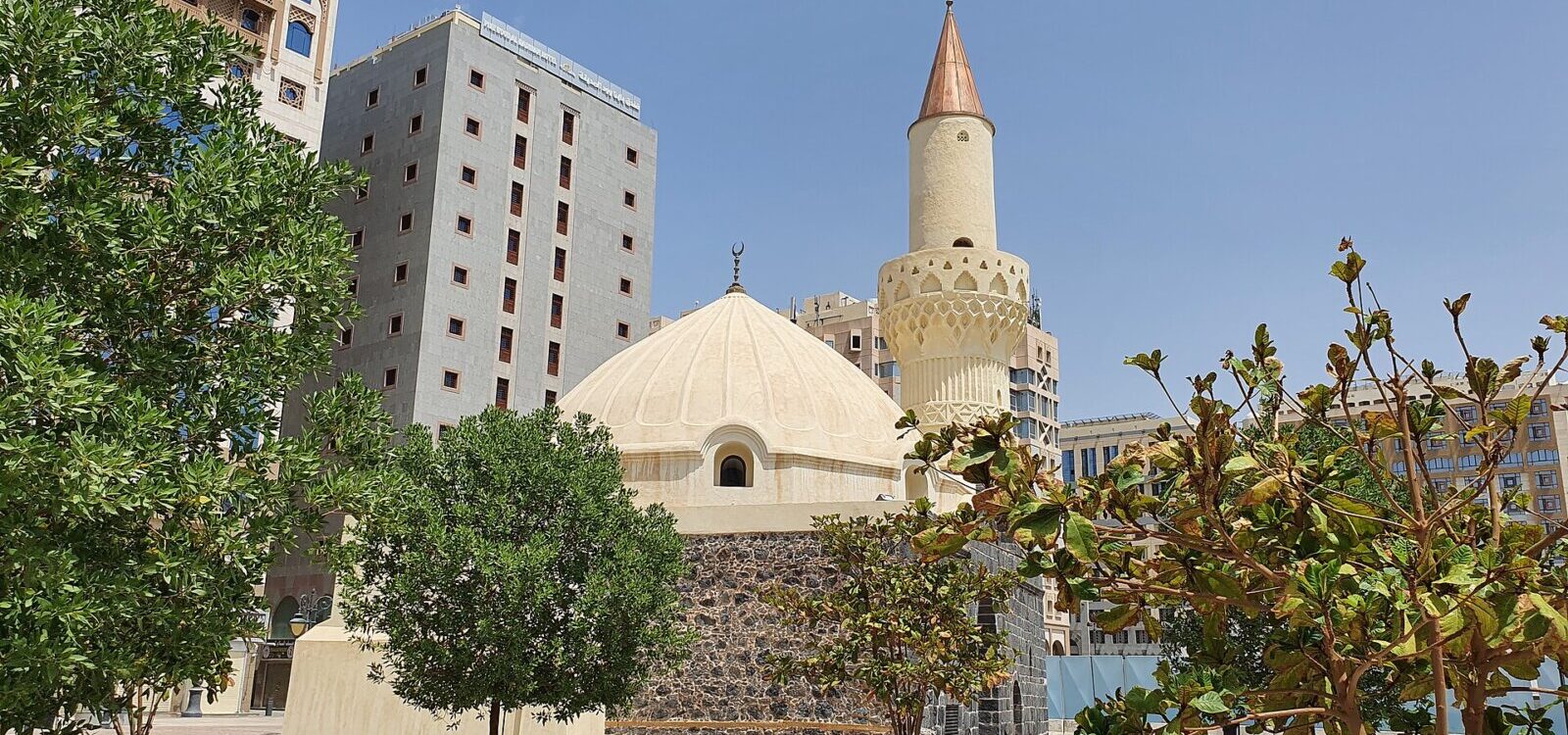
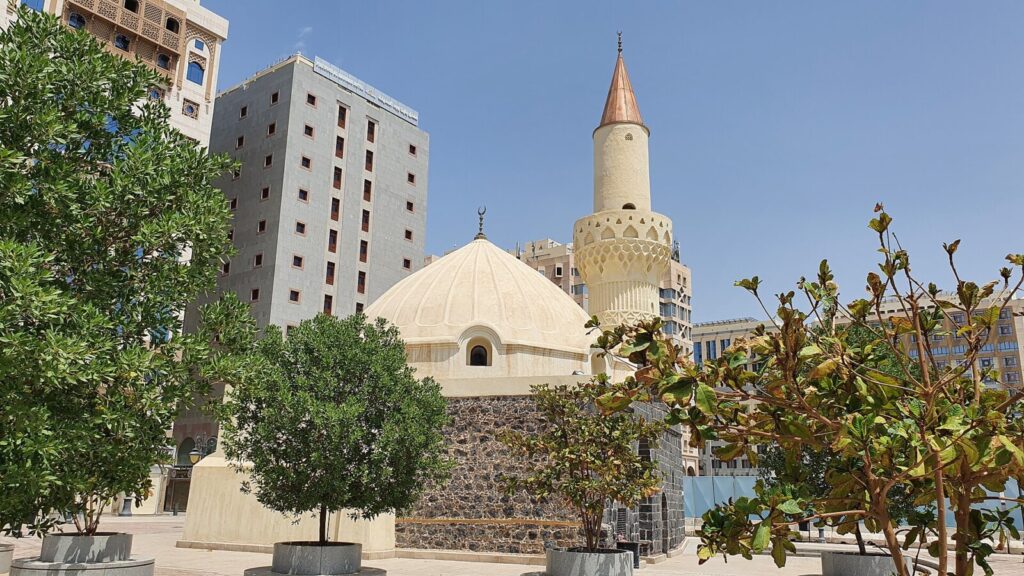
According to Saudipedia, the mosque was built in the old Ottoman style with carved black basalt stone. A large dome covers the prayer hall of the square-plan building. The mosque, which covers about 280 square metres, accommodates a congregation of about 150 people.
There is an open courtyard on the eastern side of the mosque, and both of its entrances are on this side. The cylindrical minaret rising on the northern side is about 22.86 metres high and is decorated with old geometric carvings, muqarnas and plasterwork. The dark basalt walls are made of the stone of the volcanic harrahs that surround Madinah, and together with the nearby Masjid al-Ghamamah they give the area a shared architectural character.
Visiting Information and Etiquette
No official visiting hours have been published for Abu Bakr Mosque, and we were unable to find verified information about the hours during which its doors are open. For this reason, we recommend linking your visit to just before or after one of the daily prayers you perform at the Prophet’s Mosque, and being content to see the mosque from the outside if the door is closed. As arrangements may change, it is best to confirm the current situation on site.
Some points to keep in mind during the visit:
- Go in clean, modest clothing; follow the directions of the staff.
- Remember that the mosque is a small place of worship; do not pass in front of people who are praying, and avoid speaking loudly.
- Avoid practices that have no place in the religion, such as rubbing your hands and face on the walls and doors or taking away stones or soil.
- Plan a short walk together with Ghamamah and the other historic mosques nearby.
There is no special form of worship for visiting Abu Bakr Mosque; the visit is made to see the place where the Prophet (peace be upon him) and his Companions performed the Eid prayers and to remember the sirah.
How to Get to Abu Bakr Mosque
The mosque, about 300 metres southwest of the Prophet’s Mosque, can be reached on foot. You can plan the visit as follows:
- On foot: Leave by the southwest courtyard of the Prophet’s Mosque and, after seeing Masjid al-Ghamamah, walk towards al-Manakhah.
- A walk around the musalla mosques: You can see the Ghamamah and Abu Bakr mosques together with the other historic mosques in the same area on a single walk.
- Combining it with the city tour: It is also possible to stop in the area on the way back from the tour of Quba Mosque, Qiblatayn and Uhud made by vehicle.
Abu Bakr Mosque in Umrah Programmes
Because Abu Bakr Mosque is close to the Prophet’s Mosque, in Umrah programmes that include Madinah it is usually seen not as a separate tour stop but as part of a short walk in free time. This visit is not part of the Umrah rites; the obligatory (fard) and necessary (wajib) acts of Umrah are performed in Makkah. The visit to the mosque is a voluntary one, made to get to know the sirah on the spot.
During your days in Madinah, making this visit after the Fajr prayer, while the city is still quiet, lets you see the mosque’s stonework and minaret more comfortably.
A Place Where a Sunnah Was Carried On
Abu Bakr Mosque, right next to the vast courtyards of the Prophet’s Mosque, is a building that is easy to overlook because of its small size and dark stone walls. Yet the place where it stands carries the memory of the first caliph leading the same prayer at a ground where the Prophet (peace be upon him) had performed the Eid prayer. In this way, the mosque quietly tells visitors how the Sunnah has been passed on from generation to generation.
Frequently Asked Questions
Where is Abu Bakr Mosque?
Why is the mosque named after Abu Bakr?
Who built Abu Bakr Mosque?
How many people does Abu Bakr Mosque hold?
Is Abu Bakr Mosque close to Masjid al-Ghamamah?
Is Abu Bakr’s grave in this mosque?
When was the mosque last restored?
Is the visit to Abu Bakr Mosque part of Umrah?
No. This visit is not one of the essential rites of Umrah; it is a voluntary sirah visit made in Madinah.
References
This article was prepared by the RotaNur editorial team on the basis of the sources below. On religious matters, the approach of the Presidency of Religious Affairs of Türkiye (Diyanet) and the TDV Encyclopaedia of Islam has been followed; as the visiting arrangements in Madinah may change, please confirm the current situation from official sources before you set out.
- Saudipedia, “Abu Bakr al-Siddiq Mosque in al-Madinah al-Munawwarah”. saudipedia.com. Accessed: 04.11.2026.
- Nebi Bozkurt, Mustafa Sabri Küçükaşcı, “Medine”, TDV İslâm Ansiklopedisi, vol. 28, 2003, pp. 305-318. islamansiklopedisi.org.tr. Accessed: 04.11.2026.
- Nebi Bozkurt, “Namazgâh”, TDV İslâm Ansiklopedisi, vol. 32, 2006, pp. 357-358. islamansiklopedisi.org.tr. Accessed: 04.11.2026.
- “Ebû Bekir”, TDV İslâm Ansiklopedisi. islamansiklopedisi.org.tr. Accessed: 04.11.2026.

Cihat Murat Yüksel is the editor of the RotaNur blog and the founder of Markention. Drawing on the sources of Türkiye's Presidency of Religious Affairs (Diyanet), he turns the questions travellers ask most about preparing for Umrah, Hajj and halal travel into clear, practical guides.
Questions answered in this article
Where Is Abu Bakr Mosque?
According to Saudipedia, Saudi Arabia’s official encyclopaedia, Abu Bakr Mosque is located in Madinah about 300 metres southwest of the Prophet’s Mosque, south of the al-Manakhah district and near Hassan ibn Ali Street. The area where the mosque stands is the surroundings of the Madinah musalla, where the Eid prayers were held in the time of the Prophet (peace be upon him). The best known of the mosques built in this area is Masjid al-Ghamamah, built on the site of the musalla.
Who was Abu Bakr?
Abu Bakr was the closest friend of the Prophet (peace be upon him), his companion on the journey of the Hijrah and, after the Prophet’s death, the first caliph of the Muslims. The mosque in Madinah that bears his name is a place of remembrance; Abu Bakr’s grave is in the Prophet’s Mosque, next to the grave of the Prophet. We have described the visit to the Prophet’s Mosque and the etiquette of offering greetings there in our article on the Prophet’s Mosque (Masjid an-Nabawi).
Comments (0)